Preparing homemade lasagna sheets is easier than you might think. Fresh egg pasta for lasagna can be made with re-milled durum semolina, with 00 flour, or with a mix of both and used even without precooking.
Homemade lasagna, in fact, do not necessarily need to be blanched before baking, provided the sheets are rolled very thin and the sauce is sufficiently moist.
To achieve a creamy lasagna that cooks well even without precooking, it’s important to prepare a good traditional ragù for lasagna and a homemade béchamel, so the fresh pasta can bake directly in the oven absorbing all the flavors.
My grandmother was from Trentino, she had married my Sicilian grandfather and spent much of her life here in Sicily. She cooked excellently and often adapted the traditions of her regional cuisine to ours, creating mixes of recipes that were truly original and very tasty.
I remember very well that one thing never lacked at my grandmother’s house: fresh pasta, which she often rolled by hand, but later, when arthritis had taken hold, she rolled it with a pasta machine or a rolling pin.
As I said, my grandmother adapted her regional cuisine to ours and homemade fresh egg pasta was a striking example: she actually made it with re-milled durum semolina and didn’t only make lasagna, but also ravioli and cannelloni.
Strange, right? And yet it was so good, it had such a rustic and flavorful texture that I adopted her technique and I almost always make it that way myself. Have you ever tried it?
Noooo?? Then you absolutely must try it, don’t you think?
Let’s hurry to the kitchen and roll up our sleeves. Depending on the result you want, you can choose to make the lasagna sheets with only re-milled durum semolina, with 00 flour, or with a half semolina and half 00 flour dough, as indicated in the ingredients below.
Also check out these other fresh pasta recipes using re-milled semolina:
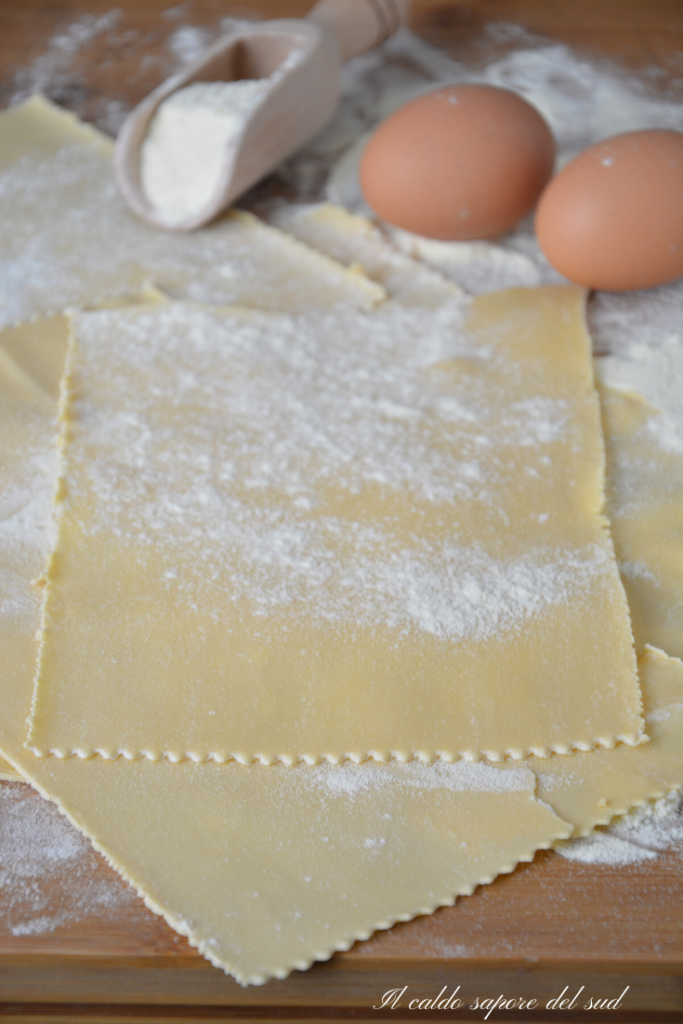
- Difficulty: Very easy
- Cost: Very inexpensive
- Preparation time: 30 Minutes
- Portions: about 16 oz (approx. 1 lb)
- Cooking methods: No precooking
- Cuisine: Italian
- Seasonality: All seasons
Ingredients for making fresh egg lasagna
As I mentioned above, I make the dough using only re-milled semolina for a more “hearty” result that holds up well during cooking. After all, that’s how my grandmother made it, but you can decide to make a traditional sheet using only 00 flour or choose a middle way and use half semolina and half 00 flour to get a rustic but slightly lighter sheet. As for the water, you should add it only if truly necessary and the flour really needs it, because otherwise the dough can become unworkable. Below you will find the three versions: usually the dough with 00 flour does not require added water, while semolina, which tends to be “drier”, may need a little.
- 1 1/4 cups (about 7 oz) re-milled durum semolina
- 2 eggs (medium)
- as needed Water (only if really necessary)
- 1 2/3 cups (about 7 oz) 00 flour
- 2 eggs (large)
- as needed water (just a few drops and only if really necessary)
- cup (about 3.5 oz) 00 flour
- cup (about 3.5 oz) re-milled durum semolina
- 2 eggs (large)
Tools
- Pasta machine for fresh pasta, or a rolling pin if you can manage.
Preparation of fresh egg lasagna
This recipe yields an amount of lasagna suitable for 4 servings.
Pour the re-milled semolina onto a work surface, make a well in the center and add the eggs. The rule is one egg for every 100 g (about 3.5 oz), but as my grandmother used to do, for every two large eggs I sometimes add the equivalent weight (without shell) in water — a little at a time — so you can adjust the dough to be very, very firm and dry.
Work the dough vigorously until smooth and homogeneous, let it rest for 10 minutes covered with a cloth, then divide it into pieces.
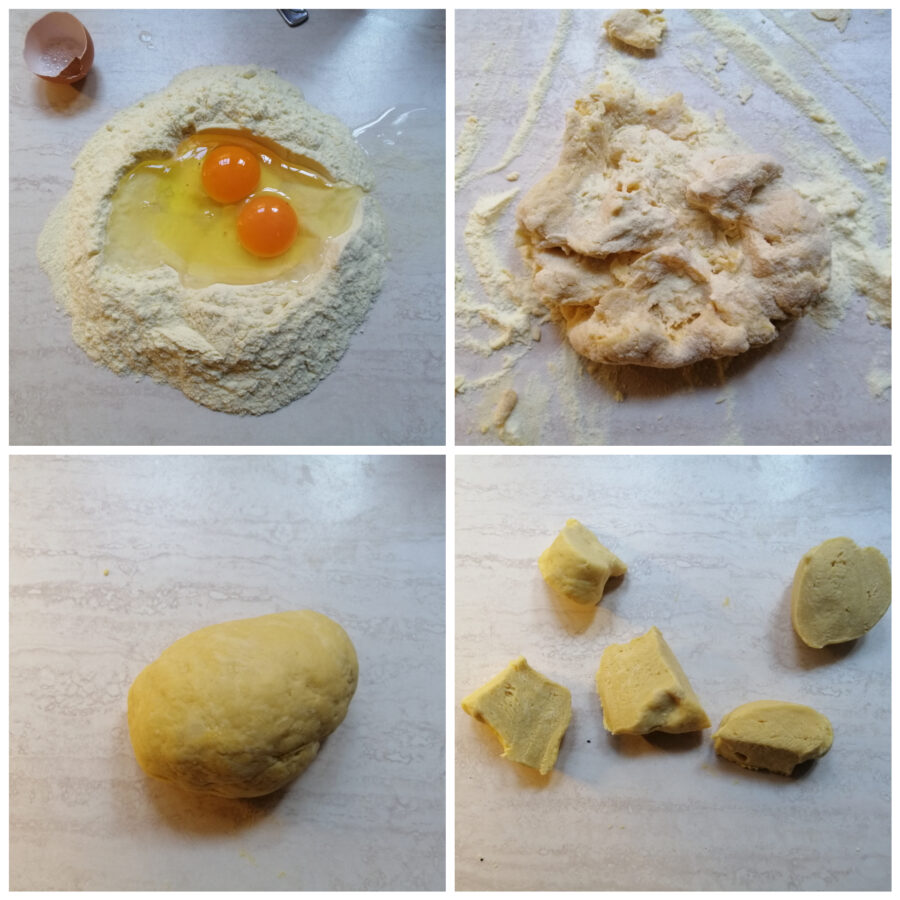
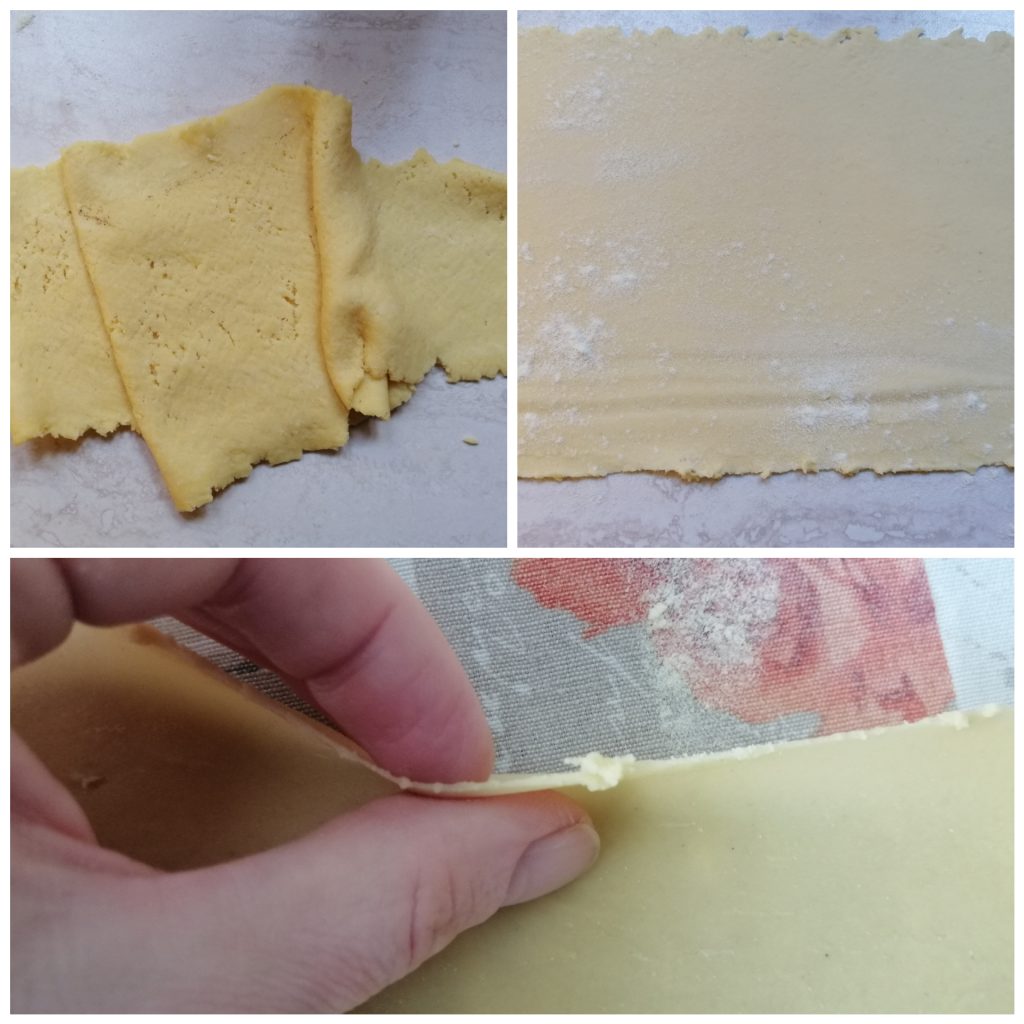
Pass each piece through the pasta machine several times, gradually moving from the widest to the thinnest setting until you obtain an even sheet.
Place each sheet on a floured cloth, and once ready use them to prepare special dishes!
If you use fresh lasagna sheets without precooking, especially with a dough made only from re-milled durum semolina, we recommend increasing the liquids in the sauce, using a ragù for lasagna that is not too dense and a rather fluid béchamel.
To check the doneness of your lasagna in the baking dish, pierce the center with a fork: you’ll see for yourself whether they are cooked or still raw.
With this lasagna sheet you can prepare:
Vegetarian lasagna with tomato sauce;
Pistachio lasagna with white ragù;
Lasagna with pumpkin, white ragù and béchamel and much more
Prepare the lasagna at the time of cooking; if you have leftovers, let the sheets dry in the air and use them broken up as “maltagliati” for soups and broths.
If you want to stay updated on my recipes, follow me on:
Pinterest, YouTube, X and TikTok.
From here, you can return to the HOME and discover new recipes!
From here, you can return to the HOME and discover new recipes!
Do homemade lasagna sheets need to be blanched?
Fresh egg lasagna sheets can be used without precooking, provided they are rolled very thin and the sauce is sufficiently moist.
Can lasagna sheets be used without precooking?
Yes, it is possible to use fresh lasagna sheets without blanching them first, especially if they are made with re-milled durum semolina or a mixed dough of semolina and 00 flour.
What is the best flour to make lasagna sheets?
Lasagna sheets can be prepared with re-milled durum semolina, with 00 flour, or with a mix of both, depending on the texture you wish to obtain.
How thin should lasagna sheets be?
For even cooking without precooking, the sheet should be rolled very thin, until you obtain a thickness of about 0.04 in (1 mm).
Can homemade fresh lasagna sheets be frozen?
Yes, lasagna sheets can be frozen after being cut and lightly floured.