
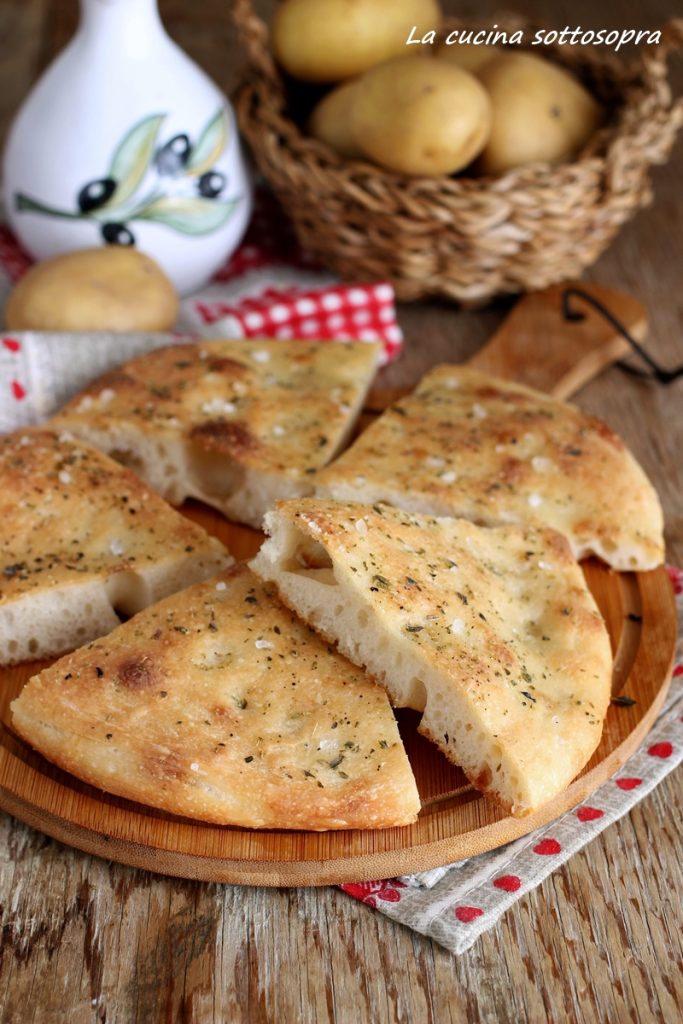
The focaccia white or white pizza is a simple and delicious leavened bread that will amaze you with its softness. A recipe that, once written in your recipe book, you will make many times.
As a good Apulian, I love focaccias, meat-filled calzones or onion calzones, and savory pies of all kinds. Whenever I have the chance, I often make the classic Barese focaccia or Nino’s focaccia, or panzerotti and savory pettole and sweet.
Once I tried this focaccia, however, I fell in love with it: the boiled potato gives this white focaccia softness, while the re-milled semolina makes the surface crispy and fragrant. I’m sure you will love it too! It’s really hard to stop after tasting the first piece.
The highlight of this white potato focaccia is its simplicity. It has few ingredients, but most importantly, you can top it as you like!
The version I propose in this recipe is the simplest, white and simply seasoned with a few grains of coarse salt and a pinch of aromatic herbs. In this version, I often prepare it to use as a “bread substitute” on special occasions or as an accompaniment to cold cuts and cheeses.
If, instead, you want to prepare it with toppings, you can try it “Apulian style” with the classic cherry tomatoes, oregano, and olives or with sliced red onions, vegetable or with potatoes and bacon. It’s an excellent dough also for making soft tray-baked pizzas topped with tomato sauce and mozzarella. I often use it as an alternative to my panzerotti dough and tray pizzas, which I have been using for years.
The quantities I’ll give you are for about 2 thin focaccias of 11 inches. If you like it thicker or with more crumb, you can use smaller pans or a square baking pan 15.75×15.75 inches.
As a good Apulian, however, I recommend the iron focaccia pans: I assure you the end result is fantastic!
It’s very simple to prepare: you can knead it by hand or with a stand mixer or with the Bimby. At the end of the recipe, I’ll also provide the procedure for preparing the Bimby white focaccia.
Save the recipe for this delicious soft white focaccia and let me know in the comments if you try it. Now let’s move on to the recipe, but first, I’ll leave you with some other recipes you might be interested in!
- Difficulty: Very easy
- Cost: Very cheap
- Rest time: 4 Hours
- Preparation time: 15 Minutes
- Portions: 6People
- Cooking methods: Boiling, Oven
- Cuisine: Italian
- Seasonality: All seasons
- Energy 305.19 (Kcal)
- Carbohydrates 53.45 (g) of which sugars 2.97 (g)
- Proteins 8.65 (g)
- Fat 7.00 (g) of which saturated 0.98 (g)of which unsaturated 0.33 (g)
- Fibers 2.77 (g)
- Sodium 1,036.85 (mg)
Indicative values for a portion of 144 g processed in an automated way starting from the nutritional information available on the CREA* and FoodData Central** databases. It is not food and / or nutritional advice.
* CREATES Food and Nutrition Research Center: https://www.crea.gov.it/alimenti-e-nutrizione https://www.alimentinutrizione.it ** U.S. Department of Agriculture, Agricultural Research Service. FoodData Central, 2019. https://fdc.nal.usda.gov
Ingredients to prepare the white focaccia
- 1 3/4 cups re-milled durum wheat semolina
- 1 3/4 cups all-purpose flour
- 1 potato (boiled – 150-200 g weighed raw and peeled)
- 1 1/10 cups water
- 2 tsp sugar
- 3 tsp fine salt
- 1 1/2 tbsp extra virgin olive oil
- 2 tsp fresh yeast (or 1 tsp dry yeast)
- to taste coarse salt
- to taste aromatic herbs (thyme, rosemary, oregano)
- to taste extra virgin olive oil
Tools to prepare the white focaccia
- Stand Mixer
- Baking Pan in iron for focaccia
- Pan
- Potato Masher
- Food Scales
Steps to prepare the white focaccia
Let’s see together how to prepare the white focaccia or white pizza, as many of you call it. At the end of the recipe, I’ll also provide the procedure for preparing the Bimby white focaccia.
I recommend using cold water for the preparation of the focaccia, especially if the external temperatures are high. It will prevent the dough from heating up too much.
Boil the potato: Weigh a medium-sized raw potato weighing about 150-200 g. Wash the skin well under running water, place it in a saucepan with cold water, and bring to a boil. From the boil, cook for about 20 minutes until the potato is soft. Pierce the potato with a fork: if it goes in easily, it means it’s cooked. Let it cool completely, peel it, and mash it well with a fork or a potato masher.
Dissolve the yeast: In a small bowl, dissolve the yeast with some water taken from the total 1 1/10 cups and the 2 tsp of sugar.
Dough preparation: In the bowl of the stand mixer, add the flour, semolina, and the boiled and cooled mashed potato. Start the stand mixer’s hook at a low speed and begin working.
With the hook running, also add the oil, the water in which you dissolved the yeast, and following that, the remaining cold water, which should be poured in a thin stream.
When the dough starts to gain consistency, finally add the salt.
Slightly increase the speed of the stand mixer and work the dough for about ten minutes or until it is kneaded. You will notice the dough is ready because it will have a smooth appearance, will “cling” to the stand mixer’s hook, and will detach from the sides of the bowl.First rise: Once ready, lightly grease a bowl with extra virgin olive oil and place the dough inside. Cover the bowl with plastic wrap or a lid and let the dough rest until doubled. The rising times may vary depending on the outside temperature. It can take about 2 hours in summer, while in winter it may take 3-4 hours. Rising times are relative and depend on many factors.
Focaccia stretching and second rise: Once the white focaccia dough has doubled, generously grease the bottom of the baking pan with extra virgin olive oil and pour in the risen dough. If using two pans, the dough should be divided into two and placed in the two pans.
Let the dough rest in the pan without stretching it for 15 minutes: this will allow the dough to “relax” and make it easier to stretch.
Starting from the center, with the tip of your fingers, very gently stretch the dough towards the edges, being careful not to deflate it too much.
Season the focaccia with a few grains of coarse salt, some aromatic herbs to taste, and another drizzle of oil on the surface.
Let the focaccia rise until doubled. It will take about an hour.Baking the white focaccia: Preheat the static oven to 430°F and bake the focaccia. Cook for about 15-20 minutes.
Keep an eye on the baking to avoid burning it. The focaccia should be golden on the surface, so adjust the baking times according to your oven.
Once ready, take it out of the oven, let it warm slightly, and enjoy it right away! White focaccia is excellent as a snack, to enrich the bread basket, or to accompany dinners and lunches.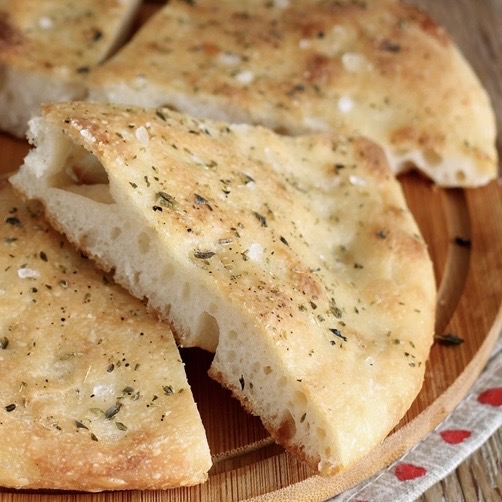
White focaccia can also be prepared with the Bimby. Let’s see the procedure together.
Boil a medium-sized potato weighing about 150-200 g. Cook it for about 20 minutes. When it is soft, let it cool and mash it with a fork or a potato masher.
In the bowl, place the water, oil, yeast, and sugar: 2 min. speed 2.
Add the flour, semolina, mashed potato, and finally the salt: knead 5 min. speed Spiga. Let the dough rise in the Bimby or in a greased bowl.
When it has doubled, proceed as per recipe.
Storage, tips, and variations
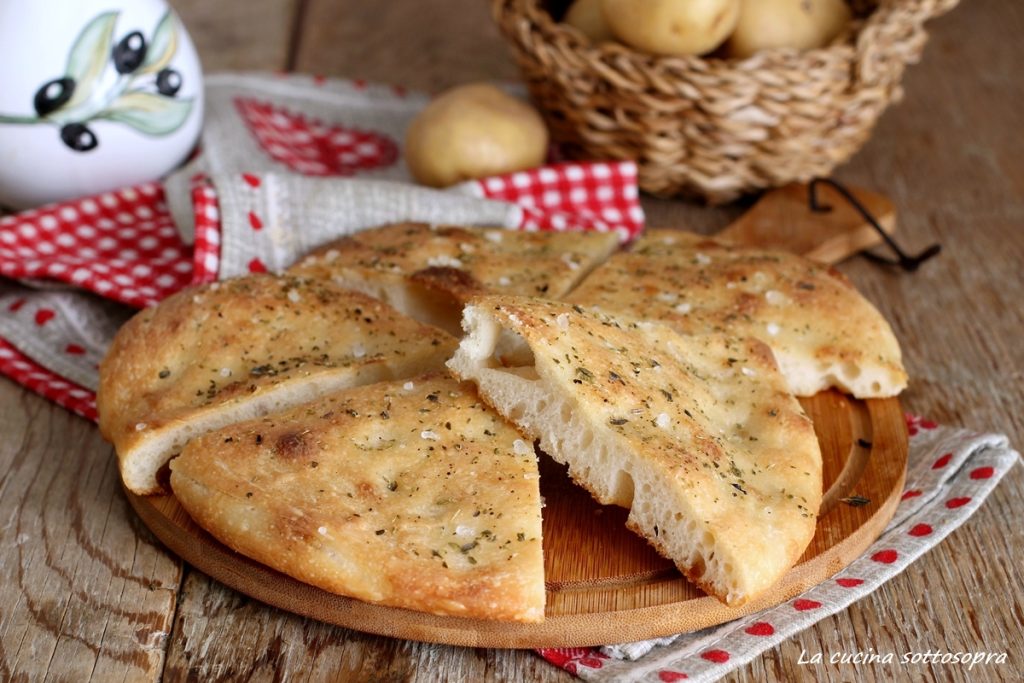
– White focaccia should be eaten as soon as it is made to fully enjoy its goodness. It keeps for a maximum of 24 hours. I recommend lightly reheating it in the oven at 212°F for a few minutes if you plan to eat it the next day.
– You can omit the aromatic herbs if you don’t like them.
– I recommend not adding too large potatoes to the dough, as it could excessively moisten the focaccia crumb. Do not exceed 150-200 g of raw potatoes.
– Before baking the white focaccia, you can create an emulsion with a bit of oil and water and pour it over the focaccia surface before baking. You will get an even softer result.
– You can top it with cherry tomatoes or other seasonal vegetables. You can also use it as a base for a tray pizza, topping it with tomato sauce and mozzarella.
FAQ (Frequently Asked Questions)
Can you use less yeast in the focaccia?
Certainly. The issue of the amount of yeast always divides opinions. With 2 tsp of yeast, you will make focaccia in half a day. However, if you prefer a longer fermentation, halve the amount of yeast and double the fermentation times. This way, the focaccia will be even more digestible.
If I want to prepare focaccia for Sunday lunch, how should I organize myself?
I suggest two ways. Boil the potatoes the night before and let them cool. Early Sunday morning, knead and let it rise so that you can bake it before lunchtime. The second alternative is to prepare the focaccia entirely the day before. However, during baking, you will only bake the focaccia for 10 minutes. This way, you will block the fermentation. On Sunday morning, all you have to do is complete the baking in the oven for another 10-15 minutes at 392-428°F.
Why do I have to use cold water for kneading?
Using hot or even boiling water for kneading is an ancient misconception. Heat is an enemy of yeasts, which could even die from the heat, but also of the gluten network, which is what allows the dough to retain air and makes it soft and bubbly. For this reason, as kneading already heats the dough, it is good to use cold water or even ice in summer. The cold water allows you to perfectly knead the dough without overheating it too much and also has the ability to increase the extensibility of the gluten network, i.e., the ability to stretch without breaking.
Can only all-purpose flour be used without semolina?
Yes, but re-milled semolina adds flavor and crunchiness to the crust.
Can white focaccia be kneaded by hand?
Certainly. I recommend, however, working it for a long time until you have a smooth and elastic dough.
Can I use 00 flour or whole wheat or multigrain flour?
Yes, you can use 00 flour, although it is preferable to use 0 flour or Manitoba flour. The reason is that with 0 flour or Manitoba, the focaccia kneads better and stays fragrant longer. However, if you only have 00 flour available, go ahead and use it. As for whole wheat or multigrain flour, they can be used. However, I recommend using half 0 flour and half whole wheat or multigrain. You will also need to slightly increase the water because these flours absorb more.
