
Let’s talk about pizza with a stand mixer: do you want to make pizza but are unsure if it will turn out well? Have you never tried or have you tried and it didn’t turn out well? Would you like to achieve a good dough for both baking pan and refractory stone? Then you’re in the right place.
To work the pizza with the stand mixer, I use the Kenwood Prospero 280, but there are many models from other excellent brands on the market that can help you create many recipes, but you can easily make this dough by hand! Prepare the dough a day in advance and let it rest because the key ingredient in this recipe is time, which will allow the dough to rise and increase in volume by producing carbon dioxide within the gluten network and mature, i.e., break down more complex structures like starches, fats, and proteins into simpler elements, making it more elastic and digestible. Follow these instructions and the pizza with the stand mixer will turn out great.

- Difficulty: Easy
- Cost: Economical
- Portions: 3 dough balls on stone and 2 in pan
- Cooking methods: Electric oven
- Cuisine: Italian
- Seasonality: All seasons
Ingredients
- 4 cups Flour (for medium strength pizza)
- 1.5 cups Water (room temperature)
- 0.1 oz Fresh yeast
- 1 tsp Salt
- 2 tbsps Olive oil
Tools
- Mixer Kenwood Prospero KM280
Preparation
Dissolve the yeast in lukewarm water in the stand mixer bowl.
Add a few tablespoons of flour and knead at low speed using the hook.
As the machine works, add the rest of the flour, salt, and oil. Continue kneading until you get a soft and smooth consistency that detaches from the bowl walls.
You might have some flour left over or need to add more, depending on the dough’s consistency, which should be soft and detach from the bowl walls.Transfer the dough to an oiled bowl, cover it with plastic wrap, and place it in the fridge to mature for 24-36 hours.
Once matured, the dough will have doubled its volume and is ready to be worked.The next day, take the dough out of the fridge. Have you seen how it has grown? Look at those bubbles!
Let it rise at room temperature for about 4 hours, then take the dough and make dough balls.
With 4 cups of initial flour, it’s possible to make 2 dough balls for baking pan pizza or 3 dough balls of 10 oz each for the round pizza with a refractory stone.
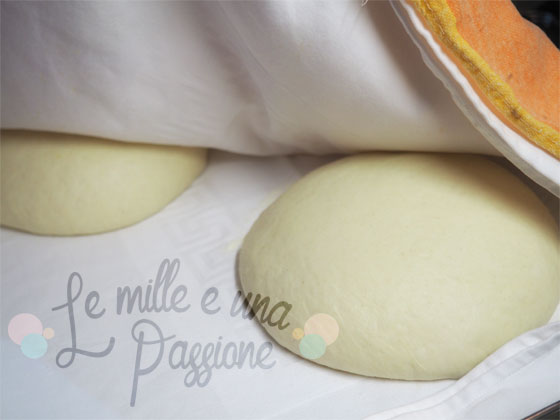
Place the dough balls on a clean cloth and cover them with another cloth dampened with water and wrung out to let them rise for about 2 hours. This will allow them to rise without forming a crust.
Turn on the oven at fan mode at 465°F / 480°F and while it heats up, spread the pizza on the baking tray with a drizzle of oil, add toppings as desired, and once the oven has reached temperature, put it in.
If you want a pizza with melty mozzarella or ham not too cooked, add them halfway through baking.
When the pizza edges are well-colored, it’s ready.
If you want to use a refractory stone and have a nice crunchy pizza, click HERE.Was it difficult to prepare the pizza with the stand mixer?
Read the comments of those who have tried it or had some doubts like you, you might find other useful information for preparing your pizza!
Watch how I stretch the round pizza
Watch how I stretch the round pizza
How to make pizza on a refractory stone
Here you can find the guide on how to bake pizza on a refractory stone. https://blog.giallozafferano.it/lemilleunapassione/come-fare-la-pizza-con-pietra-refrattaria/
Here you can find the guide on how to bake pizza on a refractory stone. https://blog.giallozafferano.it/lemilleunapassione/come-fare-la-pizza-con-pietra-refrattaria/
Notes
The dough should be matured for a more digestible and elastic pizza. You can do this in the fridge, where the yeasts work slowly.
If you don’t have time to mature the dough, you can skip the maturation step in the fridge, but the result will be less digestible and less elastic.
Baking at 465-480°F is ideal for a crispy crust. If you don’t have a refractory stone, use a baking sheet or a pizza pan with a low edge for even baking.
Storage
If leftover, the dough can be stored in the fridge for 1-2 days in a well-covered bowl.
If leftover, the baked pizza can be stored in the fridge for 2-3 days. To reheat, place it in the oven at 350°F for 5-10 minutes for a crispy base.
Variations
You can add herbs like oregano, rosemary, or basil to the dough for an extra flavor touch.
For a lighter pizza, try replacing some of the flour with whole wheat flour or spelt flour.
Customize the pizza topping with your favorite ingredients, such as grilled vegetables, mushrooms, or different cheeses.
FAQ – Pizza with Stand Mixer
Can I use another type of mixer?
Of course, any mixer with a dough hook can be used. If you don’t have a stand mixer, you can knead by hand, but it will be a bit more laborious.
How long does it take to mature in the fridge?
Ideally between 24 and 36 hours. The longer it matures, the better, but even 24 hours will give great results.
How do I know if the dough is ready to be worked?
The dough will have increased in volume, appear elastic, smooth, and have visible air bubbles. It should not be too sticky.
Can I bake the pizza in a static oven?
Yes, you can, but I recommend increasing the temperature to about 480°F and baking a few minutes longer to achieve a crispy base.
Can the pizza be frozen?
Yes, you can freeze the raw dough balls before the final rise. When you’re ready to bake them, let them thaw and rise as directed.
