Failproof Apple Strudel
I treasure this recipe from my grandmother, which she once received from a friend born in Ortisei who moved to Naples.
It’s a wonderful, fragrant and indulgent dessert, my comfort food during the autumn and winter months. Here I explain it step by step, so anyone can make it, even kitchen beginners—the recipe has been perfected over generations, so it’s foolproof and fail-safe.
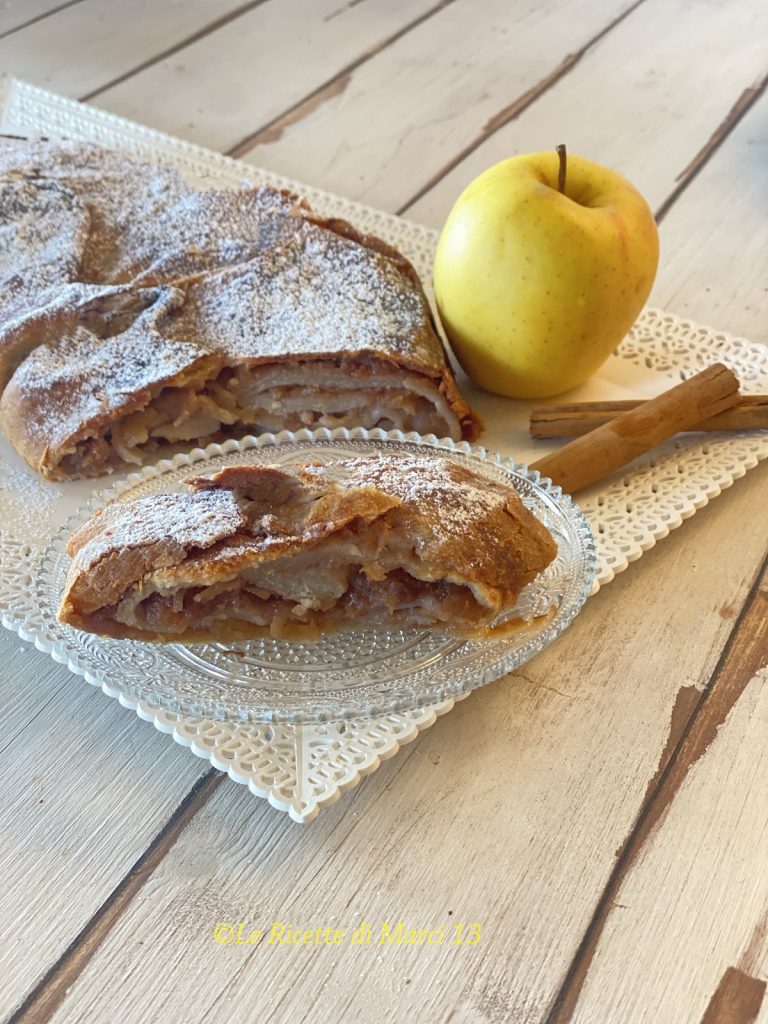
Apple strudel is an ancient dessert typical of Trentino-Alto Adige, made with a very thin pastry (it should be transparent) rolled up and filled with apples, raisins and melted butter flavored with cinnamon.
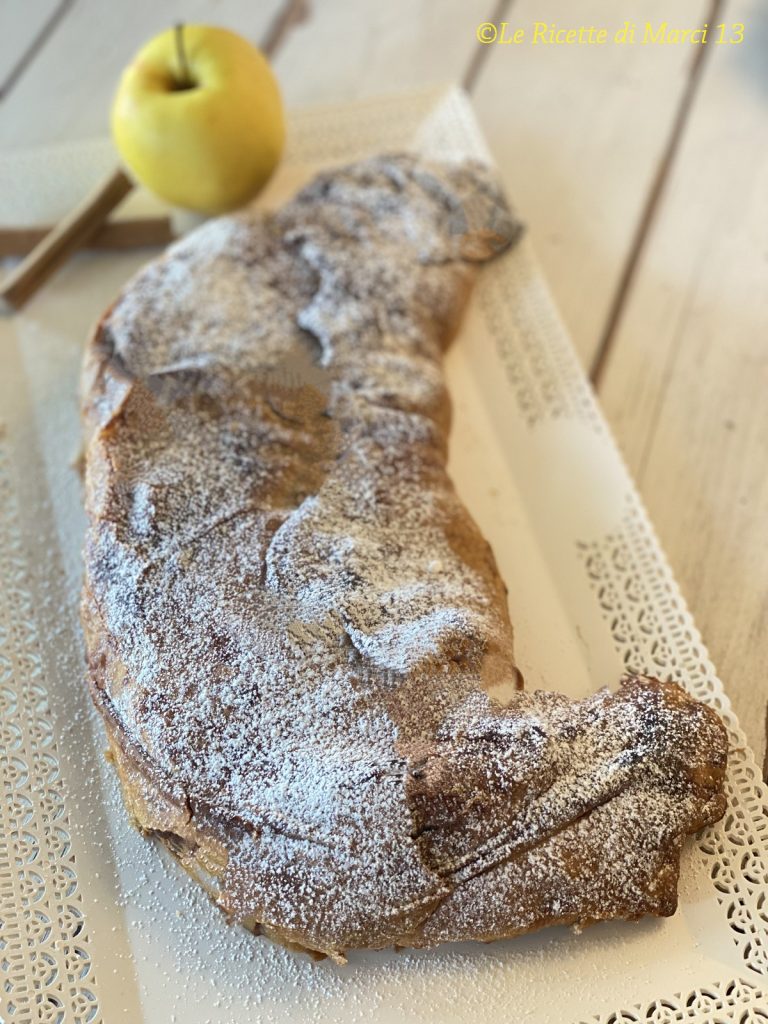
The appearance of this dessert does not do justice to its sublime goodness. The great Artusi wrote about it: “Do not be alarmed if this dessert seems to you a mess in its composition and if after baking it seems something ugly, like a huge leech, or an shapeless little snake, because you will like it in taste“.
The German term Strudel can be translated as “whirlpool“, recalling the rolled shape of the dessert. According to tradition, the correct thinness of the pastry is such that you should be able to read a love letter placed inside through its transparency.
If you’re looking for ideas for a healthy homemade breakfast, click on my Special: “Pantry Cakes & Bakes“.
If you want tested, surefire recipes (sweet or savory) click on this Special: “My TOP Recipes“.
If you want other cakes with apples or other fruit, click on my Special: “Desserts with APPLES and/or FRUIT“
You might also be interested in:
- Difficulty: Easy
- Cost: Budget
- Rest time: 30 Minutes
- Preparation time: 30 Minutes
- Cooking time: 50 Minutes
- Portions: 8 servings
- Cooking methods: Oven
- Cuisine: Italian
- Seasonality: Autumn, Winter, All seasons
Ingredients for the Failproof Apple Strudel
- 2 1/8 cups all-purpose flour (00)
- 3.5 tbsp butter (high quality (for the dough))
- 1 egg (whole)
- 1/3 cup whole milk (about 3.4 fl oz)
- 1/2 tsp fine salt
- 1 tbsp granulated sugar (optional)
- 1/2 tsp vanilla extract (optional)
- 2.65 lb Renette apples (about 2.65 lb whole apples (you should end up with approx. 700 g / 1.54 lb peeled))
- 1 sachet ground cinnamon
- 11 tbsp butter (high quality (for filling) — about 160 g)
- 3 oz Corinth raisins (or sultanas (about 1/2 cup))
- 1 1/4 cups powdered sugar (or granulated)
- 1 lemon zest (grated)
- 2 3/4 tbsp rum (or grappa, optional — for flavoring the raisins)
- 1/2 cup walnuts (chopped, optional)
- as needed vanilla powdered sugar (to dust the surface)
- 1 cup heavy cream (for serving, optional)
Tools
- Knife
- Peeler
- Stand mixer Kenwood with illuminated 7 L bowl W 1400
- Saucepan
- Rolling pin
- Parchment paper
- Pastry brush
- Baking sheet MasterClass non-stick
Steps for the Failproof Apple Strudel
First, soak the raisins for 10 minutes in boiling water, then drain. Put the raisins in a small bowl, add the rum and a small teaspoon of granulated sugar, and let them soak for 30 minutes to absorb the flavor.
Meanwhile, wash, peel and core the apples (they should weigh about 700 g / 1.54 lb after trimming), then slice them into thin slices. Put them in a bowl, add the raisins with their rum, the grated zest of one lemon, the sachet of cinnamon, 3/4 cup of sugar (you can also add chopped walnuts if you like), and mix well. Cover with plastic wrap and let the mixture rest and absorb the flavors at room temperature for 30 minutes.
Now prepare the strudel dough:
Take a small saucepan and melt about 3 tbsp of butter into the milk over a double boiler.
Then, in the bowl of a stand mixer, combine the flour, a pinch of salt, the lukewarm milk-and-butter mixture, one whole egg, 1 tbsp granulated sugar and the vanilla (optional). Mix with the paddle attachment for at least 15 minutes until you get a smooth, homogeneous dough that doesn’t stick to your hands or the bowl. If you prefer, you can knead the dough by hand vigorously for at least 20 minutes.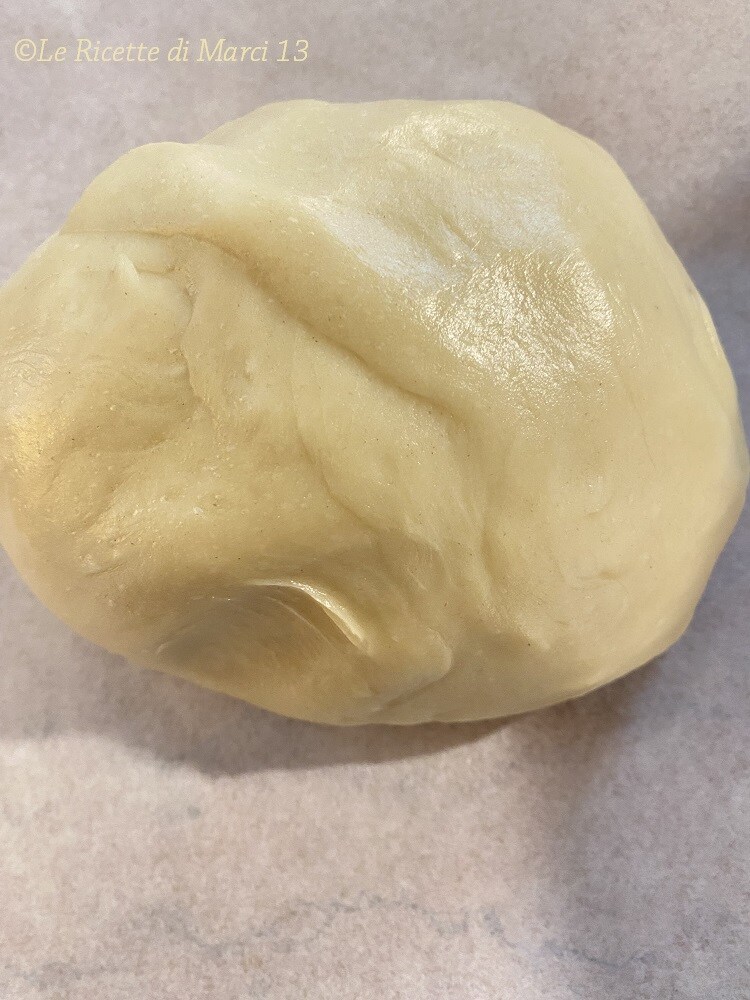
Warm a pot, dust the work surface with flour, place the dough on the work surface and cover it with the warm pot; let the dough rest for 30 minutes so it becomes elastic. A warm dough will be easier to work with.
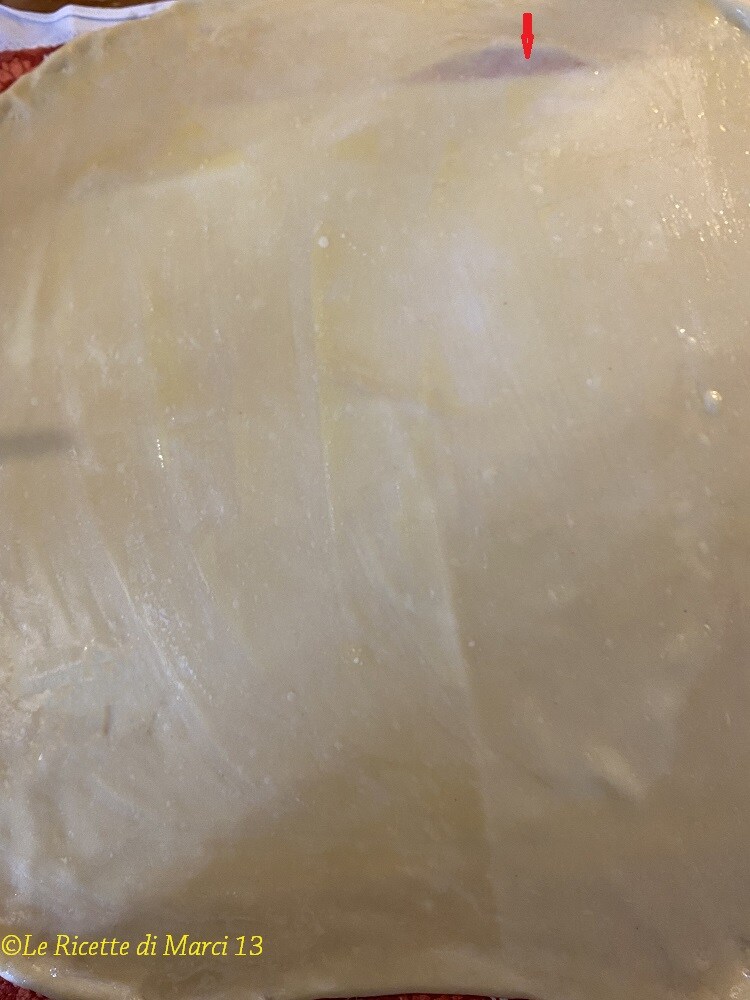
Meanwhile, melt the remaining 11 tbsp of butter (for the filling) over a double boiler. After half an hour of resting, take a clean tea towel, flour it and roll the dough into a rectangle with a rolling pin. Then stretch it using the backs of your floured hands until it is very thin — it should be transparent so you can just see the towel beneath, as in the photo.
Brush the surface of the pastry with about 1 1/2 tbsp of melted butter (taken from the 11 tbsp), distribute the apple-and-raisin filling evenly — including any liquid from the maceration — and then pour over about 7 tbsp of melted butter (reserve the remaining ~3 tbsp to brush the surface of the roll).
Fold the side edges inward so they cover the apples by a couple of centimeters (about 3/4 inch) to prevent the filling from coming out. Then roll the dough up from the bottom to the top, using the towel to help you.
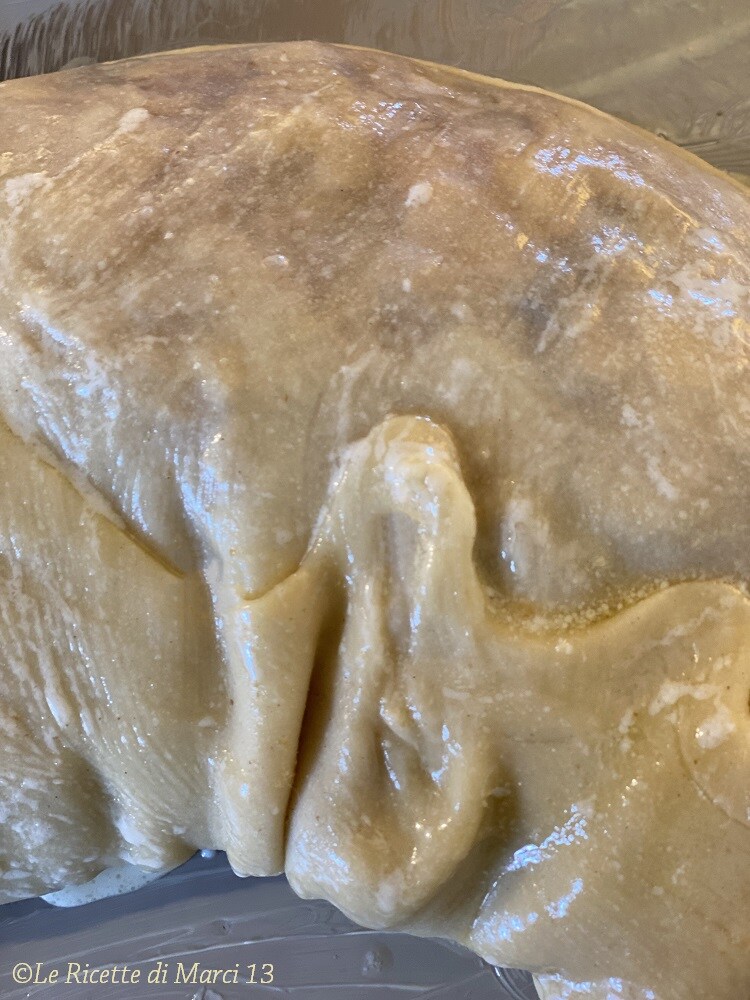
Using the towel, transfer the strudel to a baking sheet lined with parchment paper and well-buttered, placing the seam side down. Finally, brush the entire surface of the strudel with the remaining ~3 tbsp of melted butter.
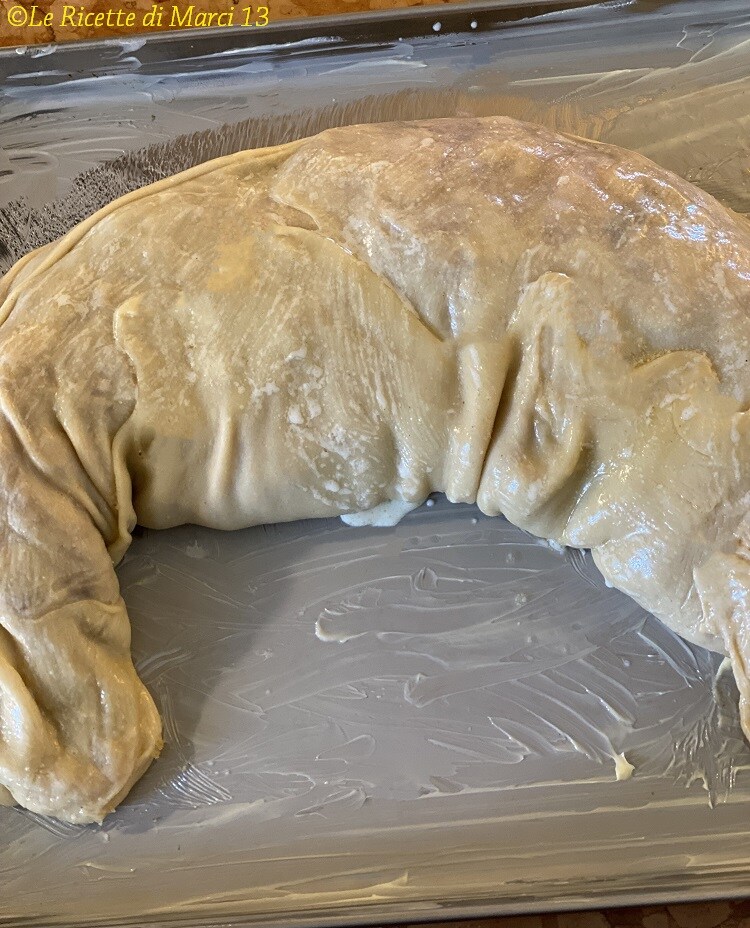
Place the baking sheet in a preheated static oven at 356°F (180°C) for 50 minutes. While the strudel bakes, open the oven occasionally and, with a spoon, collect any liquid that comes out of the strudel and brush it back onto the surface; by the end of baking you’ll get a lovely semi-caramelized crust (optional).
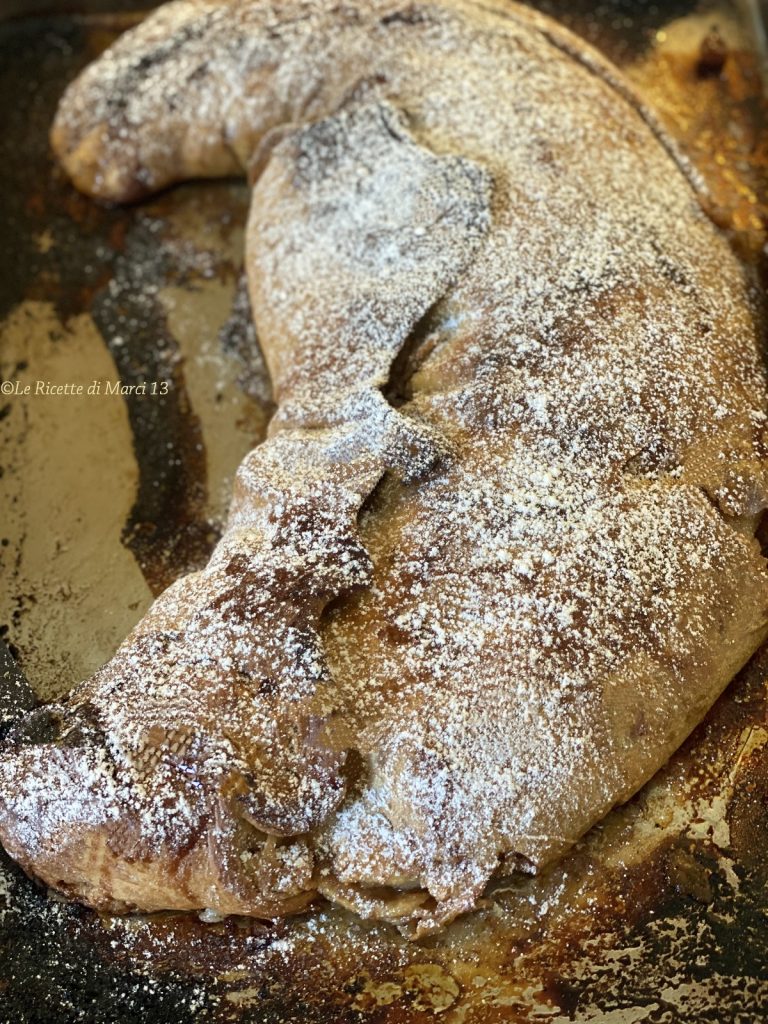
Remove the strudel from the oven and let it cool for at least a couple of hours before serving dusted with powdered sugar. This resting time helps the filling set so it’s easier to slice.
If you like, serve the apple strudel with lightly whipped cream sweetened with a tablespoon of sugar.
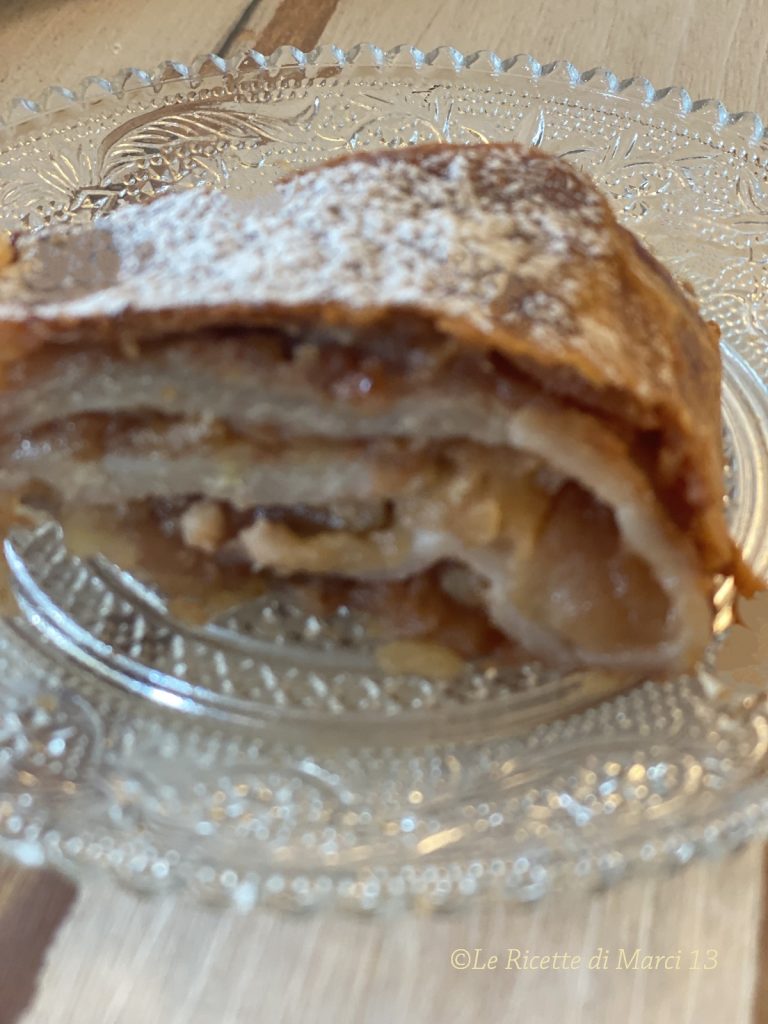
This is a slice (unfortunately the photo is a bit blurred) …. a true delight for the palate.
Shopping Tips!!!
To weigh ingredients for my recipes I use this handy digital kitchen scale with a large removable bowl, tare function and built-in timer.
Very practical and pretty: this set of Guzzini colored bowls, always useful in the kitchen.
To work doughs without effort I use my Titanium Chef Patissier XL stand mixer with illuminated 7L bowl, 1400 W power and integrated scale, my faithful ally in the kitchen for mixing, weighing, whipping, grinding, melting chocolate and pasteurizing eggs.
If, instead, you are looking for a cheaper stand mixer, you can comfortably choose Kenwood Titanium Chef Baker, with dual bowls (5L & 3.5L) and integrated scale.
To bake the strudel I used this roomy MasterClass nonstick baking tray.
You can buy all the items I recommend above on Amazon at great prices — just click directly on the links.
FAQ (Questions & Answers)
Origins and history of the Strudel?
The history of strudel begins in Asian regions, where desserts characterized by thin layered pastry with a filling date back to ancient Mesopotamia. In fact, an Assyrian manuscript from the 8th century BC mentions a dessert prepared for the Assyrian court consisting of thin layers of pastry filled with nuts and honey.
From that moment, the use of this slightly crunchy layered pastry likely spread to Turkey, Greece and throughout the Mediterranean. These sweets became known as Baklava and spread rapidly thanks to merchants and trading fleets traveling between Asia and Eastern Europe, who traded spices, textiles and other precious goods. These layered pastries moved from Turkey to Hungary quickly, where they also became larger.
In 1699 Hungary became part of the Austrian Empire and from there the pastry spread rapidly to Vienna. In the city the desserts were immediately called strudel because the word means roll or whirl.
Austrian pastry chefs made the final significant refinements to the dessert, which became famous worldwide.
The Viennese recipe uses a very thin pastry and typical local ingredients: apples, raisins and pine nuts are used in the filling of the typical Apfelstrudel; there are also variations with cherries or cheese, for example. (see here)How should baked apple strudel be stored?
Baked apple strudel should be kept covered at room temperature for 1-2 days, then stored covered in the refrigerator for up to 2 more days. If refrigerated, let it come to room temperature for a few minutes before serving or warm it briefly in the oven.
Finally, you can also freeze it (better if already portioned into slices): it keeps up to 5 months. Thaw at room temperature and consume within 24 hours.