Foolproof Apple Strudel
I jealously preserve this recipe from my grandmother, which was given to her by a friend born in Ortisei, transplanted in Naples.
It’s a wonderful, fragrant, and delicious dessert, my comfort food during the autumn/winter months, and here I explain it step by step, so anyone can prepare it, even beginners in the kitchen, after all, the recipe is super tested over generations, so foolproof and flop-proof.
The apple strudel is an ancient-origin dessert, typical of Trentino Alto Adige, made of very thin pastry (it must be transparent) rolled, filled with apples, raisins, and cinnamon-scented melted butter.
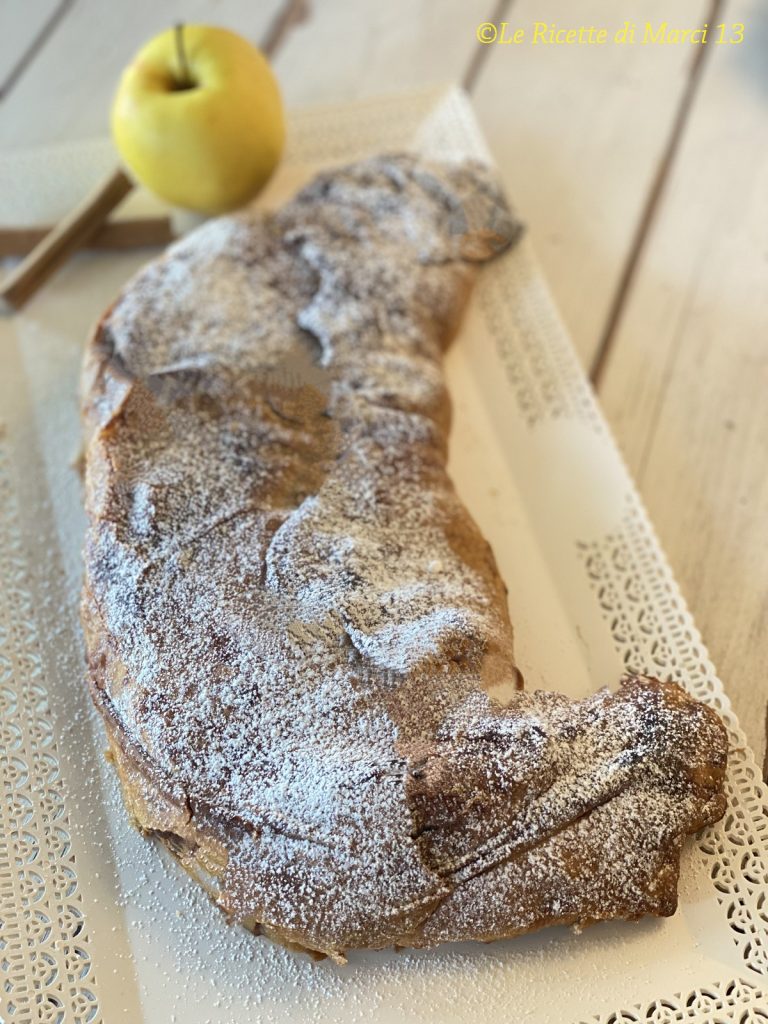
The appearance of the dessert does not do justice to its sublime goodness, the great Artusi wrote in this regard: “Do not be discouraged if this dessert seems like a concoction in its composition and if it seems somewhat ugly after cooking, like a huge leech, or a shapeless serpent, because then the taste will please you.
The German term “strudel” translates to “whirl,” reminiscent of the rolled form of the dessert. According to tradition, the right consistency of the pastry should be such that you can read a love letter inserted inside it in transparency.
If you are looking for ideas for a homemade healthy breakfast, click on my Special. “Pantry Desserts“.
If you are looking for tested recipes with guaranteed success (sweet or savory) click on the Special: “My TOP Recipes“.
If you are looking for other apple cakes or other fruits, click on my Special: “Desserts with APPLES and/or FRUIT“
You might also be interested in:
- Difficulty: Easy
- Cost: Cheap
- Rest time: 30 Minutes
- Preparation time: 30 Minutes
- Portions: 8 people
- Cooking methods: Oven
- Cuisine: Italian
- Seasonality: Autumn, Winter, All seasons
Ingredients for Foolproof Apple Strudel
- 2 1/16 cups all-purpose flour
- 3 1/2 tbsp butter (quality)
- 1 egg (whole)
- 3.4 fl oz whole milk
- 1/2 tsp fine salt
- 1 tbsp granulated sugar (optional)
- 1/2 tsp vanilla extract (optional)
- 2.65 lbs Renette apples (or golden yellow, 1.54 lbs peeled)
- 1 packet ground cinnamon
- 11 tbsp butter (quality)
- 3 oz Corinth raisins (or sultanas)
- 1 1/4 cups powdered sugar (or granulated)
- 1 lemon zest (grated)
- 1.35 fl oz rum (or grappa, optional, used to flavor raisins)
- 1 3/4 oz walnuts (chopped, optional)
- to taste vanilla powdered sugar (to garnish the surface)
- 1 cup fresh whipping cream (to accompany the strudel, optional)
Tools
- Bowls set of Guzzini bowls of various sizes
- Knife
- Apple corer
- Cutting board with two side trays, also oven-proof
- Stand mixer Kenwood with Illuminated Bowl W 1400, 7-liter bowl
- Small pot
- Rolling pin
- Parchment paper
- Brush
- Baking tray Masterclass non-stick
Steps for Foolproof Apple Strudel
First of all, soak the raisins in boiling water for 10 minutes, then drain the water, take a small bowl, pour the raisins and add the rum and a small tablespoon of granulated sugar, let it flavor for 30 minutes.
In the meantime, wash and peel the apples, remove the core (they should weigh about 700 g in the end), then cut them into thin slices, transfer them to a bowl, add the raisins with their rum, the grated zest of one lemon, the packet of cinnamon, 150 of sugar (if you like, you can also add chopped walnuts) and mix everything, cover with plastic wrap and let flavor for 30 minutes at room temperature.
Now dedicate yourself to the strudel dough:
Take a small pot and melt 40 g of butter in the milk in a bain-marie.
Then put in the bowl of the stand mixer: the flour, a pinch of salt, the lukewarm milk and butter mixture, a whole egg, the 15 g of granulated sugar and the vanillin (optional), mix everything with the paddle attachment for at least 15 minutes, it should result in a smooth and homogeneous mixture that does not stick to the hands or the sides of the bowl. If you like, you can knead the dough by hand vigorously for at least 20 minutes.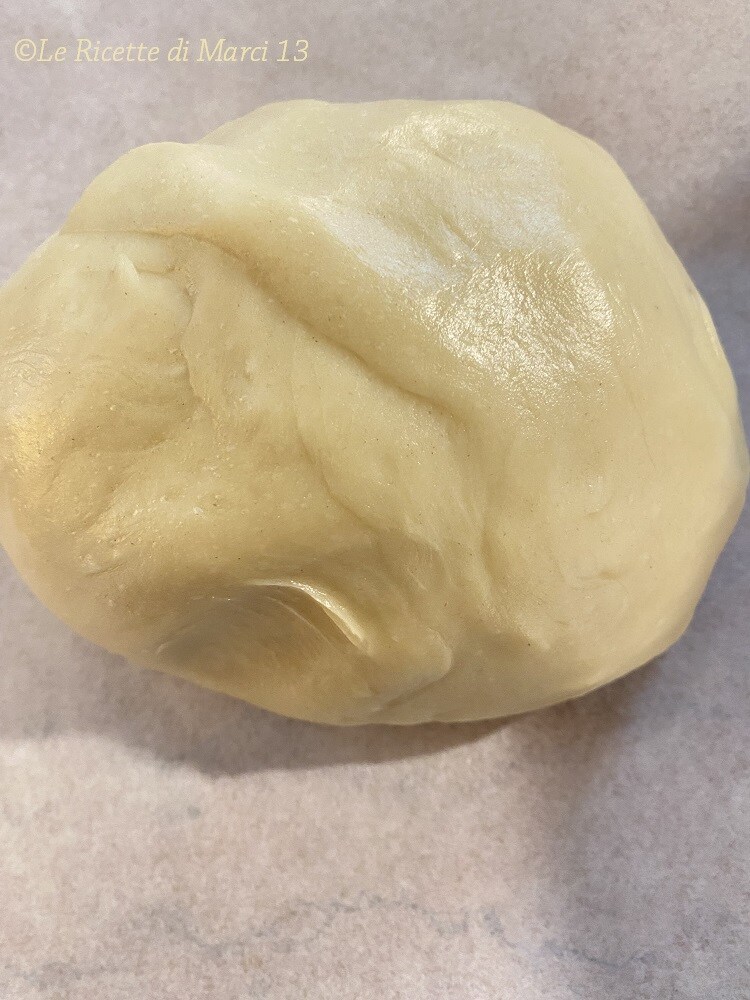
Warm up a pot, dust the work surface with flour, place the dough on the work surface and cover it with the warm pot, let the dough rest for 30 minutes, so it gains elasticity. The warm dough will be more malleable.
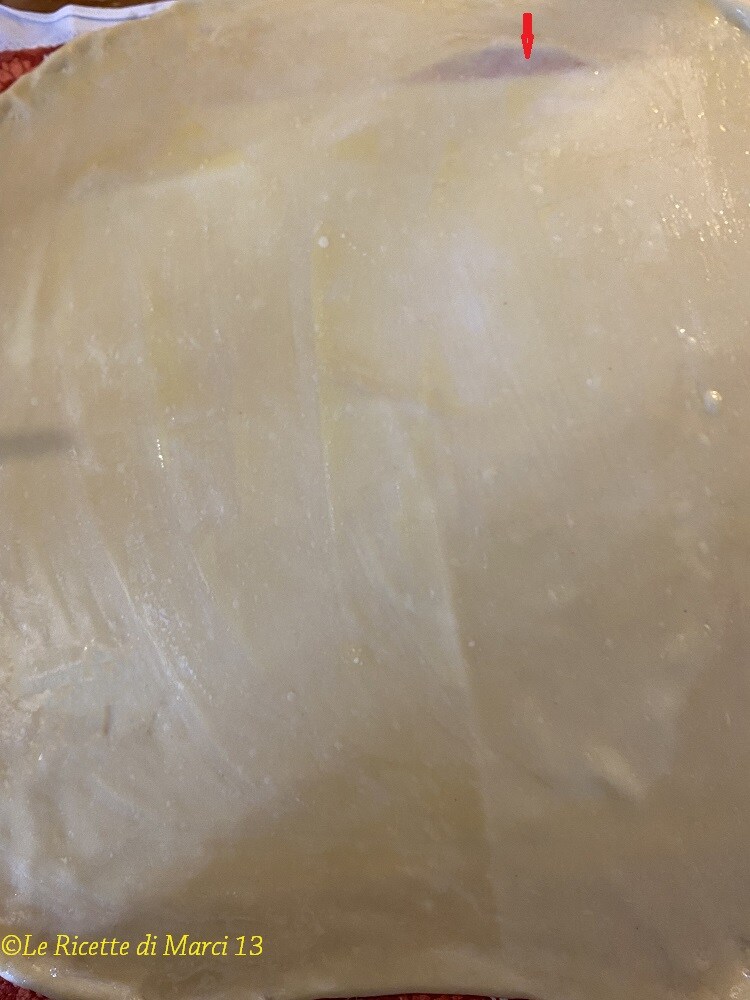
Meanwhile, melt 160 g of butter in a bain-marie. After the dough has rested for half an hour, take a clean cloth, flour it, and roll out the dough into a rectangle with a rolling pin, then stretch it with the back of your floured hands until it is very thin, it must be so transparent that you can see the cloth through it, as in the photo (see red arrow in the photo).
Brush the surface of the strudel with 20 g of melted butter (taken from the 160 g), evenly distribute all the apple and raisin filling along with their maceration liquid. Finally, pour 100 g of melted butter (reserve the remaining 40 g of butter to brush the surface of the roll)
Fold the side edges inward so as to cover the apples by a few centimeters, this way you won’t run the risk of having the strudel filling come out. Then roll the dough onto itself from the bottom up, using the cloth to help.
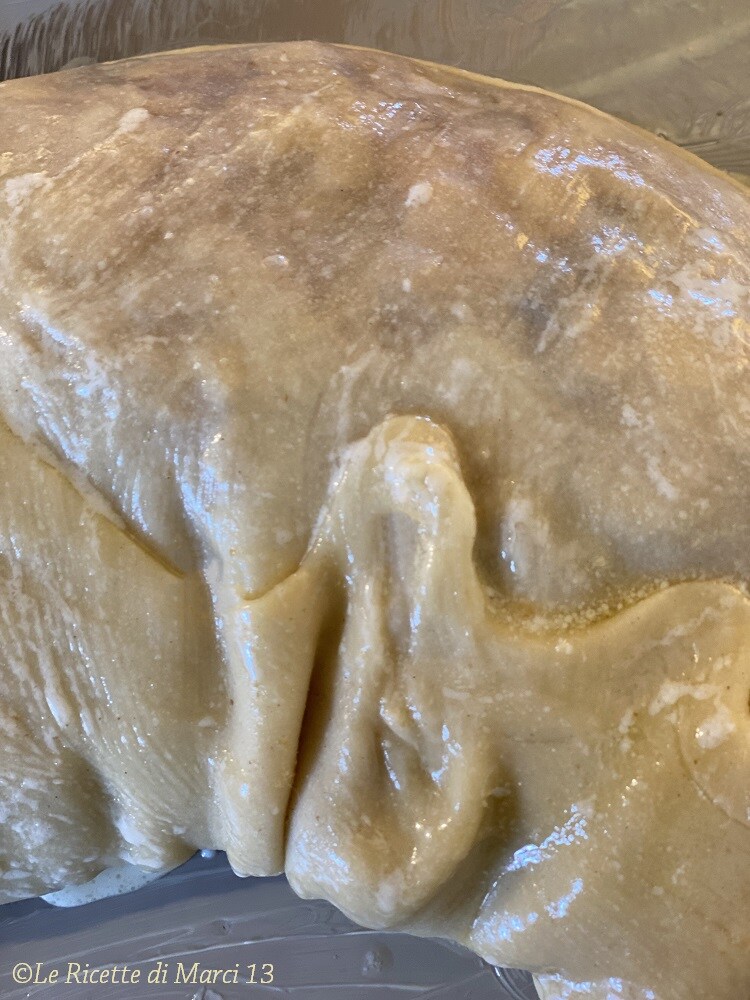
At this point, still using the cloth, transfer the strudel onto a baking tray (or rimmed baking sheet) lined with parchment paper and then buttered very well, and finally try to keep the seam on the bottom. Finally, brush the entire surface of the strudel with the remaining 40 g of melted butter.
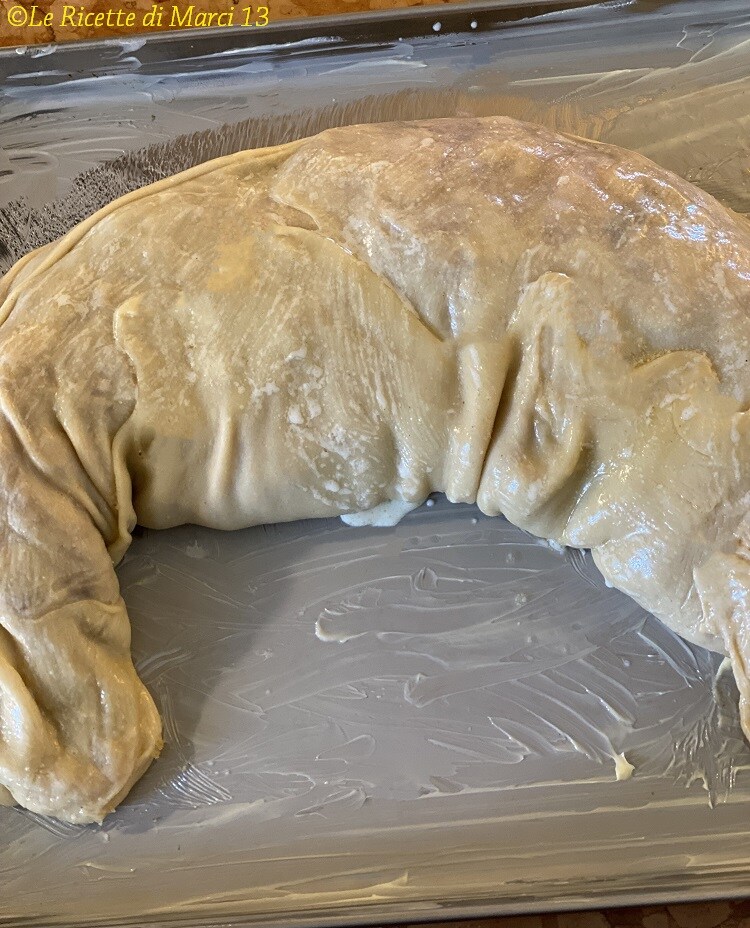
Transfer the tray to a preheated static oven at 356°F (180°C) for 50 minutes. As the strudel bakes, occasionally open the oven and with a spoon collect the liquid that oozes from the dessert and brush it on the surface; by the end of the cooking, a delightful semi-caramelized crust will have formed (optional).
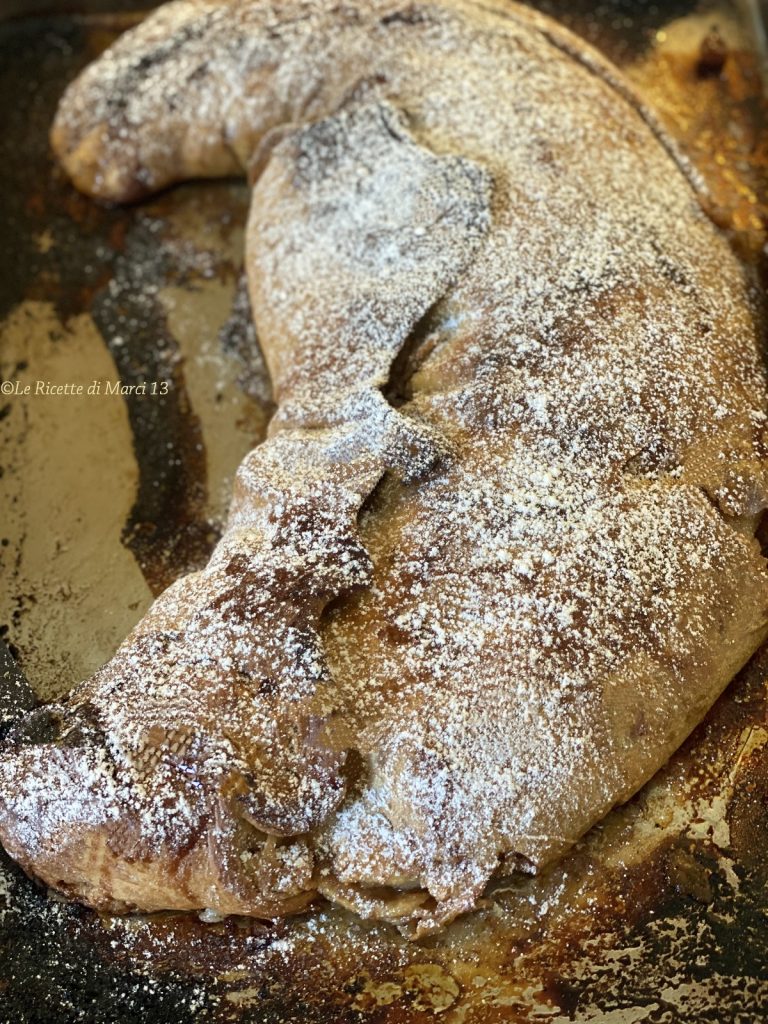
Remove the strudel from the oven and let it cool for at least a couple of hours before serving, dusted with powdered sugar, to let the dessert compact well and make it easier to cut into slices.
If desired, you can accompany the apple strudel with semi-whipped fresh cream with a spoonful of sugar.
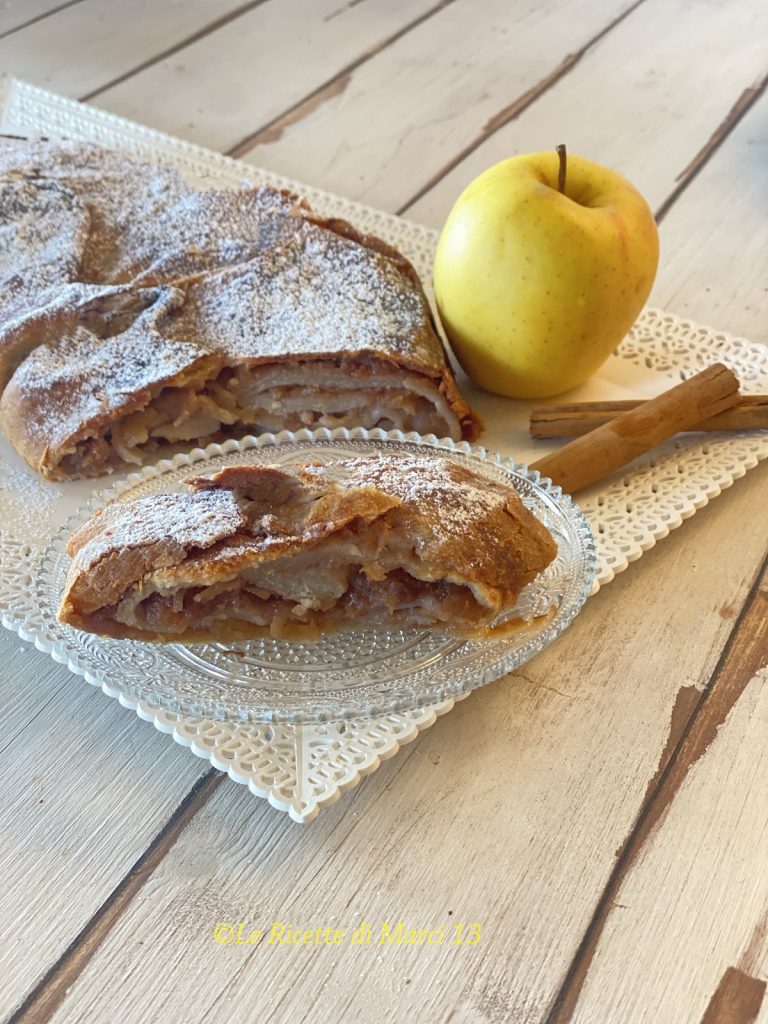
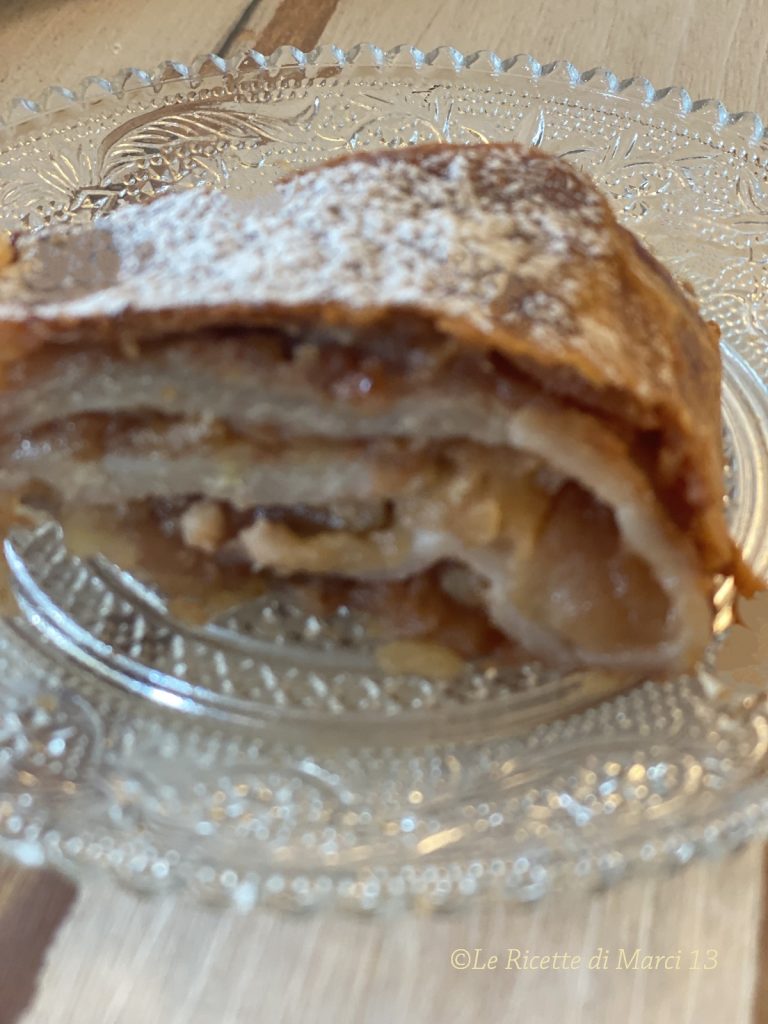
This is the slice (unfortunately the photo came out blurry) ….a real delight for the palate.
Shopping Advice!!!
To weigh the ingredients for my preparations, I use this practical digital kitchen scale, with a large removable bowl, tare function and built-in timer.
These colorful Guzzini bowl sets are very practical and cute, always handy in the kitchen.
To work the dough effortlessly, I use my Titanium Chef Patissier XL stand mixer with illuminated 7L bowl, 1400W power, integrated scale, and blender, my faithful ally in the kitchen for: kneading, weighing, whisking, cooking, chopping, melting chocolate, pasteurizing eggs.
If you’re looking for a more economical stand mixer model, you can easily choose to purchase Kenwood Titanium Chef Baker, with double bowls of 5l and 3.5l and 1200W power, integrated scale.
To bake the strudel, I used this spacious MasterClass non-stick baking tray
You can purchase all the items I recommend above on Amazon, at a great price, just click directly on the relative links.
FAQ (Questions and Answers)
Origins and History of the Strudel?
The history of strudel starts from Asian regions, where desserts characterized by the use of puff pastry with filling date back as far as the distant times of Mesopotamia. In fact, an Assyrian manuscript from the 8th century BC was found, which talks about a dessert prepared for the Assyrian court and which presented as a series of thin layers of puff pastry filled with nuts and honey. From that moment, most likely, the use of this slightly crunchy type of pastry spread to Turkey, Greece, and throughout the Mediterranean. These desserts took the name of Baclava and spread quickly thanks to merchants and fleets engaged in trade between Asia and Eastern Europe, selling and buying spices, fabrics, and other precious goods. The small puff pastry desserts quickly moved from Turkey to Hungary, where they also became larger.
In 1699, Hungary became part of the Austrian Empire, and from there, the spread to Vienna was very rapid. In the city, the desserts were immediately called strudel, due to their shape, since the word means roll or swirl. It was the Austrian pastry chefs who made the final significant adjustments to the dessert, which became so famous worldwide. The Viennese recipe uses a very thin pastry and typical ingredients of the area. Apples, raisins, and pine nuts are used to prepare the filling of the typical Apfelsrudel; there are different variations, in which, for example, cherries or cheese are added. (see here)