Neapolitan casatiello: the foolproof original recipe, step by step
Today I share the wonderful recipe for the Neapolitan casatiello, a rustic ring-shaped leavened bread stuffed with cured meats, cheeses and hard-boiled eggs. It’s always delicious but is traditionally prepared in Campania for Easter or Easter Monday, for outings and picnics.
In Naples it is served accompanied by the “fellata“, the quintessential Neapolitan Easter appetizer made of salted ricotta, hard-boiled eggs, cured meats and cheeses.
If you are looking for other recipes (sweet and savory) for Easter and Easter Monday, click on my “Easter Recipes Special”.
You might also be interested in:
- Pizza chiena (Neapolitan stuffed pizza) — original family recipe
- Pizza alla Campofranco: the Neapolitan brioche that thinks it's a pizza.
- Easter pecorino bread, step by step. Tested and foolproof recipe.
- Rustic pastiera made with tagliolini. Ancient Campanian Easter recipe.
- Neapolitan rustic pizza DOC! Step by step
- Difficulty: Easy
- Cost: Budget-friendly
- Rest time: 6 Hours
- Preparation time: 30 Minutes
- Cooking time: 1 Hour
- Portions: 8 servings
- Cooking methods: Oven
- Cuisine: Italian regional
- Region: Campania
- Seasonality: All seasons, Easter
Ingredients for Neapolitan Casatiello (original recipe)
- 2 1/2 cups Manitoba flour (I use Caputo Oro)
- 2 1/2 cups Type 0 flour (I use Caputo Nuvola)
- 5/8 cup Milk
- 5/8 cup Water
- 0.5 oz Fresh baker's yeast
- 1 cup Lard (+ 1/2 cup for rolling)
- 1 tbsp Fine salt
- 1 tbsp Sugar
- to taste Black pepper (about 1 tsp)
- 5.3 oz Neapolitan salami (sliced into strips)
- 5.3 oz Mortadella (diced)
- 3.5 oz Cicoli (soft pork cracklings, diced – optional)
- 5.3 oz Semi-spicy Provolone (diced)
- 3.5 oz Mild Provolone (I use Sorrento, diced)
- 2 oz Grated Parmesan and/or Pecorino (about 2/3 cup grated)
- to taste Black pepper (at least 2 g (~1/2 tsp))
Tools
- Bowl
- Stand mixer Kenwood, with illuminated 7 L bowl and W1400
- Pan Set of casatiello pans, various sizes (12.6"-11"-9.5")
Preparing Neapolitan Casatiello (original recipe)
Note: the lard and the yeast must be at room temperature, NOT cold from the refrigerator.
Dissolve the fresh yeast in 150 g of warm water and 150 g of warm milk (about 26°C) in a bowl.
Add the sugar and the flours and work the dough in the stand mixer with the paddle for about 7 minutes at speed 1 (about 30 minutes if you knead by hand).
When the dough starts to come together and wraps around the paddle, add 200 g of lard one tablespoon at a time (let the first tablespoon absorb before adding the next) — also add the pepper and continue working at speed 1.5 for another 10–15 minutes.
Finally, remove the paddle and switch to the dough hook, add the salt and work at speed 2 for about 3 more minutes.
In total, the casatiello dough should be worked in the stand mixer for a maximum of about 25 minutes, otherwise it will warm up too much.
.
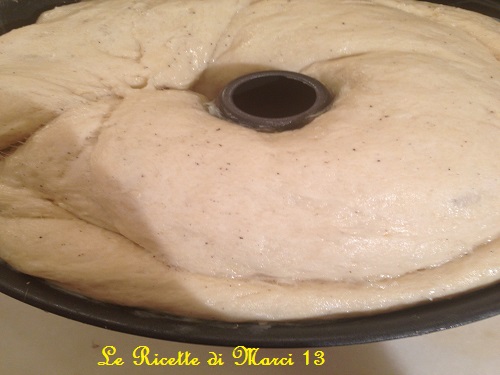
Place the dough to rise in a lightly greased bowl (use lard) and spread a thin layer of lard on the surface as well. Let rise for about 3 hours.
Note: the cured meats and cheeses should also be at room temperature (NOT cold from the refrigerator).
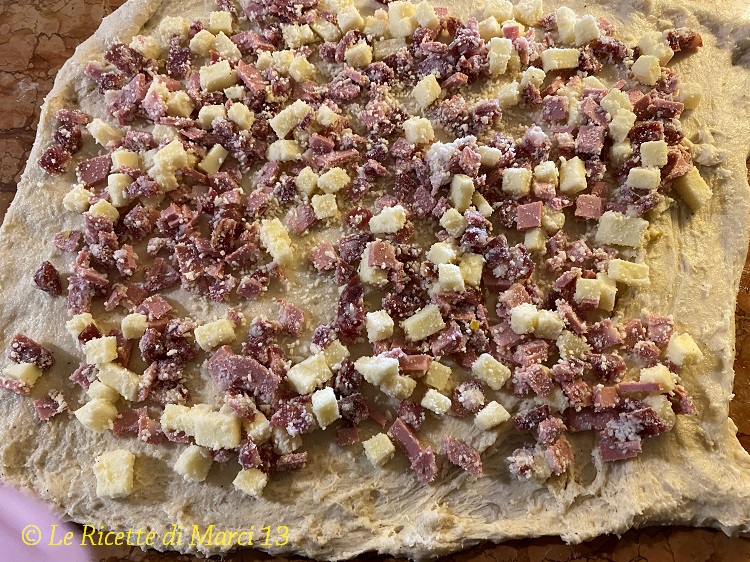
After the dough has risen, with lard-greased hands, stretch the dough by hand (do NOT use a rolling pin) into a rectangle, spread a layer of lard on the surface, then arrange the filling: cured meats, cheeses, pepper, and grated Parmesan (or Pecorino). Press lightly with your hands so the filling adheres well to the dough.
P.S.: When I add the filling to the dough, I take it with hands greased with lard to add extra flavor.
Roll the casatiello dough into a log and, at each coil, lightly grease with a little lard.
Gently place the dough into a greased 25 cm (about 10-inch) pan (use lard, DO NOT flour). Also grease the surface of the casatiello with lard.
Let rise for about 3 hours until it reaches the top of the pan.
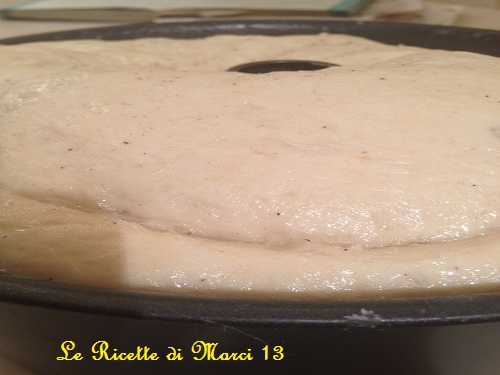
Bake the casatiello in the oven at 320°F; however, start baking at 212°F when the oven hasn’t yet reached 320°F (the Neapolitan casatiello must bake slowly) and bake for about 1 hour and 20 minutes. Unmold from the pan when cool.
The casatiello improves if it rests for a day and keeps well for 3–4 days, covered with plastic wrap.
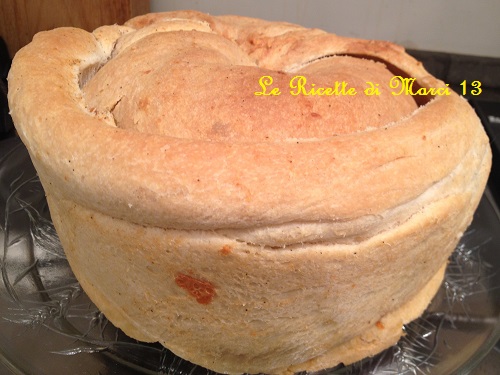
This is the tortano without external eggs.
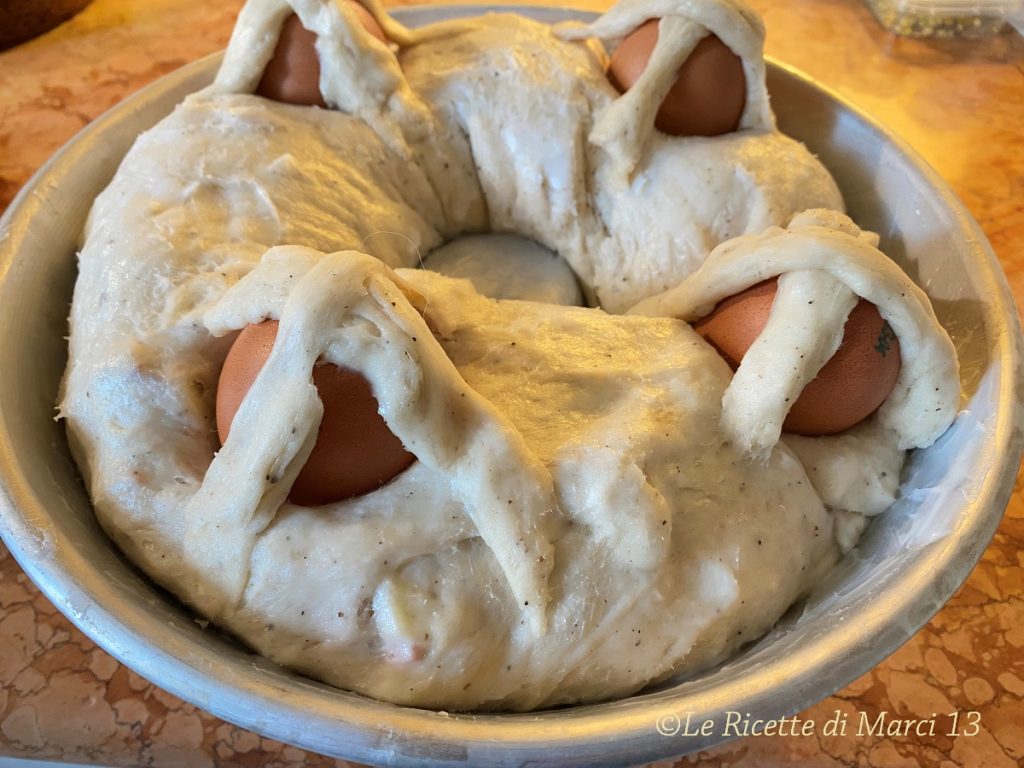
This instead is the traditional casatiello with raw eggs placed externally in the dough. The strips of dough that cage the semi-submerged eggs represent the cross on which Jesus died and also his crown of thorns, while the ring shape recalls the cyclical nature of the Easter resurrection.
Shopping tips!!!
To knead perfectly, I use my Titanium Chef Patissier XL stand mixer with illuminated 7L bowl, integrated scale and blender, 1400 W of power — a faithful kitchen ally for: kneading, weighing, whipping, blending, grinding, and pasteurizing eggs.
If, instead, you are looking for a more economical and smaller stand mixer, you can comfortably choose to buy the excellent Kenwood Titanium Chef Baker XL, 1200W, 5L bowl and built-in scale.
Difference between Casatiello and Tortano
The dough for tortano and casatiello is the same. The difference is that in the tortano there are no raw eggs in their shells placed on the outside of the dough.
In the casatiello, the eggs — with their shells intact — are inserted on the outside (the raw eggs in their shells are placed in niches in the dough and enclosed by strips of dough positioned as a cross over the eggs).