Neapolitan Struffoli all the secrets step by step
The original recipe for these DOC Neapolitan Struffoli is from my paternal grandmother, carefully preserved in our family and passed down through generations.
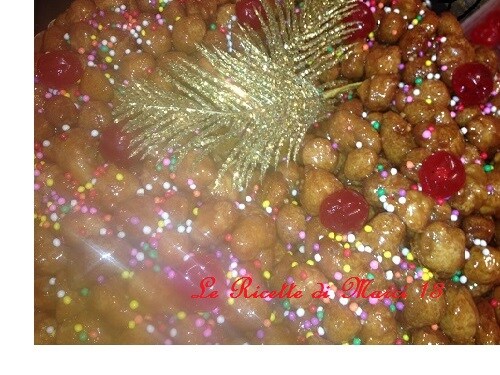
Struffoli are the quintessential Christmas dessert in Naples between Christmas and New Year’s, a cheerful and festive dessert, decorated with candied fruit and colorful sprinkles, and they are also commonly given as a (always well-received) gift to relatives and friends.
The dough for struffoli is very easy to make, it just requires a bit of patience and attention during preparation and frying, but if you follow my family’s original recipe and its SECRETS step by step, you won’t have any issues, it’s a foolproof recipe!
I want to emphasize that real Neapolitan struffoli are NOT soft, and absolutely no leavening agent should be used when cutting the slice: it should be compact, with the struffoli sticking together and crispy, not falling apart; hence, it’s important to use raw honey rather than liquid honey, which keeps them together.
Additionally, my struffoli are lactose-free, because they are made with quality lard.
If you want to make these magnificent Neapolitan struffoli in large quantities, to speed up the preparation I recommend (instead of forming dough logs by hand) rolling the dough into thin sheets with a pasta roller and then cutting it into small pieces (get one for yourself at Christmas and you’ll have it ready for making Carnival fritters and homemade pasta in general).
You might also be interested in:
My TOP recipes, foolproof recipes, a sure success.
You might also be interested in:
- Difficulty: Medium
- Cost: Medium
- Rest time: 30 Minutes
- Preparation time: 40 Minutes
- Portions: 8 people
- Cooking methods: Frying
- Cuisine: Regional Italian
- Region: Campania
- Seasonality: Christmas, New Year
Ingredients for Struffoli all the secrets:
- 4 cups all-purpose flour
- 3 oz lard (or butter, BUT lard gives friability)
- 5 eggs
- 2 egg yolks
- 1/3 cup granulated sugar
- 1 tsp fine salt
- 1 tsp vanilla extract
- 1 lemon (zested)
- 1/4 tsp ground cinnamon
- 1 1/3 tbsps anise liqueur
- 1 lb honey (raw)
- 1/4 cup granulated sugar
- 2 oranges
- 2 mandarins
- 1 lemon
- 1/3 cup olive oil (for frying)
- as needed colorful sprinkles
- as needed candied fruit
- as needed candied cherries
Tools for Struffoli all the secrets:
- Stand Mixer Kenwood with 1400 W of power, illuminated bowl
- Pasta Roller
- Fryer
Steps for Struffoli all the secrets
First, add lard and flour to the stand mixer and give it a turn with the K beater, then add the eggs (5 whole and two yolks), sugar (1/3 cup), salt, vanilla, grated zest of 1 lemon, cinnamon, and anise, and mix until the dough does not stick to your hands.
Then let the dough rest in the fridge covered for about an hour (the dough rest is important).

After the necessary time has passed, proceed to form long rolls of dough (or to speed up, you can use the pasta roller) lightly flouring the work surface and trying to use as little flour as possible.
The rolls should be thin (this is the secret for making them more crispy!) and once formed, they are cut with a knife into tiny cubes (in frying, due to the presence of eggs, they expand and puff up) and are placed on a floured surface, without overlapping.
Once the dough is done, heat a high-sided pan (or the appropriate fryer) with olive oil (it should be hot, but not boiling, around 350°F), and fry the struffoli a few at a time (important!) ensuring to pass them through a sieve first to remove excess flour (this is the secret! to prevent oil overflow during frying). Once the struffoli are golden, place them on a plate with absorbent paper.
Once frying is finished, melt in a large high-sided pot, 1 lb of raw honey (typically it’s calculated: for half a kilo of already cooked struffoli, 250 g of raw honey; these in the photo were 700 g) with 1/4 cup of sugar, two oranges, two mandarins, and one grated lemon. As soon as the honey has melted and is boiling, pour in the struffoli and coat them well with honey, stirring them gently with a large spoon. Be careful not to leave them on the heat too long, or they will caramelize and become hard, instead they should be crispy but NOT soft!!
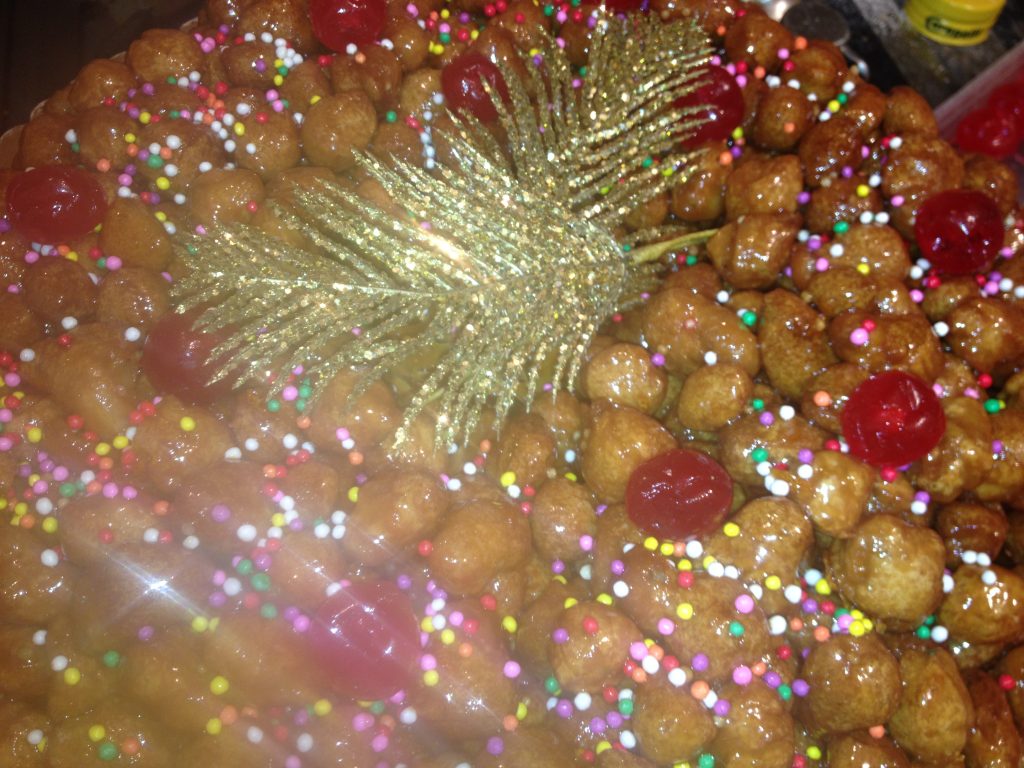
Pour the struffoli onto a serving plate, with a glass in the center, shape them into a ring (if you want, you can help yourself with a halved orange to avoid burning yourself) and sprinkle with colorful sprinkles (in Naples, they are called “diavolilli”) and candied cherries.
Tips for Neapolitan Struffoli all the secrets
To prevent foam from overflowing during the frying of struffoli, remove excess flour with a sieve and insert a steel spoon to prevent oil from overflowing from the pan.
Struffoli last for up to a week, but mine finish much sooner 😉
Shopping Tips !!!
For perfect and convenient mixing, I often use my Kenwood Titanium Chef Patissier XL stand mixer with 7L illuminated bowl, integrated scale, and blender with 1400 W power, a faithful ally in the kitchen for mixing, weighing, whipping, melting chocolate, and pasteurizing eggs.
If you’re looking for a more economical and smaller stand mixer model, you can safely choose to purchase Kenwood Titanium Chef Baker, with dual 5L and 3.5L bowls, 1200W power.
You can find both stand mixers on Amazon, at a special price.
If you want to prepare these magnificent struffoli in large quantities, to speed up preparation I recommend (instead of forming dough logs) rolling the dough into thin sheets with a electric pasta roller. I own this Marcato Atlasmotor, it’s the best and I get along very well with it because it is equipped with a motor and three different pasta formats (you’ll also find it useful for Carnival fritters).
To quickly fry struffoli without oil overflowing from the pot, I use this practical 3-liter fryer, with cool walls that prevent food residues from burning at the bottom, equipped with a safety oil filter that prevents excessive splashing, boiling, and overflow, particularly useful for frying even frozen food, easy to disassemble for cleaning in the dishwasher.
You can purchase all the items I recommend above, on Amazon, at a great price, just click directly on the respective links.
You can purchase all the items I recommend above, on Amazon, at a great price, just click directly on the respective links.
You can purchase all the items I recommend above, on Amazon, at a great price, just click directly on the respective links.
FAQ (Questions and Answers)
How long can struffoli be stored?
Struffoli can be stored at room temperature, covered with aluminum foil, for up to 10-15 days, thanks to honey, which is a natural preservative
Why should real struffoli be small?
Because this increases the surface area of the dough that comes into contact with the honey, thus enhancing the flavor.
What is the origin and history of Struffoli?
It seems that they were brought to the Gulf of Naples by the Greeks, already during the time of Magna Graecia. In fact, in current Greek cuisine, there is a similar preparation called loukoumades.
What are Struffoli?
Small balls of dough, no more than 1 cm in diameter, fried in oil (or lard) and then coated in hot honey and arranged on a serving plate in the shape of a ring or a cornucopia, decorated with candied fruit and colorful sprinkles.
How to avoid foam in Struffoli frying?
By removing excess flour with a sieve, adding a steel spoon (or a cork stopper), and frequently changing the frying oil.
Why are they called Struffoli?
The Neapolitan etymological dictionary associates the “struffolo” with a “small bundle of straw or tow”: the term commonly used in the kitchen may have derived, by similarity, from the “struffo”, the tuft used for cleaning and polishing marble.
In turn, this word would have been introduced into Italy, subsequently becoming part of vernacular vocabulary, by the Lombards, who used the term “struff” to define something that was “removed from a larger piece”.
But the most accepted hypothesis is that the etymology of “struffolo” traces back to the Greek “strongoulos”, which means “round”.