Quick focaccia with figs and prosciutto
The focaccia (or “ciaccia” or “schiaccia”) is a type of flatbread similar to focaccia made in Tuscany, seasoned with oil and salt.
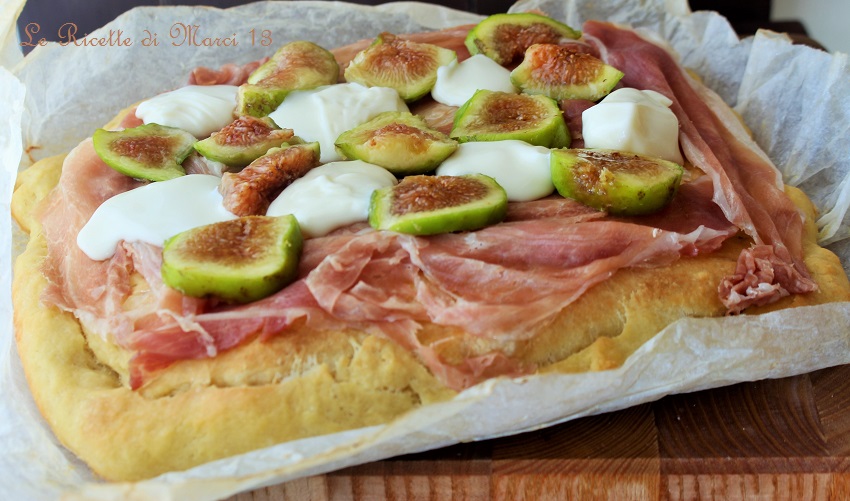
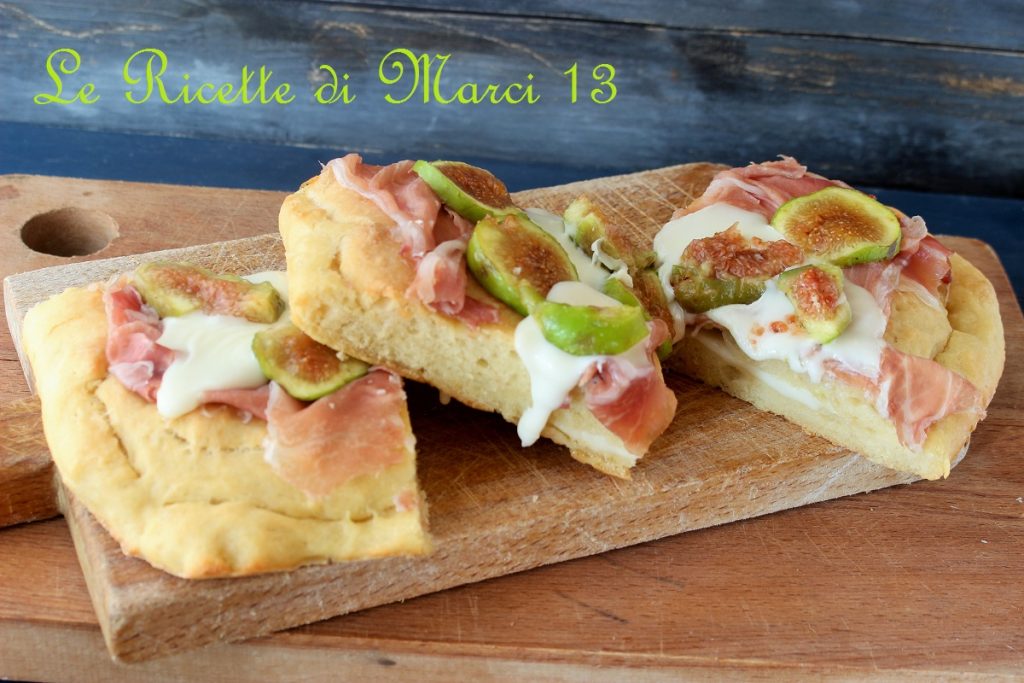
A delicious focaccia with figs and prosciutto, a main dish that I’ve enriched by adding slices of mild provolone (we call it “bebè di Sorrento”, but galbanino is also fine) between two layers of dough and stracchino on top (after I took the focaccia out of the oven).
The beauty of this leavened dough is that it requires very little effort, only 10 minutes, which is very little for leavened dough.
Naturally, this soft focaccia can be served instead of bread, with cold cuts and cheeses or be filled in various ways.
If you are looking for easy and quick recipes (sweet or savory), click on my Special: “Easy and Quick Recipes”.
If you love leavened creations (sweet or savory), click on my Special: “Rustic Brioches and Savory Leavened” or: “Sweet Leavened”.
- Difficulty: Easy
- Cost: Economical
- Rest time: 12 Hours
- Preparation time: 1 Hour 30 Minutes
- Portions: 6 people
- Cooking methods: Oven
- Cuisine: Italian
- Seasonality: Summer, Fall
Ingredients for Quick Focaccia with Figs and Prosciutto
- 3 1/4 cups Flour (0 for pizzas)
- 10 g Fresh yeast
- 1 1/8 cups Water
- 1 tsp Salt
- 2 tbsp Sugar
- 3.5 tbsp Extra virgin olive oil
- as needed Figs
- 5.3 oz Mild provolone
- 5.3 oz Prosciutto (Fiocco)
- 5.3 oz Stracchino (or Gorgonzola)
- as needed Walnuts (optional)
Tools
- Bowl
- Stand mixer Kenwood with 1 illuminated 7 L bowl, 1400 W Power
- Baking tray
Preparation of Quick Focaccia with Figs and Prosciutto
To make the focaccia dough, you can use two rising times: a quick one (90 minutes at room temperature) and a slower one (12 hours in the fridge). The second method makes the focaccia more digestible.
1) Quick Method: knead all the ingredients for about ten minutes, let it rise for about 90 minutes, divide the dough into two, and make the folds as I will show later.
After 90 minutes, turn the dough onto a floured surface, and make the first type of folds, explained very well here. Then divide the dough into 2/3 and 1/3.
Let the two pieces rest for 20 minutes, covered with a damp tea towel, before rolling out the dough.
Meanwhile, preheat the oven to 390/480°FNow take the larger piece of dough and spread it with oiled hands on an oiled baking tray about 10×12 inches, ensuring the edges are high, lay thin slices of mild provolone on top, and, still with oiled hands, spread the remaining 1/3 of the dough on top, pressing the surface with your fingertips.
Fold the edges of the lower dough over this, sealing well, and bake in a preheated oven at 390/480°F for about 30 minutes until golden brown.
Remove the focaccia from the oven and, while it’s still hot, cover with slices of prosciutto so that the fat melts and flavors the focaccia, and add figs cut into wedges. Once the focaccia has cooled, add pieces of stracchino (or gorgonzola) and chopped walnuts (optional) on the prosciutto slices.
2) If you choose the longer method, proceed as follows: dissolve the yeast and sugar in water, then pour the flour, salt, sugar, and oil into a large bowl, and knead very little, only about ten minutes (by hand or with the paddle attachment of the mixer) and add the previously dissolved water, yeast, and sugar.
Place the dough in the fridge for 12 hours at a temperature between 43°F and 46°F, no more.
After 12 hours, take the dough from the fridge and let it sit for about 2 hours at room temperature, then turn it onto a floured surface, and make the first type of folds, explained very well here.
Then divide the dough into 2/3 and 1/3.
Let the two pieces rest for 20 minutes, covered with a damp tea towel, before rolling out the dough.
Meanwhile, preheat the oven to 390/480°FNow take the larger piece of dough and spread it with oiled hands on an oiled baking tray about 10×12 inches, ensuring the edges are high, lay thin slices of mild provolone on top, and, still with oiled hands, spread the remaining 1/3 of the dough on top, and proceed as above (see quick method).
Shopping Tips!!!
To prepare this recipe, I used my Kenwood Titanium Chef Patissier XL with 1 illuminated 7 L bowl, Integrated Scale, 1400 W Power, a faithful ally in the kitchen for: kneading, whipping, heating (e.g., melting chocolate).
If you are looking for a more economical and smaller stand mixer, you can safely buy the Kenwood Titanium Chef Baker, with Integrated Scale, 1200W Power and dual bowl: 5L and 3.5L.
You can find both of these stand mixers on Amazon, at a special price.
Nutritional values of figs?
Beneficial effects: Laxative: the pulp of figs contains small seeds and mucilage that help make it a cleansing and protective fruit for the intestines and stomach. Anti-inflammatory: it has anti-inflammatory properties, especially for the respiratory and urinary tracts. It also acts externally on tissues.
Very effective are compresses made from pulp, applied locally to abscesses, skin eruptions, and acne, ideal for adolescents. Potassium deficiency: thanks to the presence of potassium, they act as a supplement, helping to counter typical symptoms such as muscle cramps, fatigue and dizziness, ideal during the school period. Supplements for poor diets: suitable in the diet of those with poor appetite, convalescents, children, and the elderly.
Figs, being energizing, are also helpful to people under physical stress to recover energy. (see Here) .Differences between Focaccia and Flatbread
Flatbread, primarily rooted in Tuscany, differs from focaccia mainly in the dough’s hydration and the use of olive oil as a condiment.
In addition, flatbread is generally thinner than focaccia, and the term “flatbread” derives from the technique of flattening the dough before baking, creating an irregular surface with characteristic “holes” that help retain the olive oil, a distinctive element of this product.
Flatbread can vary in toppings, ranging from oil and salt to more elaborate ingredients like tomatoes, onions, or zucchini, enriching and varying its flavor.