The real Neapolitan Ragù. The original recipe
The real “Neapolitan Ragù” is not just sauce, condiment, but it is a lot of patience and passion. Every ingredient must have its cooking time (at least six hours in total!) and it should ideally rest for a day.
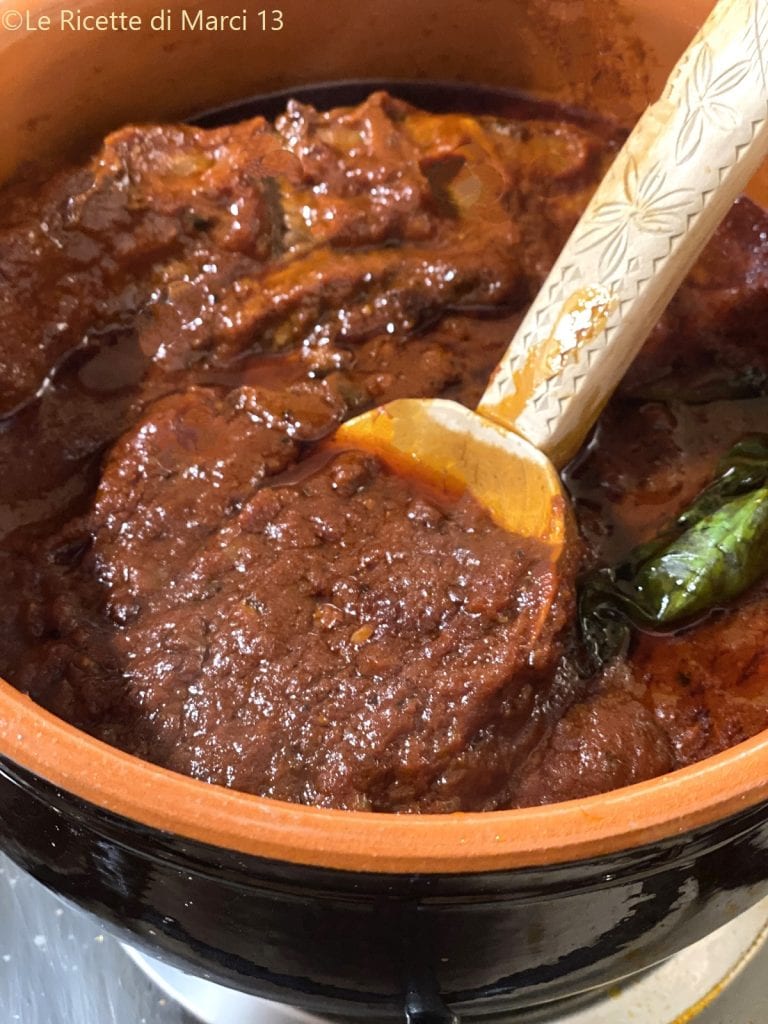
The real Neapolitan ragù is dark red, otherwise it is just meat with tomato and it must “pippiare” for at least 5-6 hours.
In Naples, ragù is the typical condiment for Sunday family lunch, celebrations, and holidays, ideal for seasoning lasagna, gnocchi, and pasta dishes.
In my recipe, I reveal all the family secrets to prepare the real Neapolitan Ragù (the traditional dark red one) with step-by-step photos, you can’t go wrong, and the success of this dish on the table is guaranteed.
In Naples, every family has its own ragù recipe, this is the original ragù of my family, passed down through generations and always a huge success.
With this ragù, you can season thick pasta (in Naples we use “ziti spezzati”) gnocchi, lasagna, tagliatelle.
The meat with the ragù is also a tasty second course, the meat is very tender, even better if you serve as a side “friarielli” (a kind of tender broccoli rabe, to be sautéed raw in a pan with garlic, oil, and chili pepper) and constitutes an excellent main course.
The traditional Neapolitan ragù must peppiare (from peppïà – pippijà = to gurgle, make the sound of a pipe).
A Neapolitan ragù that simmers and does not peppiare for many hours, would not be a real ragù, just meat with tomato.
Only after the sauce has peppiato for several hours and the strange phenomenon of the separation of oil and lard that float to the surface occurs, leaving the tomato sauce at the bottom of the pot, can you be sure that the ragù is achieved, and after a quick stir with the trusty wooden spoon, you can turn off the heat (quote from the late Raffaele Bracale, here.)
You might also be interested in:
My TOP Recipes, a collection of foolproof, tested recipes.
DOC Neapolitan Cuisine, a collection of ancient and modern Neapolitan recipes
- Difficulty: Medium
- Cost: Medium
- Rest time: 1 Day
- Preparation time: 6 Hours
- Portions: 8 people
- Cooking methods: Stovetop
- Cuisine: Regional Italian
- Region: Campania
- Seasonality: All seasons
Ingredients for the DOC Neapolitan Ragù
- 1.76 lbs beef rump (in Naples we use the 'piccione' cut, it must be first cut meat, I have it cut into LARGE pieces by the butcher (NO minced meat))
- 1.1 lbs pork shoulder (or 1.1 lbs of braciole stuffed with fine salt, pepper, pecorino cheese cubes, minced garlic and parsley, raisins and pine nuts and tied with string)
- 1.1 lbs pork ribs (in Naples they are called TRACCHIE)
- 2 sausages (optional)
- 3.5 oz smoked pancetta (rolled, cut into strips)
- 1.32 lbs golden onions
- 3 tomato passata (I use Cirio verace passata 24.7 oz)
- 7.05 oz tomato paste (better double or triple concentrated)
- 7.05 oz lard
- 3.5 oz extra virgin olive oil (of quality)
- 10 oz dry red wine (preferably Gragnano or Aglianico)
- to taste black peppercorns (ground)
- 0.53 oz fine salt
- to taste fresh chili pepper (optional)
- to taste grated Parmesan cheese (or pecorino, optional)
- to taste basil (optional)
Tools for the real Neapolitan ragù
- Bowls of various sizes
- Cutting Board with two side trays for scraps
- Mezzaluna sharp, with double blade
- High-edged Casserole in cast iron, Le Creuset
Steps for the Neapolitan Ragù
First, finely chop the onions (no blender) then take a high-edged casserole (preferably earthenware, cast iron, or copper) and let the onions simmer with extra virgin oil, lard, pancetta slices in pieces, pepper for about 12 minutes.
I also add chopped chili pepper because I like it, but in the traditional recipe only ground black pepper is used.
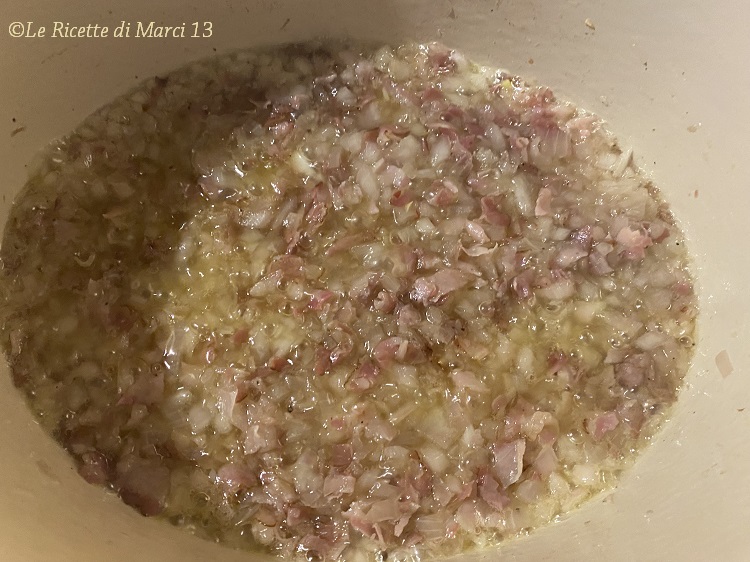
– PHASE I –
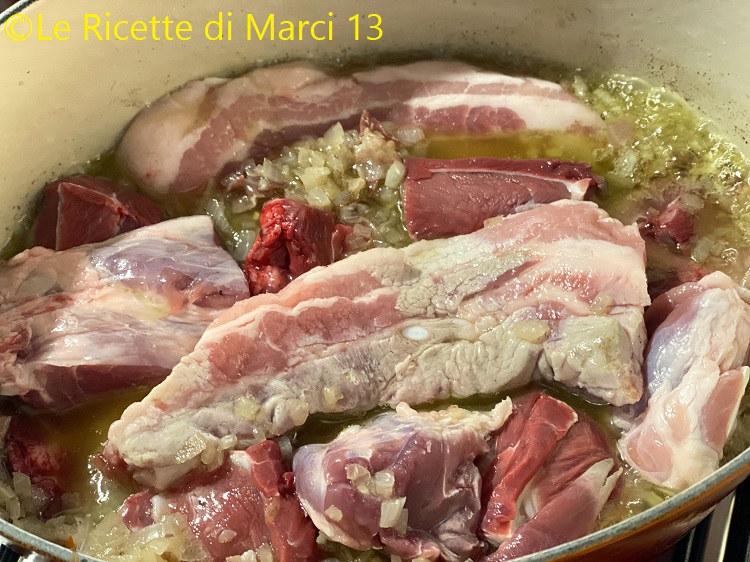
Then add all the meat to the casserole (first cut into large pieces, pork ribs, pork shoulder (braciole and sausages are optional) and brown it over high heat for about 8 minutes (do not add salt) then cover it with a lid for 10 minutes over medium heat, it is said that the meat should be “stunned”.
When the onions start to color, uncover, stir and turn the meat more often, adding, little by little, the dry red wine which must evaporate completely. Once this is done, the onions will be well browned, all traces of liquid will have disappeared, and only the fat that is slowly simmering will remain.
This first phase will keep you busy for about 1.5 hours from the moment the meat is added to the casserole.
During this entire time, it is not advisable to leave the stove: the onions could burn, ruining everything (better to check every 30 minutes)
– PHASE II –
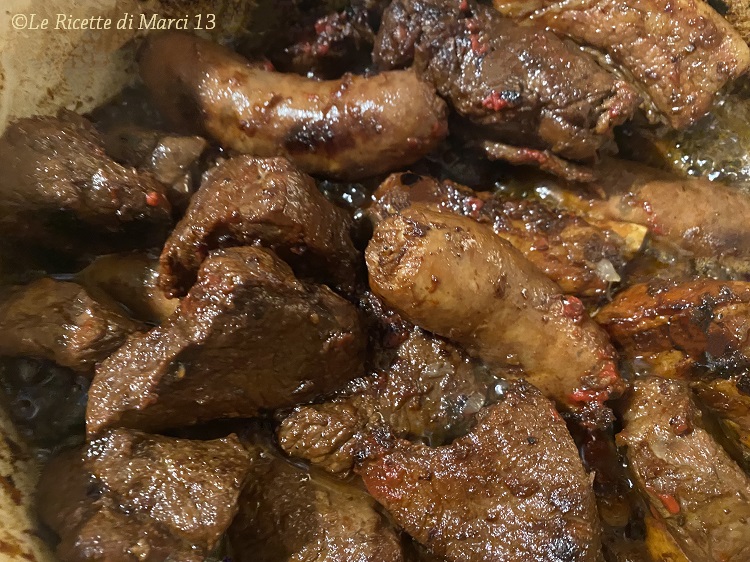
During this phase, the pork ribs (tracchiolelle) will surely be cooked and should be removed carefully, to avoid them breaking open and falling apart.
Then, increase the heat slightly, just enough to accommodate the other ingredients that are cold.
Add no more than two or three tablespoons of double (or triple) concentrated tomato paste and let it fry, until it becomes very dark. Be very careful: the paste must melt into the fat, but not burn!
Only at this point, add more paste, always in the same quantities, and so on, always with the same procedure, until you have finished it.
This second phase (even more delicate than the first because you have to check the cooking of the meat and there’s a risk of the tomato sticking) will engage you for another 50 minutes or so (if the concoction tends to stick at the bottom, change the pot for a non-stick one).
– PHASE III –
At this point, raise the flame again for 2 minutes, add all the tomato passata, the salt, the basil leaves torn by hand, and not more than a ladle of boiling water (used to clean the tomato bottles) lower the heat to minimum and with the pot uncovered, add again all the meat, let it cook first for about an hour and then, covering it as suggested in the introduction, let it peppiare (cook over very low heat) for at least 40 minutes
Let the meat rest in the sauce overnight, at room temperature, the next day, turn on the heat again to a minimum and cook for about an hour, then remove the meat and let the sauce peppiare covered at minimum heat for about 40 minutes.
The sauce will be cooked when it appears dense, glossy, very dark and greasy.
Check the salt, it should not be necessary to add more, put the meat back in the casserole and let it boil again for a few minutes before using it.
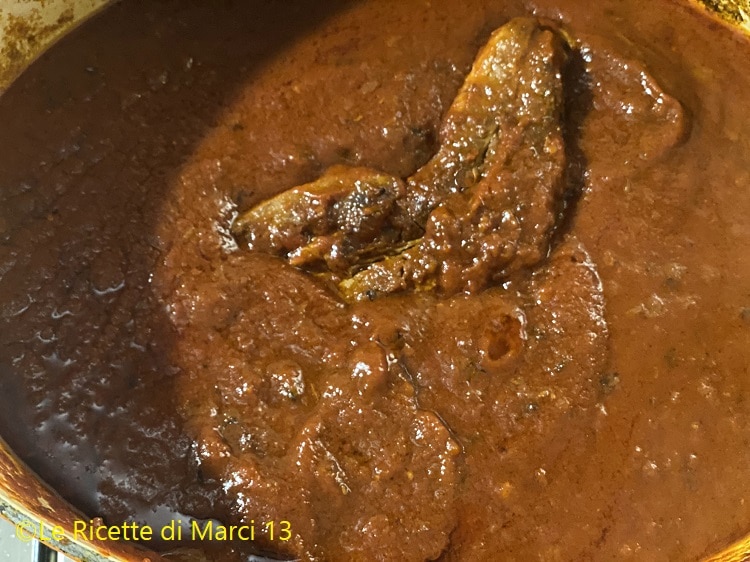
Ragù still bright red
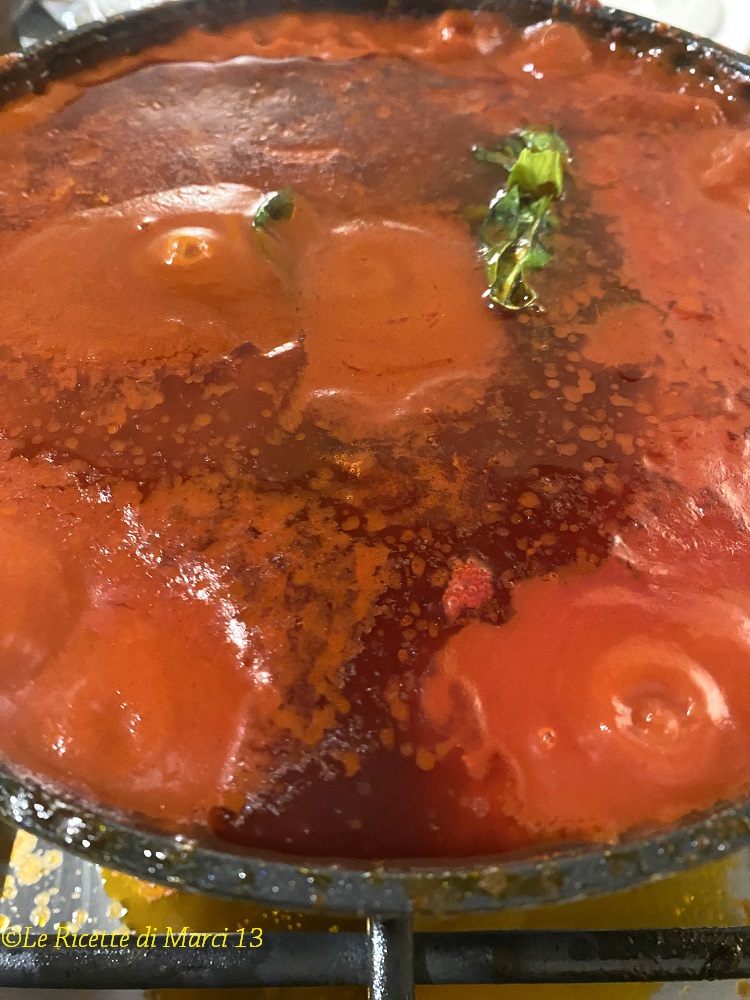
Ragù, cooked to perfection, dark red
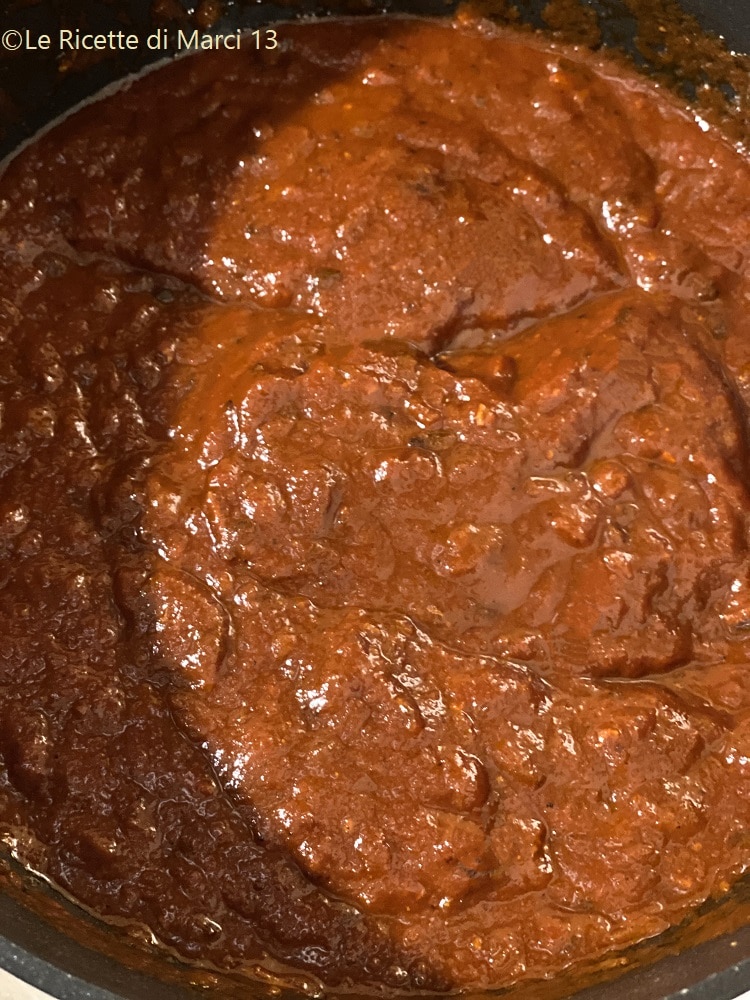
Cook the pasta al dente and season it with plenty of ragù and grated Parmesan or pecorino (optional). Or season gnocchi, lasagna, or polenta with the ragù.
NOTES AND TIPS
It is better to prepare the ragù the day before using it, letting it rest, matures and will be even more flavorful.
According to some, when the sauce starts to boil for the first time, it should cook for another 2 hours, but they must be divided between the late afternoon of the previous day and the morning of the next day. In between, there should be a night of rest in which the meat blends with the sauce.
With these quantities, you can season about 1.76 lbs of pasta. If you need abundant ragù for making Neapolitan lasagna, I recommend adding 1 more tomato passata of 24.7 oz.
Shopping Tips!!!
To cook the ragù, I used this high-edged oval casserole by Le Creuset is perfect for slow cooking, like ragù, genovese, delicious and super tender roasts, it spreads the heat evenly and retains it for a long time, ensuring excellent results. The cost is not low, but now you can find it at a great price on Amazon, ideal for a Christmas gift.
To quickly chop vegetables, grind chocolate, nuts, and much more, this sharp double-bladed mezzaluna is very convenient.
You can purchase all the items I recommend above on Amazon, at a great price, just click directly on the respective links.
FAQ (Questions and Answers)
What are the origins of Neapolitan Ragù?
This type of French preparation began to appear in Neapolitan cuisine around the XVIII century, during the reign of Ferdinand IV of Bourbon, a period when there was a great influence of French culture and fashion at court; that is why many Neapolitan dishes took their name from the “distortions” of French cooks (“monzù”), such as ragù (ragout).
What does pippiare mean?
Peppiare (from peppïà – pippijà = to gurgle, make the sound of a pipe) is an onomatopoeic voice indicating the sound similar to that produced by those who take a puff of smoke from a pipe, when the flame under the pot where the ragù is to simmer is reduced to a minimum, and the sauce is covered with the lid, leaving a small gap. The traditional Neapolitan ragù must peppiare (from peppïà – pippijà = to gurgle, make the sound of a pipe) is an onomatopoeic voice indicating that propedeutic phase of the moment near the completion of the preparation of Neapolitan ragù, when from the bottom of the pot where the meat and tomato sauce is cooking, repeatedly bubbles of air rise to the surface which at the peak of tension break producing a sound similar to that produced by those who take a puff of smoke from a pipe. The Tuscan translates rather inaccurately and superficially: simmer. The secret to making the sauce peppiare lies – in addition to keeping the flame rather low – in not completely sealing the pot’s mouth with the lid, but resting the lid on one side of the pot, while on the opposite side placing the lid not on the pot’s edge, but on the wooden spoon placed across the mouth, so that a small air circulation is created to prevent the sauce from gaining strength from the fire and prevent it from falling into the boil which would ruin everything.