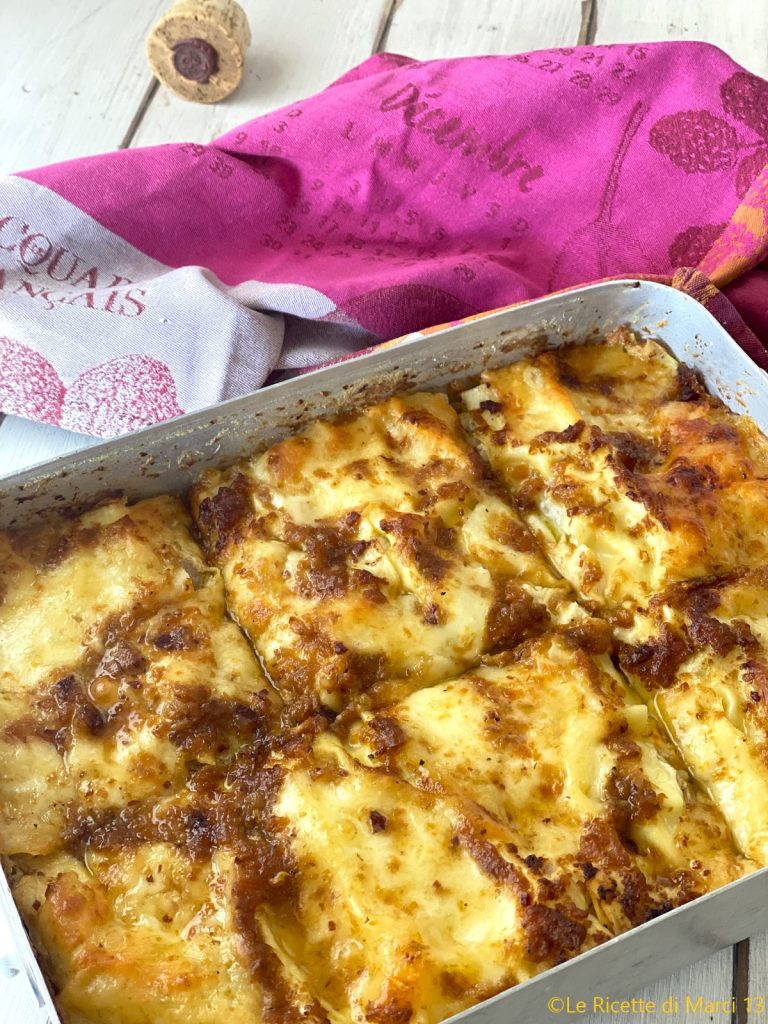
White Neapolitan lasagna is the version without the classic tomato ragù of the traditional Carnival Neapolitan lasagna.
The white lasagna is truly delicious and indulgent and lacks nothing compared to the classic red Neapolitan lasagna. It is equally tasty and rich, featuring layers of egg pasta sheets alternated with an exquisite white ragù, prepared with a mirepoix of vegetables and a mix of well-browned beef and pork, slowly cooked for two hours (unlike the red ragù which requires at least 5-6 hours of cooking).
This white meat ragù used to be called stew sauce.
The filling is not cloyed with béchamel – since the white ragù is already quite a rich condiment on its own – but is simply made of ricotta, fiordilatte, sausages, and parmesan.
It’s a family recipe tested through generations, that always garners great success and that we often prepare at home, even on special occasions and holidays like Carnival, Christmas, Easter, dinners, and birthdays.
If you love true Neapolitan cuisine, click on my Special: “DOC Neapolitan Cuisine”
If you are looking for other Carnival recipes (sweet or savory) click on my “Carnival Special“
You might also be interested in:
- Difficulty: Medium
- Cost: Medium
- Preparation time: 2 Hours 30 Minutes
- Portions: 8 people
- Cooking methods: Stove, Oven
- Cuisine: Italian
- Seasonality: All seasons, Carnival
Ingredients for White Neapolitan Lasagna with White Ragù
- 21 oz pork loin (or pork loin)
- 17.5 oz spinach (beef, we call it pigeon or buy the round)
- 10.5 oz sausages (about 2)
- 1.75 oz rolled pancetta (in pieces or raw ham)
- 12.3 oz onion
- 2 cloves garlic
- 5.6 oz carrots
- 2.1 oz celery
- 1 bouillon cube
- 1 quart water
- 7 fl oz extra virgin olive oil (quality, 3.5 fl oz for meat + 3.5 fl oz for sauté)
- 1.75 oz butter
- 7 fl oz dry white wine (3.5 fl oz for browning meat + 3.5 fl oz to finish cooking the meat)
- as needed black peppercorns (crushed)
- 1.05 oz potato starch (or cornstarch, optional)
- 8.8 oz lasagna sheets (about 12 sheets of fresh pasta)
- 17.5 oz cow's milk ricotta (Roman)
- 2 eggs (whole)
- 17.5 oz fiordilatte (refrigerated overnight)
- 2.8 oz grated Parmesan (2.5 oz for filling + 0.35 oz for the surface of the lasagna)
- 0.25 oz fine salt
- as needed black peppercorns (ground)
- 2 sausages (sliced thinly (previously cooked with the ragù))
Tools
- Bowl
- Mezzaluna sharp with double blade
- Cutting board with two built-in side trays, also oven-safe
- Cast iron pot Le Creuset
- Immersion blender Braun, powerful 1200 W + electric grinder
- Lasagna pan non-stick
Steps for White Neapolitan Lasagna with White Ragù
I should mention that you can also prepare this white ragù with: 2.2 lbs of round and 14 oz of sausage.
It’s best to buy the ricotta and fiordilatte the day before, so that they don’t release too much milk during cooking.
I used pre-cooked fresh pasta lasagna sheets, but you can make them at home too.
Chop the mix of onions, carrots, and celery with a mezzaluna (NOT with a mixer).
Place a saucepan with 1 quart of water and 1 vegetable or meat bouillon cube on the stove, to obtain a boiling broth.
Take a saucepan (preferably cast iron or earthenware) and pour in 3.5 fl oz of extra virgin olive oil, 1.75 oz of butter, 1 garlic, pepper, and the pancetta pieces, let it all flavor and then add the meat and brown it over medium-high heat for about 15 minutes. Then, deglaze with 3.5 fl oz of dry white wine and continue to brown until the wine evaporates (about 5 minutes).
At this point, remove the meat from the pot and keep it warm covered.
In the same pot where you browned the meat, add another 3.5 fl oz of extra virgin olive oil, the minced onions, carrots, and celery, and let it brown until the vegetables are reduced to a paste, it will take 15 – 20 minutes and they should take on a blond/dark color (as shown in the photo below). If you see that the vegetables tend to burn during cooking, you can add 1-2 ladles of boiling broth.
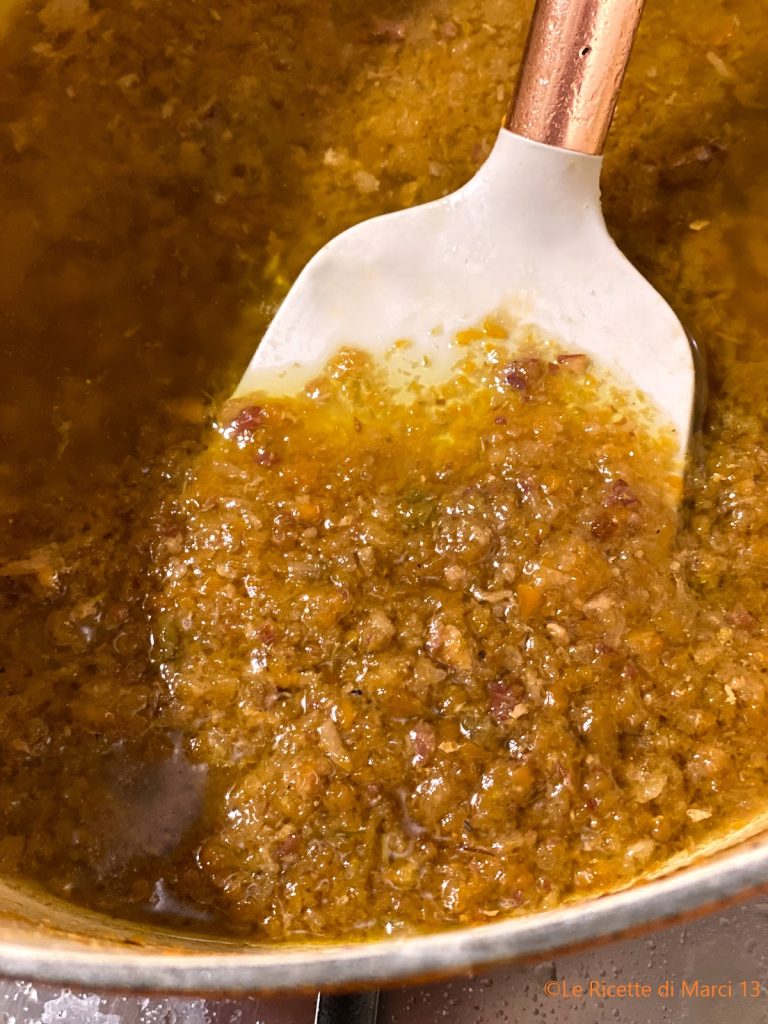
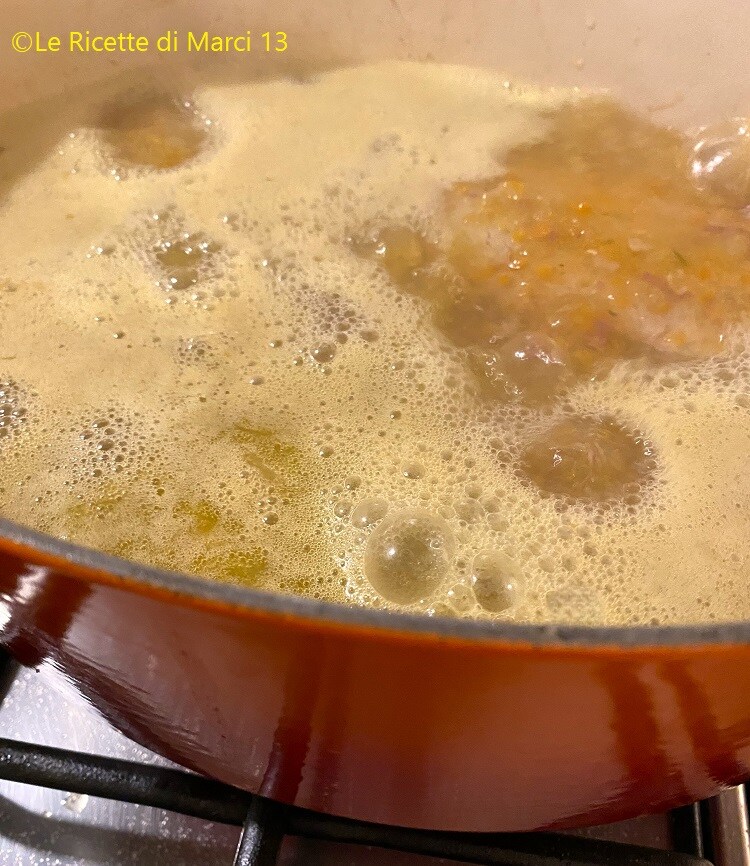
When the herbs are well cooked and browned, return the meat kept warm to the pot, let it flavor in the vegetable mince for about 5 minutes with another 3.5 fl oz of dry white wine and 1.05 oz of potato starch (optional, see Notes and Tips below), then pour all the boiling broth over the meat, which should be covered to the edge, add the pepper and salt (be careful not to add too much as the bouillon cube and pancetta are salty), let it come back to a boil and then cover the pot with its lid (leaving a crack open for air circulation).
Cook the white ragù on low heat for about 2 hours, until all the liquid is absorbed.
At the end of the 2 hours, you will have a thick and delicious stew sauce, which you will use to season the lasagna. I blended the sauce with an immersion blender, but it’s optional.
Put the meat aside again, take (only) the sausages and cut them into thin slices, you will need them for the lasagna filling.
With the rest of the very tender meat, you will get a tasty second dish.
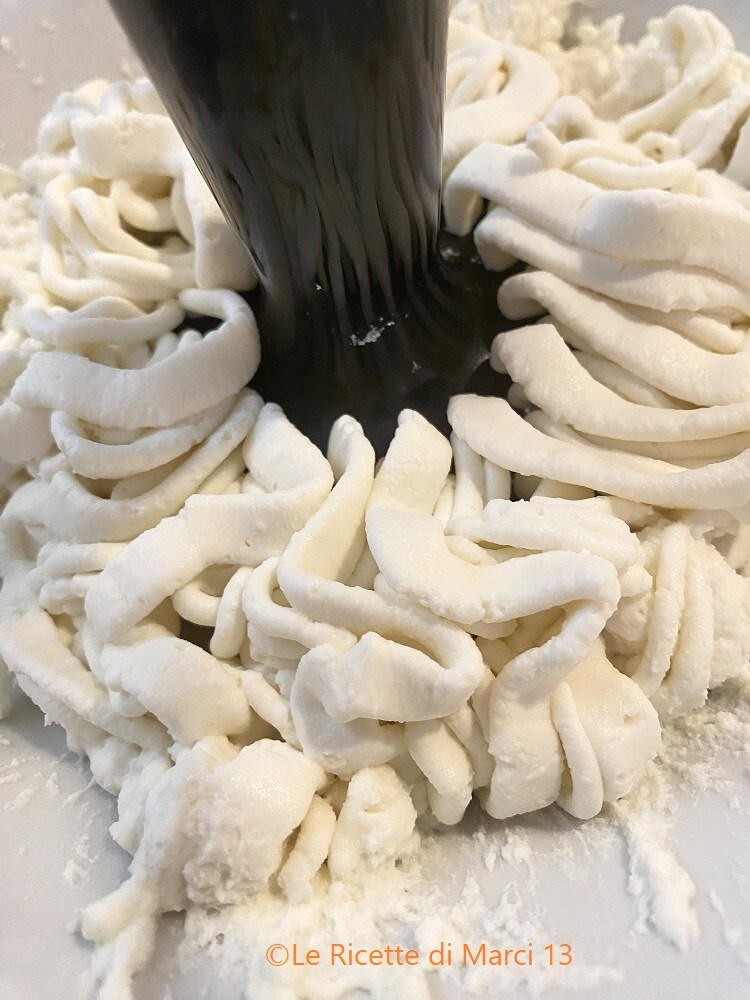
Pass the ricotta through a sieve (I used the handy electric purée accessory from Braun, see Purchase Tips at the end of the recipe), gather it in a bowl, and add 2 eggs, 2.5 oz of grated Parmesan, 0.25 oz of salt, and pepper.
Cut the fiordilatte into thin slices.
Butter a rectangular lasagna pan about 12×8.6 inches, 2.36 inches high.
Pour a ladle of boiling sauce into the buttered pan and spread it over the entire surface, then cover the sauce with a first layer of lasagna sheets, spread a layer of ricotta on top and a few slices of sausage (previously cooked in the white ragù) and here and there slices of fiordilatte, finally sprinkle a few tablespoons of sauce.
Make a second layer of lasagna and season it like the previous one.
The last layer (I did 4 layers) should be only lasagna, sprinkle the lasagna with 0.35 oz of grated Parmesan and on the Parmesan arrange very thin slices of fiordilatte over the entire surface and finally, spread the remaining stew sauce over all the slices of fiordilatte.
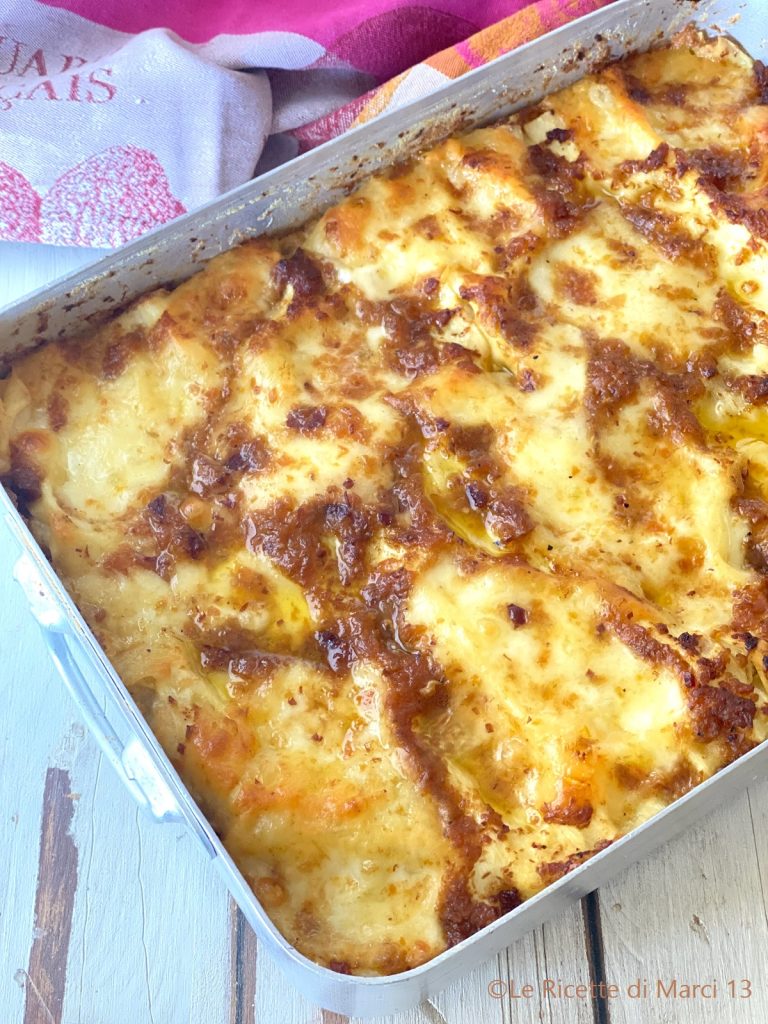
Place the pan in a pre-heated static oven at 340°F for about 40 minutes, it should stew slowly to not overly color the surface and cook well inside.
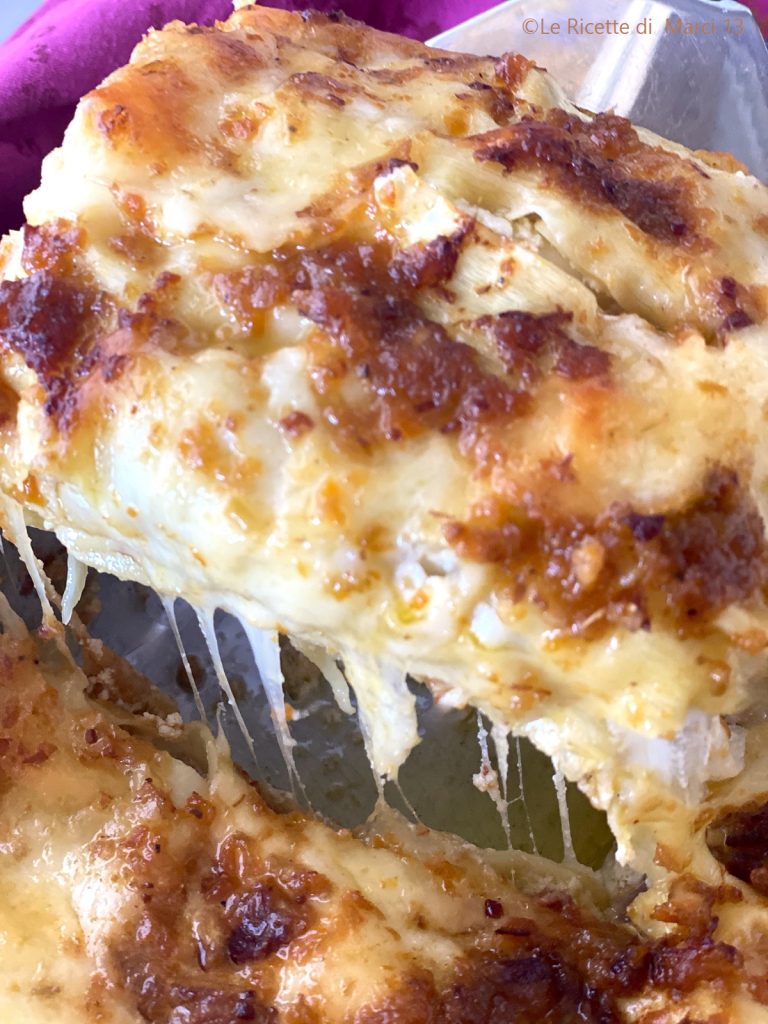
Once cooked, let it rest for 10 minutes before cutting it into slices.
Notes and Tips
The best way to prepare a white ragù (or stew sauce) is the one used in this recipe, you do NOT brown meat and herbs together, BUT first you brown the meat to seal in the juices and keep it tender, then you wilt the vegetables separately and afterward reunite meat and vegetables for a slow cooking in the chosen liquid (in this case boiling broth).
To obtain an even creamier white ragù – before adding all the broth – you can pour into the sauce: about 1.05 oz of cornstarch or potato starch.
Shopping Tips!!!
To chop the mix of vegetables I used this handy cutting board with built-in side trays (one for the sliced food, the other for scraps) and this super sharp mezzaluna with double blade.
Perfect for long cooking, the Le Creuset cast iron pot, prevents food from sticking to the bottom of the pot, but if you are looking for a more economical reliable cast iron pot I recommend this ultra-resistant cast iron cocotte.
I passed the ricotta in a few minutes with the practical electric food blender Braun.
Great for cooking the lasagna, this non-stick lasagna pan and scratch-resistant.
You can find all the recommended items above on Amazon at a great price, just click the respective links above.
You can find all the recommended items above on Amazon at a great price, just click the respective links above.
FAQ (Questions and Answers)
What is white ragù (or stew sauce)?
Stew cooking is a technique with which many dishes of the Italian culinary tradition are prepared, a type of long and delicate cooking.
Stew cooking is a cooking method where the food is immersed in a variably flavored aqueous liquid.
It is a mixed procedure that combines two techniques: roasting and boiling. In practice, the food (meat, fish, vegetables) is browned over high heat in a fat (butter or oil) and then covered with an aqueous liquid and cooked for a long time in the oven or in a pot.
With the stew cooking technique, you can obtain a delicious white ragù, which, as far as meat is concerned, is particularly suitable for cuts rich in connective tissue that needs to be softened and dissolved, such as the chuck, neck, scoter, round, or breast. Cooking meat in a stew allows the collagen that holds the fibers together to dissolve and, at the same time, prevents the meat from becoming too tough without losing too many juices. We thus obtain tender and flavorful meat, thanks also to the addition of wine and broth.
Specifically for stewed meats, the cooking temperature should be above 167°F to dissolve the collagen, but below 185°F, to prevent the meat from cooking quickly and drying out too much.