
The pasqualina is one of those recipes that tells a story even before being tasted. It is a dish that smells like home, of waiting, of hands working together to prepare something special for Easter. Born in Liguria as a rich and scenic savory pie, the traditional pasqualina is a braid of very thin layers, chard, ricotta and whole eggs that, when cooked, become a little jewel embedded in the filling. A recipe that, over the centuries, has become a symbol of celebration, sharing and that simple but wise cooking that knows how to turn humble ingredients into a masterpiece.
Its history dates back to the 16th century, when it was prepared with as many as thirty-three layers, one for each year of Christ: a symbolic number that emphasized the deep connection between this dish and the Easter tradition. Today the layers are fewer, but the meaning remains intact. The pasqualina continues to be a ritual, a gesture repeated every year that carries the taste of memory.
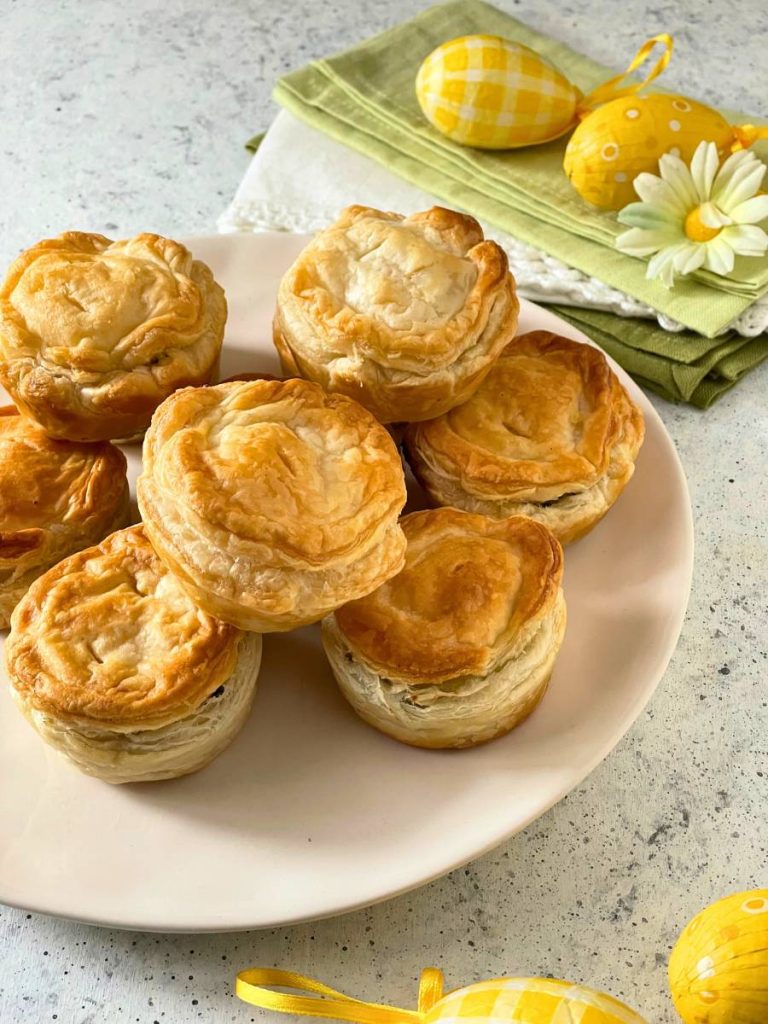
Because it is so rich in history and meaning, in recent years the pasqualina has begun to live new interpretations, more modern and versatile, without losing its identity. One of these is the mini version, designed for those who like to bring something elegant, practical and perfect for buffets, appetizers or outdoor lunches to the table. The mini pasqualine keep all the flavor of the original recipe, but in a more manageable format, ideal for serving at convivial occasions or as finger food during the Easter lunch.
The choice to transform a great classic into small single portions comes from the need to make the recipe more flexible and suitable for today’s rhythms. The mini pasqualine are easy to portion, present beautifully and allow the flavors to remain intact without having to cut the pie at the time of service. In addition, they are perfect for those who like to prepare in advance: they keep well, are easy to transport and can be enjoyed hot or at room temperature.
In these small savory pies we find everything that makes the pasqualina special: the crispness of the pastry, the softness of the filling, the aroma of spring vegetables and that festive feeling that only traditional dishes can give. A recipe that combines past and present, tradition and creativity, in a format that wins at first glance.
Here are some recipes perfect for Easter lunch or a picnic on Easter Monday.
- Difficulty: Easy
- Cost: Affordable
- Preparation time: 20 Minutes
- Cooking time: 25 Minutes
- Portions: 12 servings
- Cooking methods: Oven
- Cuisine: Italian
- Seasonality: Spring
- Energy 299.66 (Kcal)
- Carbohydrates 19.04 (g) of which sugars 0.40 (g)
- Proteins 8.83 (g)
- Fat 21.13 (g) of which saturated 4.88 (g)of which unsaturated 14.10 (g)
- Fibers 0.95 (g)
- Sodium 210.10 (mg)
Indicative values for a portion of 90 g processed in an automated way starting from the nutritional information available on the CREA* and FoodData Central** databases. It is not food and / or nutritional advice.
* CREATES Food and Nutrition Research Center: https://www.crea.gov.it/alimenti-e-nutrizione https://www.alimentinutrizione.it ** U.S. Department of Agriculture, Agricultural Research Service. FoodData Central, 2019. https://fdc.nal.usda.gov
Ingredients for the mini pasqualina
- 2 rolls puff pastry
- 7 oz spinach (cooked)
- 2/3 cup ricotta (sheep's milk blend)
- 4 eggs
- 1/2 cup Parmigiano Reggiano PDO
- 1 egg
- to taste extra virgin olive oil
- to taste salt
Tools
- Muffin pan
- Egg slicer
Preparation of the mini pasqualina
Chop the spinach and sauté them in a pan with a drizzle of extra virgin olive oil and a pinch of salt. This will flavor them and make them drier. Transfer them to a bowl and let them cool.
Hard-boil the eggs and, once ready, peel them and slice them. I use the appropriate tool for this.
Add the ricotta, the Parmigiano Reggiano and the egg to the bowl with the spinach. Mix thoroughly.
Unroll the puff pastry and, using a round cutter, cut 12 discs the diameter of your muffin tin. I used a 4-inch cutter. Lightly butter the molds and line the cavities with the pastry discs.
Add a tablespoon of the spinach and ricotta mixture, then place a slice of hard-boiled egg on top.
Using a slightly smaller cutter, cut twelve small discs that will serve as lids. Close the pasqualine with the pastry lids, sealing the edges.
Bake the pasqualine in a preheated oven at 338°F for about 25 minutes; they should be well browned.
Remove them from the oven as soon as they are done and let them cool slightly before serving. They are also great at room temperature.
Follow me on social media
my page Facebook my profile Instagram my page Pinterest
FAQ (Questions and Answers)
What are the traditional Italian Easter dishes?
Easter cuisine in Italy varies greatly from region to region, but some dishes have become true symbols of the celebration. Among these stand out the torta pasqualina from Liguria, lamb in various preparations, the pizza di Pasqua from Umbria and the Marches, the pastiera napoletana and the colomba. Each recipe tells a piece of local history and celebrates the arrival of spring with simple ingredients and ancient rituals.
Why do many countries prepare savory pies or special breads for Easter?
Savory pies, braided breads and leavened sweets are connected to symbols of rebirth and abundance. In Italy we find the pasqualina and the cheese pie; in Greece the tsoureki, a sweet braided bread; in Spain the mona de Pascua; in Eastern Europe decorated breads with colored eggs. These preparations celebrate the return of light and life after winter, combining religious tradition and peasant culture.
What are the most common Easter dishes around the world?
Each country has its specialties: in the United States the Easter Ham (glazed ham) is popular; in the United Kingdom Hot Cross Buns are served; in Greece roast lamb and red eggs; in France agneau pascal and the gâteau de Pâques; in Argentina the empanadas de vigilia; in Germany the Osterzopf, a sweet braid. Despite the differences, many dishes share symbolic ingredients such as eggs, spring herbs and leavened goods, which evoke rebirth and conviviality.
