
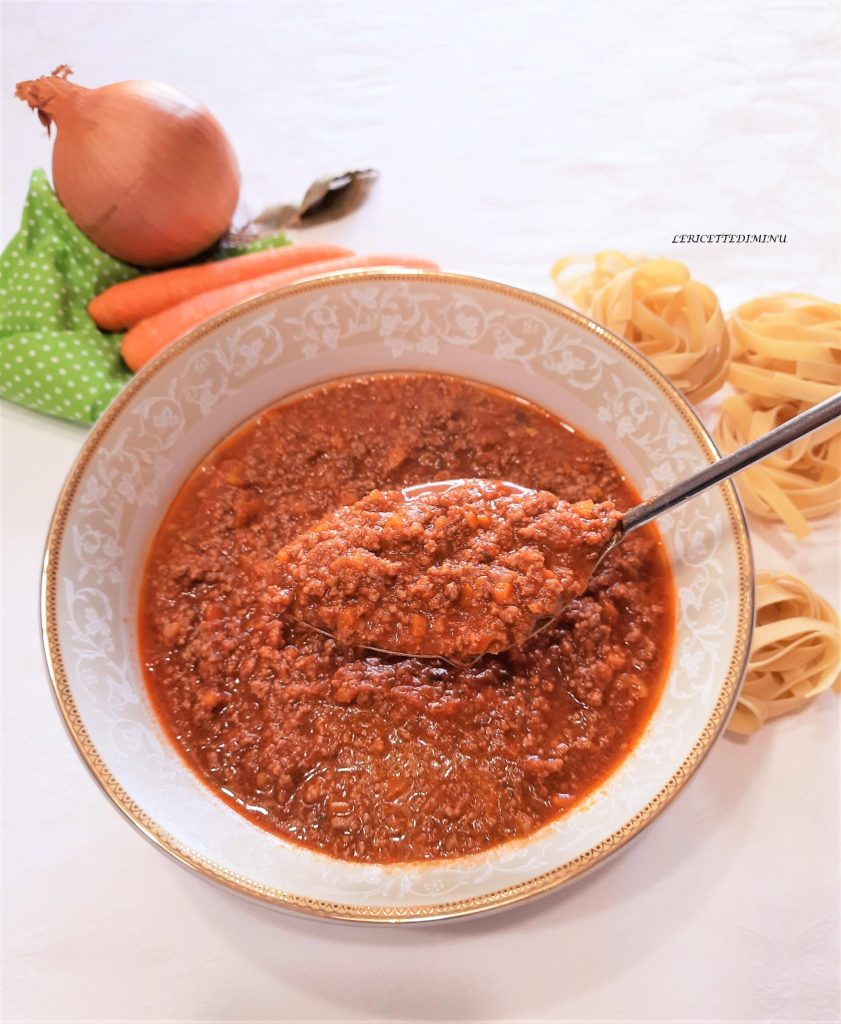
Bolognese sauce is the quintessential ragù, the one everyone loves and expects to eat as soon as they hear about ragù.
Alongside the classic recipe, which usually includes pancetta, I more often use the version of Bolognese sauce without pancetta that has only beef among its ingredients.
This one, to be suitable for long-cooking sauces, should not be too lean.
By cooking it slowly, you get a hearty and tasty ragù that can wonderfully dress tagliatelle, lasagna, or cannelloni, but can also richly flavor the classic dry pasta for daily use.
Try it, and you’ll see you’ll fall in love with it.
- Difficulty: Easy
- Cost: Economical
- Preparation time: 10 Minutes
- Portions: 4
- Cooking methods: Stovetop
- Cuisine: Italian
- Energy 511.66 (Kcal)
- Carbohydrates 14.30 (g) of which sugars 4.15 (g)
- Proteins 34.42 (g)
- Fat 32.88 (g) of which saturated 10.22 (g)of which unsaturated 10.44 (g)
- Fibers 2.59 (g)
- Sodium 296.46 (mg)
Indicative values for a portion of 262 g processed in an automated way starting from the nutritional information available on the CREA* and FoodData Central** databases. It is not food and / or nutritional advice.
* CREATES Food and Nutrition Research Center: https://www.crea.gov.it/alimenti-e-nutrizione https://www.alimentinutrizione.it ** U.S. Department of Agriculture, Agricultural Research Service. FoodData Central, 2019. https://fdc.nal.usda.gov
Ingredients
- 1.1 lbs ground beef (not too lean)
- 1.7 cups tomato puree
- 1 cup carrots
- 1/2 cup celery
- 2/3 cup onions (dry golden)
- 1 tsp tomato paste (double)
- 2/3 cup wine (dry white or red)
- 2 cloves
- 1 leaf bay leaf
- to taste extra virgin olive oil
- to taste salt
- to taste black pepper (ground)
- 1/2 tbsp sugar (optional)
Tools
- Pan large
- Kitchen Knife
- Cutting Board
Preparation
To prepare Bolognese sauce without pancetta, start by cleaning onions, carrots, and celery, removing the filaments from the latter. Then finely chop them on a cutting board.
In a large pan over moderate heat, sauté the vegetables in about 5 tablespoons of oil.
Once they have softened, add the beef, breaking it up with a spoon, and let it cook off all its juices for at least fifteen minutes over high heat.
Deglaze with wine and let it completely evaporate.
Then add the tomato puree and an equal amount of water, add a heaping teaspoon of tomato paste dissolved in hot water, two cloves, and a large bay leaf.
Stir and over high heat, bring to a boil with the lid on.
At this point, moderately salt. Since the paste already has its own saltiness, it’s better to limit the salt a bit at this stage, and then, when near the end of cooking, we can taste the ragù and add more if needed.
Move the pan to the smallest burner and keep the flame at a minimum, keeping the lid slightly open to allow for steam to escape.
Cook for at least two and a half hours, stirring regularly.
If necessary, add more water, preferably hot, but little by little to avoid a watery final result.
Towards the end of cooking, if you notice that the sauce used in the ragù has given it a sour taste, correct with half a tablespoon of sugar.
Alternatively, as traditionally done, you can add about half a glass of milk five minutes before turning off the heat.The Bolognese sauce without pancetta is now ready.
Storage
In the fridge in an airtight container for a couple of days. The ragù can be frozen if only fresh ingredients were used.
In the fridge in an airtight container for a couple of days. The ragù can be frozen if only fresh ingredients were used.
Here is a selection of excellent products useful in the kitchen. Many of these have been personally bought and tested by me. The list will be constantly updated.
To view the recommended products click here.
To view the recommended products click here.
