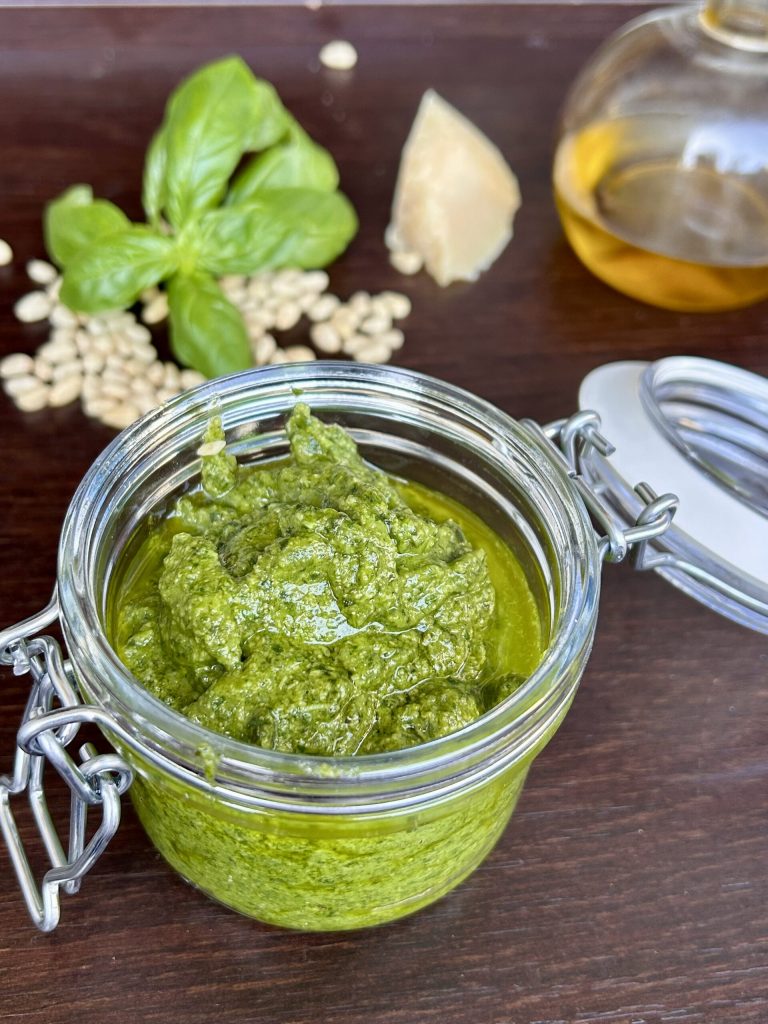
The Genovese pesto, is a typical Ligurian dish made with fresh ingredients, without cooking. The typical ingredients of Genovese pesto are basil, olive oil, garlic, Parmesan, pecorino, and salt. It is a very quick recipe to prepare that is best done by hand using a mortar to crush all the ingredients, but being very practical and having to follow the fast pace of today’s life, I assure you that you can also prepare it using a food processor. It will still be a very genuine pesto with the unique flavors and aromas of basil, garlic, and good Italian cheese. For family reasons I prepare pesto only with Parmesan but the original recipe also includes a part of pecorino, therefore you can use like me only Parmesan or replace a third of the weight with pecorino.
The pesto you prepare at home keeps well in the refrigerator for a couple of days if stored in glass jars with lids, but you can easily freeze the excess and consume it as needed. This allows you to prepare a small stash to consume in the colder months when it’s difficult to find good fresh basil.
For quick first courses that are useful to bring to work, I also remind you
- Difficulty: Very Easy
- Cost: Medium
- Preparation time: 10 Minutes
- Portions: 1 package
- Cooking methods: No Cooking
- Cuisine: Italian
- Seasonality: Spring, Summer, and Autumn
- Energy 750.33 (Kcal)
- Carbohydrates 5.24 (g) of which sugars 0.91 (g)
- Proteins 20.74 (g)
- Fat 75.52 (g) of which saturated 17.47 (g)of which unsaturated 15.88 (g)
- Fibers 1.61 (g)
- Sodium 690.62 (mg)
Indicative values for a portion of 175 g processed in an automated way starting from the nutritional information available on the CREA* and FoodData Central** databases. It is not food and / or nutritional advice.
* CREATES Food and Nutrition Research Center: https://www.crea.gov.it/alimenti-e-nutrizione https://www.alimentinutrizione.it ** U.S. Department of Agriculture, Agricultural Research Service. FoodData Central, 2019. https://fdc.nal.usda.gov
Ingredients
- 1.76 oz basil (fresh leaves)
- 1.76 oz extra virgin olive oil
- 1.76 oz Parmesan cheese
- 2 cloves garlic (medium)
- 0.71 oz pine nuts
- to taste salt
Tools
I prepare the Genovese pesto using an immersion blender, so I recommend a good blender with a large glass
- 1 Blender
Preparation
The preparation of Genovese pesto takes just a few minutes, the time to put the pasta water on the stove, and it will be ready when the pasta is cooked.
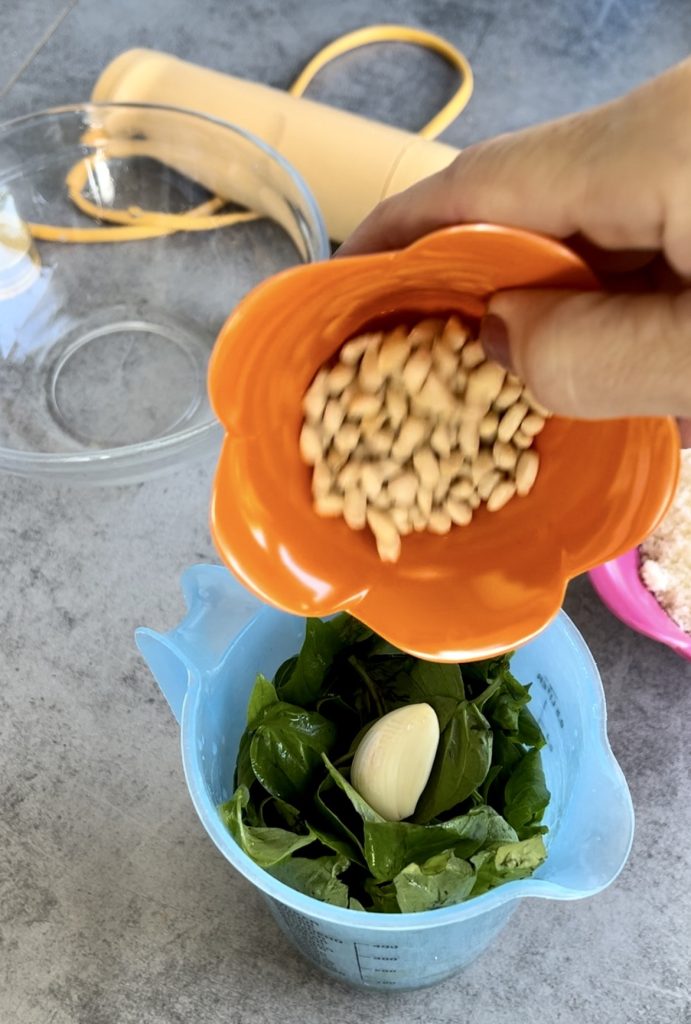
Wash the basil leaves very well, I soak them for a few minutes in water and baking soda, then rinse them very well. Put all the ingredients together in the graduated glass of the blender.
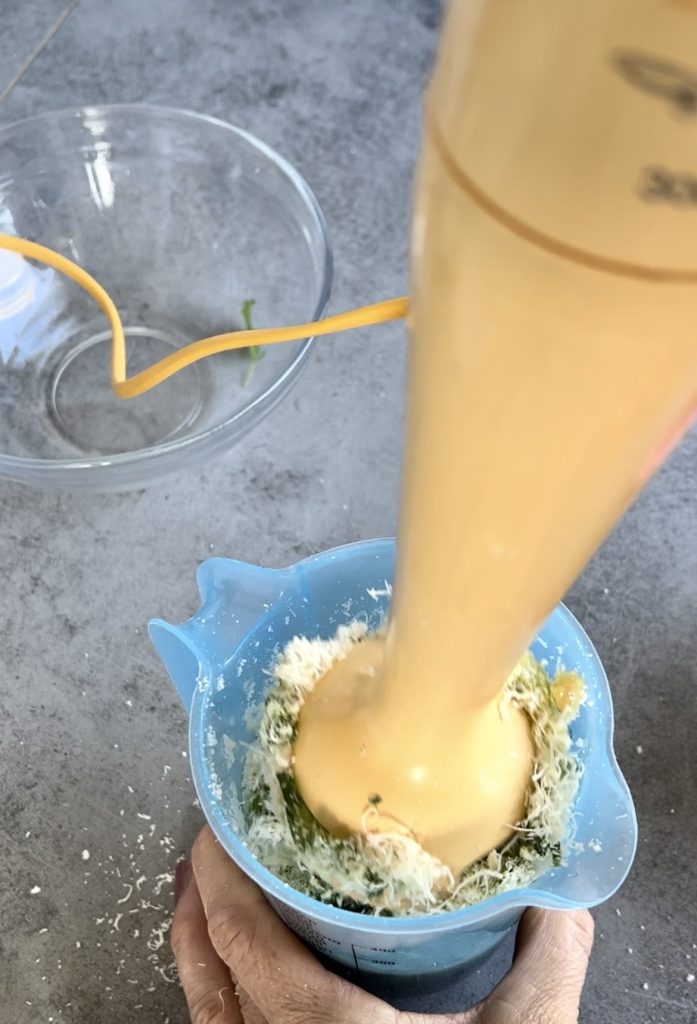
Turn on the blender to blend all the ingredients, making movements from bottom to top, and you will see an excellent cream forming in about a minute. Blend according to your taste; I like it a bit grainy, but if you prefer a fine cream, continue blending until you reach the desired consistency.
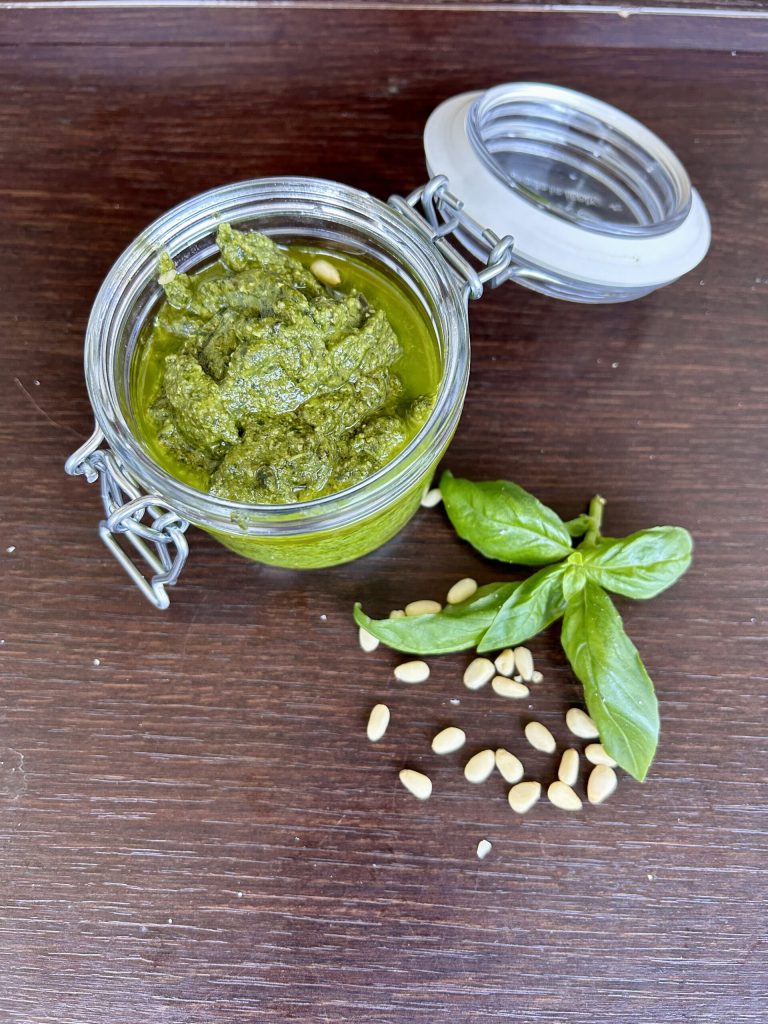
Your pesto is ready to be enjoyed; it is excellent for dressing pasta, enriching bruschettas, pizza, rice salads, and anything your imagination suggests.
NOTES
You can consume the pesto immediately after preparation or store it in the refrigerator for a couple of days, always closed. Using this recipe, perhaps due to the washing with baking soda, I have never seen the pesto oxidize, and the pasta always remains a nice bright green.
This recipe contains one or more affiliate links.
If you liked the recipe or have any questions, do not hesitate to comment here or on social media Facebook, Pinterest, Instagram and Twitter.
Frequently Asked Questions
Can I use other fresh fruit instead of pine nuts?
You can certainly replace pine nuts with walnuts for a very delicate flavor, but you can also use almonds for a more pronounced taste.
Why don’t you use pecorino?
I don’t use pecorino in this recipe because my family doesn’t like it very much, but you can easily replace 20g of Parmesan with 20g of pecorino in the recipe.