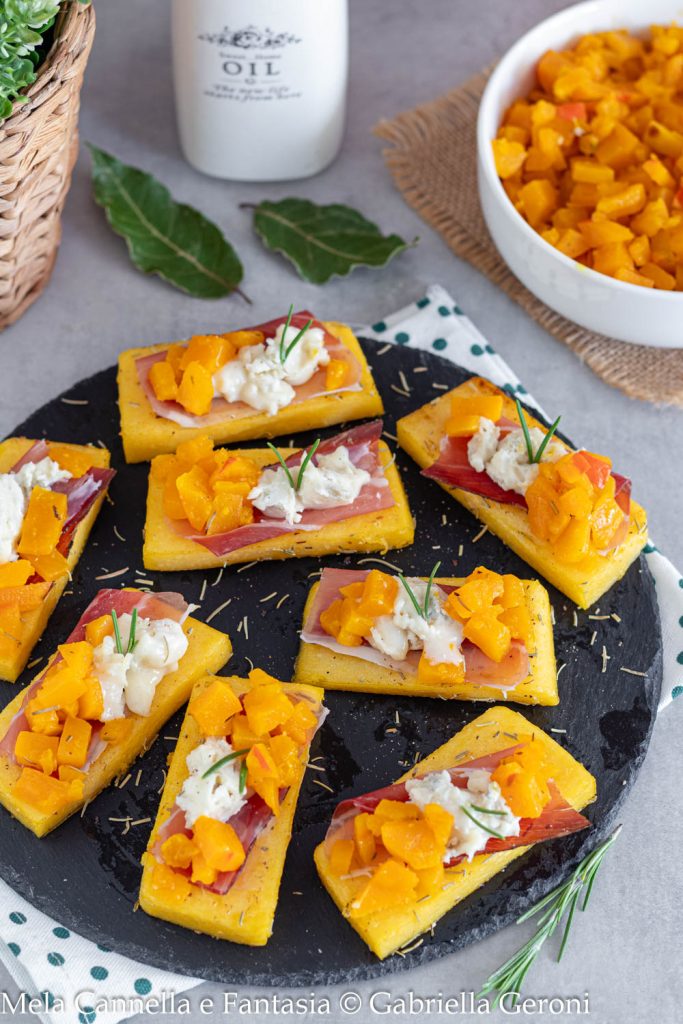
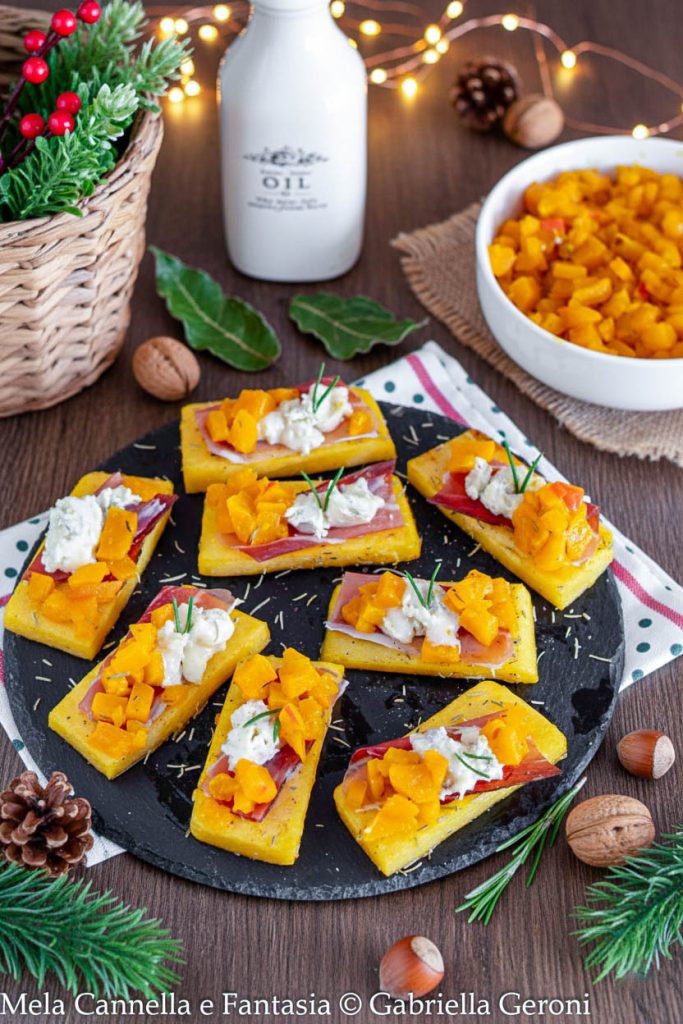
Today I’m bringing you a very simple idea for a truly delicious autumn appetizer: polenta bruschetta with pumpkin, speck, and gorgonzola 🎃🧀🥓
If you’ve been following me for a while, you already know how much I love using polenta in a “crostino” style: practical, versatile, and perfect for creating small bites that disappear in an instant.
Polenta is one of those ingredients that tell the story of the most authentic Italian cuisine: simple, economical, nutritious, and incredibly versatile.
It is made with corn flour, naturally gluten-free, so it’s perfect for those who are celiac or gluten intolerant 🌽
Some time ago, I made these polenta crostini with broccoli, anchovies, and salted ricotta. They were so appreciated that I decided to try a new version, even richer and more fragrant.
The polenta base was grilled to form a truly tasty crust on the surface.
On top, a dice of pan-fried pumpkin, a slice of speck, and some gorgonzola for the creamy note.
The final result is a truly simple dish, made with ingredients that pair perfectly, that smells like autumn and captivates you at the first bite!
Gratinated polenta is a smart appetizer you can prepare in advance, store in the fridge, and fill at the last minute.
Polenta is often overlooked or underestimated, but it has quite a few merits.
✔ Economical and sustainable
✔ Easy to prepare
✔ Highly versatile
✔ Perfect for vegetarian or lactose-free dishes (just choose the right toppings)
✔ Naturally gluten-free (so safe for celiacs and intolerants).
Moreover, it is highly digestible, does not weigh you down, and is perfect even for those with digestion problems.
At home, besides loving it in its tasty version, I prepare it Abruzzese style, with sausage and pork ribs. It is also excellent baked with ground meat and mozzarella.
Polenta crostoni are ideal for dinners with friends, buffets, aperitifs, or when you crave something delicious but simple to make.
I prepare it every year for the Christmas holidays, and every time I enjoy giving it a different shape with various molds (for example, a star to stay on theme)!
Try it also with cheese, turnip tops, and anchovies, it’s too tasty!
👉 I recommend reading the article all the way through, you will find the recipe with all my useful tips, frequently asked questions, some very intriguing variants to try, and wine pairing suggestions 🍽️🍁✨
But first, take a look at these recipes:
- Cost: Medium
- Rest time: 1 Hour
- Portions: about 12 pieces
- Cooking methods: Stove, Grill
- Cuisine: Italian
- Seasonality: Winter, Autumn
Ingredients
- 1 l water
- 250 g cornmeal (or instant polenta flour. Or if you prefer, you can use directly 300 g of pre-cooked polenta that you only need to slice and grill)
- 1 pinch salt
- 300 g pumpkin (for this recipe, Delica or Mantovana pumpkin, which are dry, compact, and flavorful, are more suitable.)
- 1 clove garlic (only if you like)
- 1 sprig rosemary
- extra virgin olive oil
- salt
- pepper
- speck slices (half a slice for each crostino)
- gorgonzola (about 100 g)
Tools
- Pan
- Cutting board
- Knife
- Non-stick grill
- Ladle
Steps
The only somewhat annoying thing you have to do to make these polenta bruschetta is clean the pumpkin!
However, if you use Hokkaido or Delica, you don’t even need to remove the skin because they are edible.
You only need to wash the skin thoroughly under water and cut the pumpkin into small cubes so they cook quickly!
At this point, heat a pan with extra virgin olive oil, add a clove of garlic and a sprig of rosemary.
Add the pumpkin, season lightly, cover with a lid, and cook on medium heat for about 10 minutes.
If you’ve cut the pumpkin into small cubes, the cooking will be really quick, also helped by the steam created inside the pan thanks to the use of the lid.
When it becomes soft, turn off the heat, set aside, and proceed to grill the polenta.
Take the already cooked polenta block, slice it to your preferred thickness, and grill it on a tray over medium heat.
When it’s nicely golden, place it on a serving plate and garnish. First, a slice of speck, then the pumpkin, and a generous teaspoon of gorgonzola.
A drizzle of extra virgin olive oil, a sprinkle of pepper if you like, and the polenta crostini with pumpkin, speck, and gorgonzola are ready to be enjoyed!
Bring the salted water to a boil and sprinkle in the cornmeal. Stir with a whisk to avoid lumps.
Cook for the time indicated on the package until the polenta becomes thick and creamy (or read the timings at the end).Then spread it on a lightly dampened tray or one lined with baking paper to a thickness of about 0.6-0.8 inches.
Let it cool completely, then cut the crostini into the shape you like and garnish as described above.
If you prefer to use cornmeal instead of the ready-made block and want to organize in advance, follow these tips:
Cooked and well-cooled polenta can be stored in the fridge for 2-3 days without losing consistency.
Spread it already in the thickness you will use for the crostini and let it cool completely.
Cover it with cling film or seal it in an airtight container.You can also cut it into crostini in advance, so it will be ready to toast or garnish at the last minute.
Cooked polenta can also be frozen (better if already cut into crostini) and lasts up to 2 months. When you’re ready to use, simply toast it directly from frozen.
I hope you’re tempted to try these polenta bruschetta! Let me know in the comments and make sure to visit me again soon! 🌾🍛👩🍳😍🥰
Article protected by copyright © – Gabriella Geroni © All Rights Reserved
⭐ TIPS AND VARIANTS
Want to avoid gorgonzola? Try Taleggio, Stracchino, Brie, or Crescenza, or soft goat cheeses.
Prefer a lighter version? Replace speck with bresaola or omit it altogether.
Pumpkin too watery? Increase the heat for 1 minute at the end of cooking to dry it out.
Add a crunchy touch: chopped nuts or toasted pumpkin seeds.
Want to avoid gorgonzola? Try Taleggio, Stracchino, Brie, or Crescenza, or soft goat cheeses.
Prefer a lighter version? Replace speck with bresaola or omit it altogether.
Pumpkin too watery? Increase the heat for 1 minute at the end of cooking to dry it out.
Add a crunchy touch: chopped nuts or toasted pumpkin seeds.
🌱 VEGETARIAN
1)Pumpkin, gorgonzola, and walnuts
2)Taleggio and pumpkin or pumpkin and sautéed mushrooms (porcini or champignon)
🎄 GOURMET VERSIONS (perfect for holidays)
Pumpkin cream, soft goat cheese, and honey caramelized nuts
Sautéed pumpkin, San Daniele prosciutto, and toasted almond flakes
Pumpkin velouté and seared shrimp
🔥 LIGHT
Use whole-grain polenta; replace gorgonzola with robiola or ricotta. Omit speck and add crispy chickpeas or cabbage salad.
FAQ (Questions and Answers)
If I cook the pumpkin in advance, how long does it last in the fridge?
Cooked pumpkin lasts 2-3 days in the fridge, well-sealed in an airtight container, and you can also freeze it; it lasts up to 3 months.
If you want to use it to make these polenta crostini or some tasty bruschettas, reheat it for 1 minute in a pan to restore its aroma and texture.Can I cook the pumpkin in an air fryer instead of a pan?
Yes! The air fryer is an excellent alternative to the pan or oven.
Cut the pumpkin into cubes, season with oil, salt, pepper, garlic, and rosemary, then cook at 356°F for 12-15 minutes, stirring halfway through. The cubes will be golden, tasty, and perfect for topping the crostini.Can I gratin pre-cooked polenta in an air fryer?
Absolutely, here’s how:
Cut the cold polenta into slices or cubes, brush lightly with oil (or spray).
Cook in an air fryer at 374°F for 10-15 minutes, turning halfway through. It will be crunchy on the outside and soft on the inside.Can I prepare the crostini in advance?
Yes! Toast the base, cook the pumpkin, and store everything separately. Assemble before serving.
How do I prevent the polenta from breaking when I cut it?
It needs to be completely cold. If necessary, put it in the fridge for 1 hour or even overnight.
Which cornmeal is most suitable for making crostini?
🌽 Bramata cornmeal (the most recommended)
It has a coarse grain, ideal for achieving a firm, compact polenta that’s easy to cut.
Perfect for crostini because it doesn’t crumble during cutting, withstands grilling/oven/air fryer very well, and maintains a rustic texture that pairs well with flavorful toppings.
👉 It’s the TOP choice if you want crostini with a crispy crust and a substantial interior.
🌽 Fioretto cornmeal (fine grain)
It works, but produces a softer polenta.
For crostini, it works if you firm it up well and let it rest in the fridge for at least 4-6 hours.
Result: more delicate and less rustic crostini.
🌽 Taragna flour
It’s a mix of cornmeal and buckwheat flour, with a more intense and aromatic flavor.
For crostini, it’s perfect when you want a more gourmet result, with slightly nutty notes,
a darker, very scenic color.
Compared to bramata, it’s slightly softer, so it needs to cool very well before cutting.
💡 In short:
The best for crunchy and perfect crostini: bramata cornmeal
For softer crostini: fioretto
For rustic and gourmet versions: taragnaCan I use instant cornmeal? Does the result change?
Yes, you can use instant cornmeal and still get excellent crostini. The main difference is in the consistency and flavor:
Instant polenta cooks in a few minutes, remains slightly softer, and tends to cool faster.
Traditional polenta (bramata or fioretto) has a more rustic flavor, a firmer consistency, and better withstands grilling or oven/air fryer baking.
For appetizers like these crostini, both versions are fine. If you want a more rustic and substantial result, choose traditional flour; if you need a quick preparation, the instant version is perfect.
Just be sure to let it cool well in the fridge before cutting to avoid crumbling.How to avoid lumps?
Lumps are among the most common problems when making polenta, especially with traditional flour. Here are the tricks that really work:
bring the water to a boil, then create a small vortex by stirring vigorously and add the flour slowly. Stir immediately for 1-2 minutes: this is the decisive moment to dissolve any lumps.
If the flour is traditional, continue stirring regularly during cooking. If lumps form, don’t despair; briefly use an immersion blender, and the polenta will become smooth again.How thick should the polenta be for crostini and appetizers?
The thickness is subjective and depends greatly on personal taste; if you prefer it lower or higher, you will have to adjust accordingly. I would say that between 0.6 and 0.8 inches is a great solution.
How to reheat polenta without drying it out?
If the polenta has been left over or you have prepared the base in advance, you can reheat it without risking it becoming hard or rubbery. Here are the best methods:
🔥 In the oven (ideal for already cut crostini)
place the slices on a tray and brush with very little oil or butter. Heat at 356°F for 10-12 minutes.
Result: soft inside, slightly crispy outside.
🔥 Pan
use a non-stick pan and heat it over medium heat with a drizzle of oil; reheat 2-3 minutes per side.
Perfect if you want a more pronounced crust.
🔥 Air fryer
place it in the basket, spray a little oil, and set at 356°F for about 8 minutes.
Great for achieving crispiness without over-drying.
💧 Trick for retaining moisture
If the polenta is particularly dry, spray a few drops of water or cover with a sheet of aluminum foil during the first few minutes: this helps to rehydrate it slightly without ruining the texture.How much water is needed to make polenta?
The amount of water depends on the type of cornmeal you choose, but in general, you can follow these proportions:
🌾Traditional polenta (bramata or fioretto):
👉 1 part flour + 4 parts water
(e.g., 250 g flour → 1 liter water; 400 g flour → 1.6 liters water)
🌾Instant:
👉 1 part flour + 3 parts water (because it absorbs less and is finer)
(250 g flour → 750 ml water; 400 g flour → 1.2 liters water)
🌾Very soft polenta (for very creamy recipes):
👉 up to 1 part flour + 5 parts water
(250 g flour → 1.25 liters water; 400 g flour → 2 liters water)
🌾Firmer (perfect for cutting and grilling):
👉 1 part flour + 3.5 parts water
(250 g flour → 875 ml water; 400 g flour → 1.4 liters water)
These proportions are a great starting point, but you can always adjust the water based on the final consistency you desire.
Almost all packages of cornmeal, both instant and traditional, indicate the recommended proportions directly on the label.
Keep in mind that manufacturers usually provide a standard recipe, often for achieving a soft polenta. If you need to prepare crostini, polenta for cutting, or set polenta, you will need to slightly reduce the water.
In any case, reading the package is always a good starting point, especially for beginners.How long does polenta need to cook?
The cooking time depends on the type of flour:
Traditional: 40-50 minutes
Fioretto (finer): 30-40 minutes
Instant polenta: 1-3 minutes
Pre-cooked (not instant): about 8 minutes
Remember that slow cooking with regular stirring promotes a smooth consistency and fuller flavor.How do I know if the polenta is really cooked?
There are 3 very simple and foolproof signs that indicate the polenta is ready:
1️⃣ It detaches from the sides of the pot
When you stir and see that it “withdraws” and no longer sticks to the sides, it means it has lost excess water and is cooked.
2️⃣ It has a velvety and not sandy texture
Taste it: if you still feel small grains of flour between your teeth, it needs more cooking. The polenta should be smooth and creamy.
3️⃣ It makes small “puffs” of steam and bubbles slowly
As it cooks, the bubbles become slower and denser: this is the sign that the starch is fully hydrated.