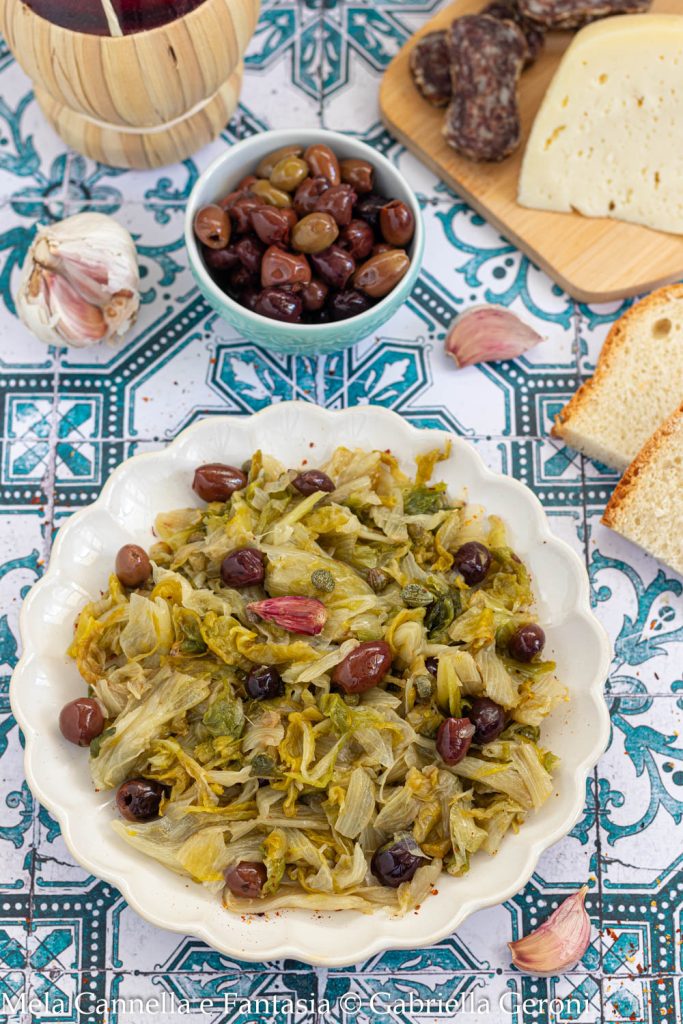
The sautéed escarole with Taggiasca olives and capers is one of the most beloved side dishes of autumn-winter. Escarole, also known as endive, is a vegetable belonging to the Cichorium genus.
Compared to chicory, Belgian endive, or puntarelle, escarole has a less bitter taste.
It can be consumed both raw as a salad, sliced thin. Alternatively, as I prefer, cooked in a skillet. Enriched with Taggiasca olives and capers, it’s incredibly delicious!
To tell the truth, sautéed escarole is a typical Campanian side dish, rich and very tasty. The original recipe includes the addition of pine nuts, raisins, and walnuts. My version is less rich but equally delightful!
The stewed escarole is a fairly economical side dish, quick to prepare as there is no need to boil the vegetables first. Just place it, after carefully washing and cutting, in a spacious pot. Just add a drop of water and cover with a lid. The moisture that will form inside will allow ideal cooking to preserve all its properties.
Moreover, escarole is perfect for seasoning first courses, for soups, and for stuffing delicious focaccias!
But now, let’s move on and prepare the stewed escarole in a skillet with capers and olives!
More recipes that might interest you!
- Cost: Economical
- Preparation time: 5 Minutes
- Portions: 4-5 people
- Cooking methods: Stovetop
- Cuisine: Italian
- Seasonality: Autumn, Winter
Ingredients
- 1 head escarole (endive)
- 2.1 oz Taggiasca olives
- 0.7 oz capers (only if you like them)
- 1 clove garlic
- to taste chili pepper (fresh or dried)
- 4 tbsps olive oil (one per person)
- to taste salt
Tools
- Skillet
- Lid
- Ladle
- Colander
- Chopping Board
Steps
First, wash the escarole well under running water.
Then slice it with a knife, trying to cut it into not too large pieces so that it fits more easily into the pot.
Place a sufficiently large skillet on the heat, insert the sliced escarole, and add just half a cup of water.
Cover with a lid and cook over medium-low heat until it becomes tender.
It will take about 15-20 minutes. Once cooked, drain it well from the water released during cooking.
Before sautéing it in the skillet again, I cut it further with scissors because I prefer the leaves to be small.
In the same skillet where you cooked the escarole (dry it if any water remains inside), pour the olive oil.
Add one or two cloves of garlic, chili pepper (fresh or dried), capers, and Taggiasca olives.
After a couple of minutes, add the escarole and sauté for a few minutes to let it become well-flavored.
Finally, adjust the salt, stir, and bring to the table immediately!
If you’re wondering how to store leftover escarole, read below!
I hope this quick, genuine, and delicious side dish pleased you! Let me know if you try it!
This article is protected by copyright © – Gabriella Geroni © All Rights Reserved
Sponsored content
FAQ (Questions and Answers)
Can I freeze the escarole before sautéing it in the skillet?
Sure! Please note that I always recommend not adding salt during the first cooking stage so you can season it better once sautéed. After cooking the escarole, let it completely drain from the water retained during cooking.
Subsequently, portion the escarole using multiple food bags if the amount to be frozen is substantial. In this way, you’ll have made a good supply that you can keep in the freezer for about 6 months.
Or if you prefer, it can be stored in the fridge for up to two-three days in airtight containers.