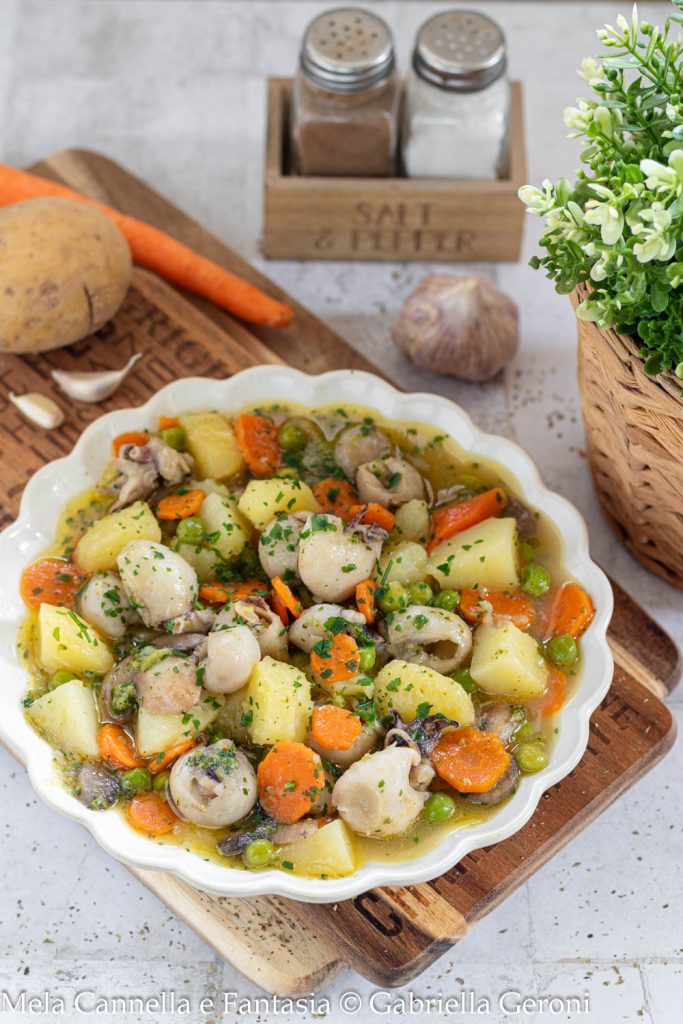
Ready to dig in? Today we’re making some delicious Stewed Cuttlefish with Potatoes, Carrots, Mushrooms, and Peas, without Tomato.
This dish is designed for those who want to bring a classic of Mediterranean cuisine to the table, using both fresh and frozen cuttlefish.
If you love eating well without complications, enjoy seafood dishes that are especially easy to make, then you’re in the right place!
This recipe is ideal for those who prefer nutritious but not too caloric dishes and especially for those who have little time to spend in the kitchen!
If you use frozen and already cleaned cuttlefish, the preparation of this recipe becomes even quicker.
Stay with me, I’ll guide you through the essential steps, from cleaning to cooking, to get a perfect result with zero effort!
Stewed cuttlefish with potatoes and peas is a lovely, complete, and balanced dish, healthy and very tasty.
The stewing method allows using little oil, ideal if you’re following a Mediterranean diet.
Stewed cuttlefish without tomato is a perfect dish for any season and occasion, and I’m sure it will win you over!
So without wasting any time, take “lu zinale“, as my Abruzzese grandma would say, and let’s get to the stove!
Before we start, here are some more delicious recipes to try:
- Difficulty: Easy
- Cost: Medium
- Preparation time: 30 Minutes
- Portions: 4People
- Cooking methods: Stove
- Cuisine: Italian
- Seasonality: All seasons
Ingredients
- 1.76 lbs cuttlefish (fresh or frozen)
- 1.1 lbs potatoes
- 2.5 cups carrots
- 2 cups mushrooms (fresh or frozen; champignon, mixed forest, or your favorite variety)
- 1 cup peas (fresh or frozen)
- 1 clove garlic
- dry white wine (about two espresso cups or a little more than half a glass)
- A few tablespoons extra virgin olive oil
- chopped parsley
- whole black pepper (only if desired)
- to taste salt
- chili pepper (fresh or dried, only if desired)
- water (or fish broth to taste)
Tools
- Cutting Board
- Ladle
- Bowl
- Pans
- Lid
Steps
Before we start, let’s discuss important cooking times for a perfect dish!
For this preparation, I used frozen cuttlefish, mushrooms, and peas.
Frozen mushrooms take about 10-15 minutes to cook. If they are large and whole, it is better to cut them before putting them in the pan or wait a few more minutes for optimal cooking.
Frozen peas (which don’t need to be thawed and can be taken straight from the package to the pan) cook quickly, averaging 5-7 minutes, especially if they are fine or extra-fine.
Cooking times for potatoes and carrots depend a lot on their size, how small or large we cut them.
Potatoes cut into medium chunks (about 1-2 inches): will take about 20-25 minutes to become tender with stewing over low heat. To verify doneness, pierce them with a fork: if it goes in easily, they are ready!Carrots cut into slices (about 0.4 inch thick): will cook slightly faster than potatoes, in approximately 15-20 minutes.
Another difference to note is between fresh and frozen fish, which have different cooking times.
Small fresh cuttlefish:
In the pan or sautéed: just a few minutes per side, about 2-3 minutes per side over medium-high heat, until they become white and tender. Prolonged cooking would make them rubbery.
Stewed: Since they are small, they will cook in about 10-15 minutes in the sauce (or broth or water), from when the liquid resumes boiling. They should be tender but not rubbery.Small frozen cuttlefish:
Generally, they require a slightly longer cooking time than fresh ones because of the freezing and thawing process.
In the pan or sautéed: After fully thawing and drying well, they will cook in about 3-5 minutes per side.
Stewed: about 15-20 minutes of cooking from when the sauce (or water or broth) boils. The tenderness should also be checked.Hence, frozen cuttlefish may require a few more minutes of cooking to reach the same tenderness as fresh ones. For fresh cuttlefish cooking times, read at the end.
Now that we know the cooking time differences, let’s move on to cleaning the cuttlefish and vegetables!
As previously mentioned, this dish can be made using fresh or frozen fish. Let’s see how to clean both.
Fresh cuttlefish: Rinse well under cold running water. Remove the internal sac with ink, the rostrum (the “beak” in the center), and the eyes.
Remove the outer skin by gently pulling it. If they are very small, as in my case, you can leave them whole, otherwise, cut the cuttlefish into strips or rings.
Frozen cuttlefish: Thaw by placing in the refrigerator a few hours before. Usually, frozen ones are already cleaned, and there’s no need to do anything. Otherwise, proceed as for fresh ones.
Pat the cuttlefish dry with absorbent paper to remove excess water. This step is crucial for optimal pan cooking.
Now peel the potatoes and cut them into medium-sized chunks. Peel the carrots and cut them into slices.
In a large pan (preferably with a thick bottom), heat a drizzle of extra virgin olive oil along with the peeled garlic clove (you can leave it whole and remove it at the end of cooking if you prefer).
Sauté the mushrooms while still frozen, uncovered, and over high heat. Add a handful of finely chopped fresh parsley. Cook for 10 minutes, then drain and set them aside.
In the same pan, pour another drizzle of oil and add potatoes and carrots. If you like a spicy touch, add a piece of chili pepper.
Sauté for a couple of minutes, then deglaze with a shot glass of white wine. Once the alcohol evaporates, pour a cup of water (or fish broth if available), cover with a lid and let it go over medium heat for 5 minutes.
After this time, add the cuttlefish, deglaze with another shot glass of white wine and let it evaporate.
Then add a cup of hot water (or broth), season with salt now only, and pepper if desired. From this moment, the cooking time will be estimated at around 20-25 minutes.
Lower the heat, cover with a lid, and cook until the potatoes are tender and the cooking liquids are somewhat absorbed.
Stir occasionally to prevent sticking.
Remember that we sautéed the mushrooms in the pan for only 10 minutes? We are about 5 minutes short of cooking time, and we need to add the peas that cook in 5-7 minutes.
Therefore, the last 5 minutes you should add the peas still frozen and the mushrooms previously sautéed. Taste to check the flavor.
Do not thaw the peas beforehand, add them directly frozen to prevent them from releasing too much water and becoming mushy.
Finish cooking for 5-7 minutes and before plating, add plenty of finely chopped fresh parsley.
And your wonderful and delicious stewed cuttlefish without tomato with potatoes and peas are ready to delight your diners’ palates! I’m sure it will be a success!
Let me know in the comments if you’ll try this recipe! And be sure to visit me again soon!
Article protected by copyright © – Gabriella Geroni © All Rights Reserved
Tips:
It is always better to cut potatoes and carrots into similarly sized pieces to ensure even cooking. The smaller the pieces, the less the cooking time.
Some varieties of potatoes cook faster than others (e.g., new potatoes).
If you prefer a crunchier texture for the carrots, add them directly with the cuttlefish.
Season with salt only at the end: helps prevent cuttlefish from releasing too many liquids during cooking.
Dipping sauce is mandatory! Don’t forget good bread to collect the tasty sauce!
FAQ (Questions and Answers)
What’s the difference between large cuttlefish and small ones? How long does a large cuttlefish take to cook?
The main difference is in size and the consequent density of muscle fibers.
Small cuttlefish, being smaller and younger, have more delicate fibers and cook quickly.
Large cuttlefish take a significantly longer time to cook, and often require a more “gentle” cooking method compared to small ones, and managing the cooking is crucial to avoid making them rubbery.
Cooking Times for Large Cuttlefish:
Stewed: Large cuttlefish, cut into pieces (rings or chunks), can take from 30 to 60 minutes or more to become tender, stewed over low heat. The exact time depends largely on the size and freshness of the cuttlefish. Larger and mature cuttlefish tend to be tougher and require longer cooking.
Boiled: Boiling a large cuttlefish whole can take from 40 minutes to 1 hour and 30 minutes or more, again depending on size. It is important to check tenderness with a fork that should be able to penetrate the meat with little resistance.
Grilled or sautéed (not recommended for large pieces): Quickly cooking large pieces of cuttlefish on the grill or in a pan is riskier because the outside could burn before the inside becomes tender. If you really want this cooking method, it is advisable to cut the cuttlefish into strips or smaller pieces and maybe tenderize it beforehand.
If you use large cuttlefish for this recipe, expect a significantly longer cooking time for the cuttlefish, compared to the other ingredients. You may need to lengthen the cooking time for the cuttlefish before adding the vegetables.What type of mushrooms can I use?
You can use champignon, porcini, mixed forest. Keep in mind that porcini may have a more intense flavor.
If I use fresh mushrooms, what are the cooking times?
Fresh mushrooms, depending on the variety and size of the cut, generally cook in a time similar or slightly shorter than frozen ones.
Thinly sliced they will cook in about 5-10 minutes, becoming tender and releasing their flavor.
Cut into larger pieces they may require 10-15 minutes.
Fresh mushrooms also release a certain amount of water during cooking, so it is important to keep this in mind.
Remember to clean fresh mushrooms thoroughly before using them (gently brushing them or wiping them with a damp cloth, avoiding washing under running water unless they are very dirty).
As recommended above, you can sauté fresh mushrooms separately in a pan, with oil, garlic, and finely chopped fresh parsley. After 10 minutes, set them aside to then combine with the other ingredients only at the end of cooking and mix the flavors well with each other.Can I use fresh peas when they’re in season? How long do they take to cook?
Yes, of course! Fresh peas are very tender and cook even more quickly than frozen ones. Usually, 3-5 minutes of stewing are enough to make them tender and keep a nice bright green color. Therefore, add them just at the end of cooking, in the last minutes, along with the parsley. This way they will best retain their sweetness and texture.
What’s the difference between using fresh or frozen cuttlefish?
Fresh cuttlefish, if cooked correctly, tend to have a firmer and more elastic texture. Frozen ones, sometimes, can be slightly softer after cooking.
Frozen cuttlefish, during cooking, may release more water than fresh ones.
It is important to ensure that this water evaporates for an optimal result.Can I also use squid instead of cuttlefish?
Yes, but the cooking times might vary slightly, as squid tends to be a bit tougher.
What can I use instead of mushrooms or peas?
Zucchini or cherry tomatoes certainly go well with the other ingredients.
Can this dish be prepared in advance?
Yes, you can prepare stewed cuttlefish in advance and store them in an airtight container in the refrigerator for up to 1-2 days. Reheat it gently before serving.
How can I make the sauce thicker?
If the sauce that has formed from the cooking liquids released by the various ingredients is too thin, you can make it thicker. Just add a teaspoon of flour or cornstarch during the last minutes of cooking.
Can I use a bit of tomato sauce to enrich this dish?
Yes, of course! If you like it red, add 4 tablespoons of tomato sauce. Alternatively, you can use a tablespoon of tomato paste instead of the sauce and dilute it with a bit of water.
What wine can I pair with this dish?
Light and fresh whites: A Vermentino from Liguria or Sardinia, a Pinot Grigio from Friuli, a Grechetto from Umbria, or a Falanghina from Campania; with their acidity and citrus notes, they cleanse the palate and pair well with the sweetness of the vegetables and the savoriness of the cuttlefish.
More structured whites: If you prefer a wine with more body, a Fiano di Avellino or a Soave Classico can be excellent choices, thanks to their aromatic complexity and good minerality.
Dry rosés: A Cerasuolo di Vittoria or a Bardolino Chiaretto with their freshness and delicate fruity notes can create a pleasant and versatile pairing.