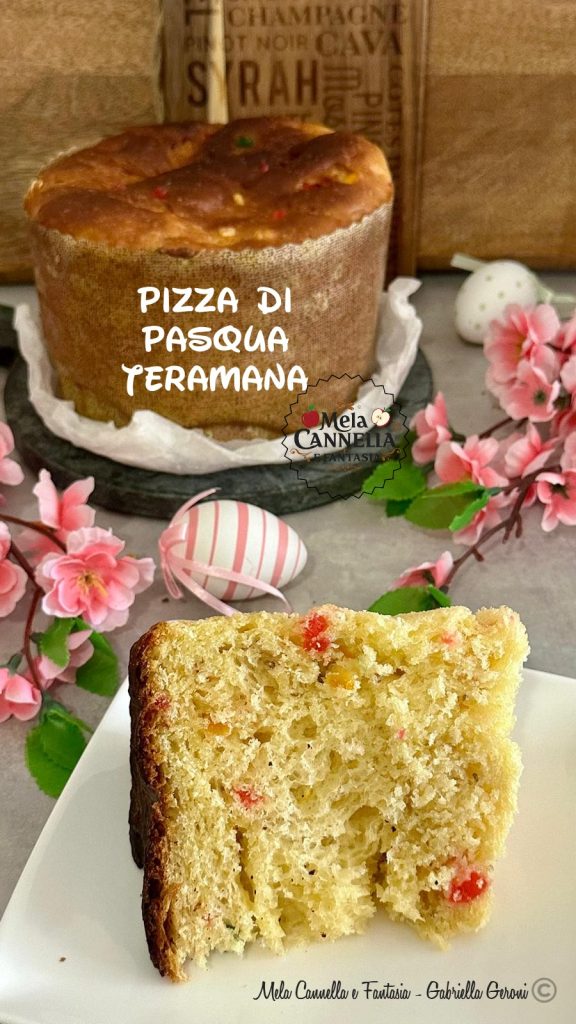
Today we bring to the table the Teramo Easter pizza. It’s a traditional Abruzzese sweet typical of the Easter tradition. An ancient cake with a delicate taste and an intoxicating aroma!
It’s a leavened pastry filled with candied fruit, extremely soft and delicious! It could be defined as the Panettone of Easter. The ingredients are simple and easy to find. That’s why, even though it’s an Easter dessert, it’s great all year round.
The preparation takes time but is not difficult. Just let the cake rise in a warm place! It stays soft for days if you put it in food bags.
You can also freeze it and enjoy a slice now and then. If you don’t like candied fruit you can fill the Easter pizza with chocolate chips. The recipe I share is a family recipe and I thank Bice for this gift.
Let’s look together at the ingredients and procedure with step-by-step photos.
At the bottom of the article you’ll find other useful tips. There’s also a small gift waiting for you ❤️
Here are some of my favorite regional recipes that I absolutely recommend you try.

- Difficulty: Medium
- Cost: Economical
- Rest time: 10 Hours
- Preparation time: 1 Hour
- Portions: 1 large pizza or two medium-sized
- Cooking methods: Electric oven
- Cuisine: Italian
- Seasonality: Easter, All seasons
Ingredients
- 600 cups all-purpose flour ("00") (Not Manitoba. About 4 3/4 cups (600 g))
- 150 cups granulated sugar (About 3/4 cup (150 g))
- 3 eggs (medium)
- 300 cups milk (whole or semi-skimmed. About 1 1/4 cups (300 ml))
- 100 tbsp olive oil (light and delicate, or use a neutral seed oil. About 6 3/4 tbsp (≈3.5 oz / ≈0.42 cup))
- 1 cube fresh brewer's yeast (i.e. 25 g (0.88 oz), or use 1 standard dry yeast packet (7 g ≈ 2 1/4 tsp))
- 50 oz candied cherries (red or green, or a mix. About 1.75 oz (50 g))
- 50 oz candied citron (cedro) (can be replaced with more candied cherries. About 1.75 oz (50 g))
- 1 lemon zest (grated)
- 1 tablespoon anise seeds (only if you like them)
Tools
- Bowls
- Hand mixer
- Ladles
- Spatula
- Pan paper
- Grater
- Parchment paper
The quantities above are for one large Easter pizza (about 2.2 lb) or for two medium-sized ones.
Double ALL ingredients listed to obtain more pizzas.
Both the first and the second rising last about 4/5 hours each.
I therefore recommend planning your time accordingly!
I started the first dough at 9:50 AM. At 10:20 AM I set it to rise.
I took it back at 2:30 PM to fill it and put it back to rise at 3:15 PM (I divided the dough in half to make two!).
At 8:30 PM I baked the Easter pizzas in the oven for about an hour. So in total it takes about 11/12 hours.
For the filling, in Teramo we use candied fruit. The red and green cherries are the most used. Small pieces of candied citron are also fine.
Tradition calls for anise to flavor it. At home no one likes it so I didn’t add it!
Let’s begin! If you’re using fresh brewer’s yeast, dissolve it in WARM milk.
CAUTION regarding the temperature of the milk: if it’s too hot the yeast will die and the pizza will never rise!
If using dry yeast READ the package instructions carefully.
There are two types of dry yeast: one is mixed with the flour.
The other must be dissolved in liquid (like the fresh one). It depends on the manufacturer.
I chose the dry yeast that mixes with the flour to save time!
In a bowl beat whole eggs and sugar with the electric whisk for at least 10-15 minutes.
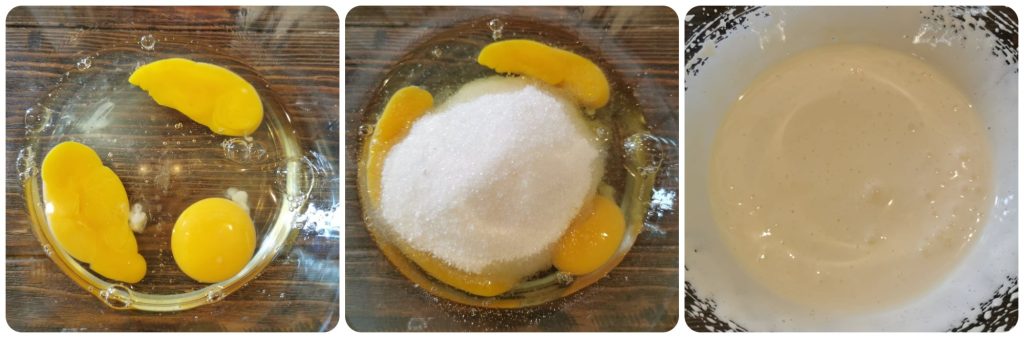
Choose a very large container to avoid the mixture overflowing during rising.
Add the olive oil (choose a light, delicate one or use seed oil) and blend again.
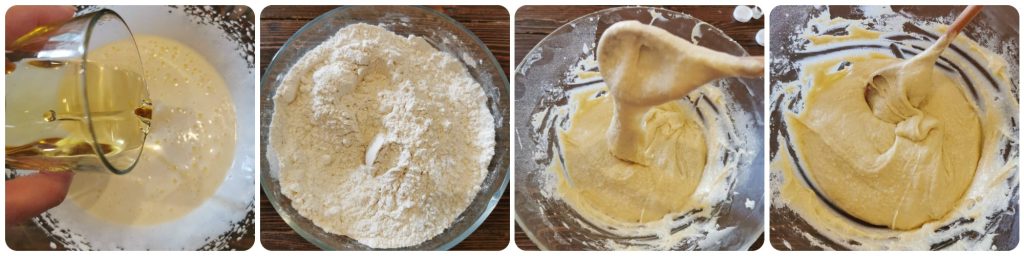
Pour in the milk with the yeast well dissolved and mix.
Gradually incorporate the flour (and the dry yeast if using the type mixed with flour) and work with the whisk.
As soon as the mixer struggles to turn, turn it off and continue with a wooden spoon to mix well.
You should obtain a soft and sticky dough, NOT workable by hand.
For this reason it’s better to help yourself with a spatula or spoon.
At this point cover the bowl surface with plastic wrap and literally place it in a warm spot.
The Abruzzese Easter pizza wants to be pampered! It hates low temperatures.
If you have a radiator at home it’s the perfect place to rest the Easter pizza.
Place a blanket or wool scarf on a support (table, chair, etc.).
Set the bowl with the dough on the blanket and wrap it around with another scarf.
Let it rise WITHOUT TOUCHING for about 4/5 hours.
If you don’t have a radiator or a warm environment, place the bowl in a turned-off oven with the light on.
After the time for the first rise, take the bowl and place it on the work surface.
Turn everything out onto the work surface. If you want to make two pizzas, divide it in half.
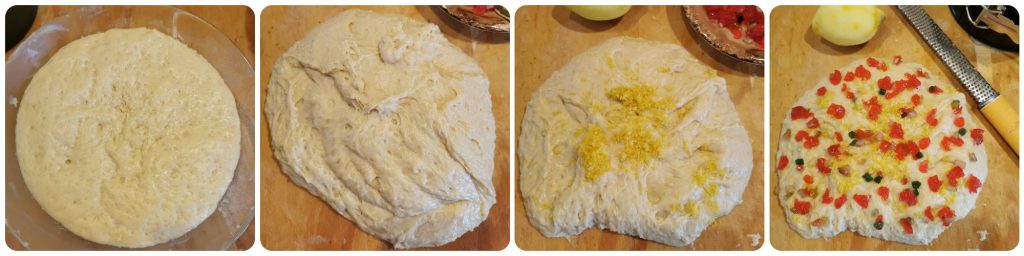
It’s not necessary to flour the surface but it’s important to use a spatula to handle the dough.
Grate a well-washed organic lemon over the turned-out dough. Also place the candied fruit on top.
I used chopped red cherries and small pieces of candied citron.
Take a spatula (or bench scraper) and lift one corner of the dough, bringing it toward the center.
Repeat from all corners until you fold the dough onto itself and incorporate the filling.
Because the dough is sticky it’s essential to use a spatula or bench scraper.
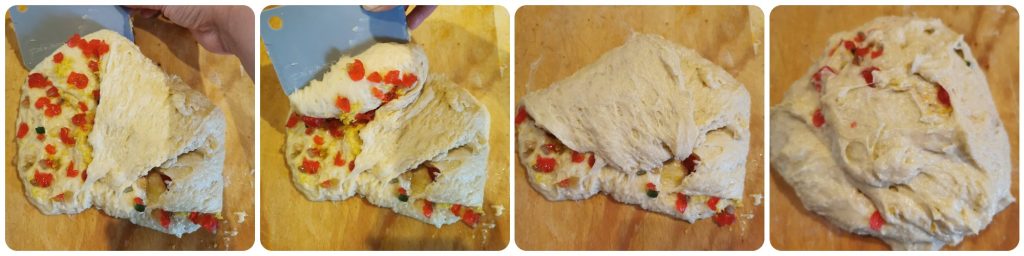
With gentle movements fold the dough onto itself as shown in the photo.
Regarding the mold you can use either disposable paper molds or classic cake pans, bearing in mind that in a paper mold being narrow and tall the pizza will also take that shape.
I preferred to use a wider baking pan, sacrificing height 😉 With these quantities you’ll need a paper mold for about 3.3 lb (or two 1.65 lb molds if you divided the dough).
If you use classic pans you should still choose tall pans.
If you split the dough in half you’ll need two pans 22 cm in diameter and at least 11 cm high (22 cm ≈ 8.66 in; 11 cm ≈ 4.33 in). Or one pan 26-28 cm in diameter at least 8 cm high (26-28 cm ≈ 10.24-11.02 in; 8 cm ≈ 3.15 in).
Since the mixture will rise a lot, line with parchment paper leaving a few extra centimeters above the rim.
This will create an additional “wall” to “contain” the dough.
Gently arrange the mixture inside, cover with a sheet of parchment paper.
Place the pan on the surface used previously with the wool blankets (or in the turned-off oven with the light on).
Let the pizza rise for about another 4/5 hours.
Once the mixture has almost reached the rim of the mold you can proceed to baking.
Preheat the oven to 320°F (conventional mode) and place a shallow pan full of water on the bottom rack.
This will create the right humidity so the Easter pizza stays soft and fluffy.
When the temperature is reached, DELICATELY place the mold in the oven.
Bake the Easter pizza for about one hour, COVERED with a sheet of parchment paper.
A handy tip I was told is to scrunch the parchment paper into a “cap” shape.
This way it will stay in place on the mold and the surface won’t get too dark.
Baking time VARIES from oven to oven and especially depending on the mold used.
If you choose tall paper panettone molds, narrow and tall, the pizza bakes in less time.
If you use classic pans it will take longer.
Therefore test after about 50 minutes.
Gently touch the surface with your fingers; if it’s firm perform the toothpick test: if it’s dry, remove from the oven.
If the surface is soft, IMMEDIATELY close the oven and continue for another about 10 minutes.
Once baked, remove your Easter pizza from the oven, let it cool and then place it on a rack.
This step will allow moisture to escape and better dry the base.
Yes, it was long, but I hope with my tips it wasn’t difficult to prepare this wonderful Easter sweet.
The aroma it gives off is fabulous and the taste even more delicate!
I really hope you’ll try making it and that you’ll like it!
If you have any questions, feel free to ask, I’m at your disposal!
Happy Easter Pizza to everyone!
Article protected by copyright © – Gabriella Geroni © All Rights Reserved
Looking for more delicious Easter ideas? I give you this collection of Must-try Easter sweets! You’ll find 14 mouthwatering recipes 😍😋
Storage and tips
Storage and tips
FAQ (Questions & Answers)
How long does this Easter sweet keep?
The Teramo Easter pizza keeps for a long time while remaining soft and fluffy. Just place it in a container that can be closed or in a large food bag.
It can also be frozen; in that case I recommend slicing it and arranging the slices in the freezer already portioned. This way you can thaw only the number of slices you need and avoid waste.I don’t like candied fruit, how can I replace it?
If you’re not a big fan of candied fruit you can replace them with chocolate chips (70 g), the procedure is the same. I usually make two Easter pizzas: one with candied fruit and one with chocolate to please my whole family.
If you prefer you can use just lemon zest (or orange) to flavor the cake.Can I add dried fruit to the dough?
I don’t recommend it; if you want to enjoy this traditional cake prepare it following the recipe. Any modification could jeopardize the success of this simple but tricky leavened sweet. It would be a shame to ruin it by experimenting. These types of recipes need practice; only after you get familiar with this dough type can you, if you wish, add dried fruit, which in my opinion is not ideal for this cake.
Can I reduce the amount of brewer’s yeast?
The answer is no, but of course everyone is free to do as they prefer in the kitchen! Why is it better not to reduce the yeast? The main, inimitable characteristic of this leavened Easter cake is its texture; the inside must be moist, soft and not dry. As a person from Teramo would say: “it must feel heavy” ❤️
To understand if you’ve made a Teramo Easter cake perfectly, place it on the palm of your hand: you’ll feel all its weight and that is a sign of an authentic Abruzzese Easter pizza, like our grandmothers used to make. If the cake is light it’s not the same. Reducing the yeast isn’t a crime but you won’t get the same result.
This is a family recipe; I’ve tried several versions with even higher yeast quantities, so my suggestion is a fair compromise for a terrific result!