
To avoid confusion, but especially to have clearer ideas before seeing how to make invert sugar and how to use it in cooking, it’s important to understand the difference between sugar syrup, glucose syrup, invert sugar.
SUGAR SYRUP: It’s simply the saturation of sugar in water. The sugar is dissolved in water and then boiled until it reaches the desired density (degrees Baumé or Brix degrees). Sugar syrup is used to sweeten pastry, ice cream, chocolate products or added to spirits for soaking. Feasible in home settings.
GLUCOSE SYRUP: Glucose syrup is extracted from starch, mainly from corn. So, to obtain it, corn, water, an acid or enzymes are used. The molecules are first hydrolyzed with water absorption, then with heat, the acids or enzymes are broken down into simple sugar molecules. Finally, using special crystallizers, the molecules crystallize and form glucose. Glucose syrup is mainly used in ice cream to lower the freezing point, but also in pastry and chocolate making. Fake glucose syrup, the homemade one with sugar, water, and lemon juice, has nothing to do with real glucose syrup. Not feasible in home settings.
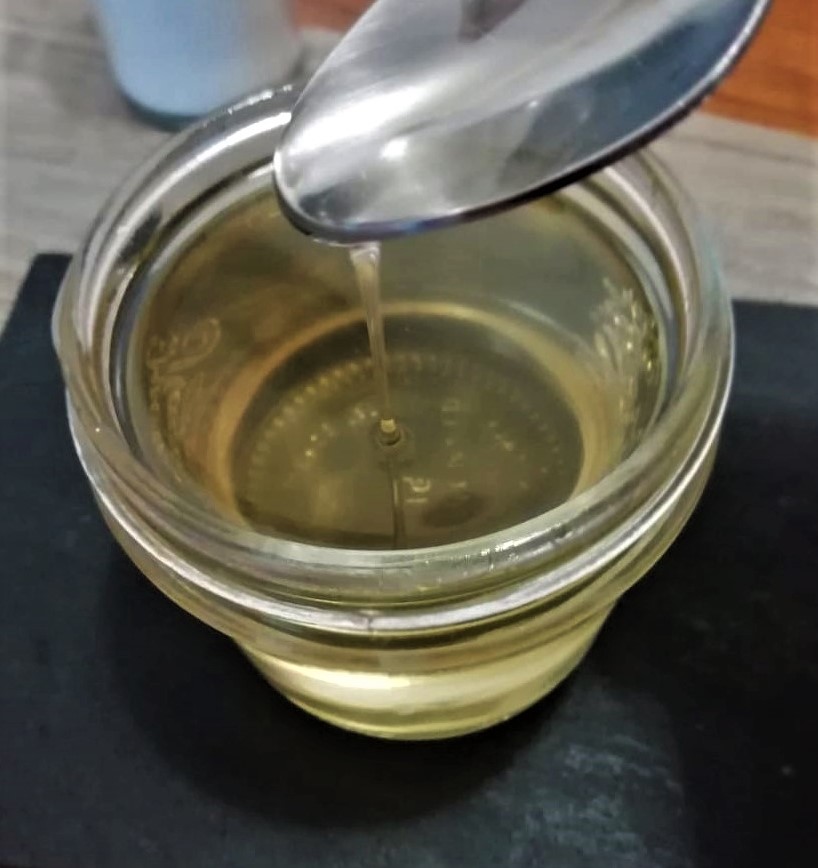
INVERT SUGAR: It is derived from crystalline sucrose, and the inversion occurs by splitting sucrose molecules into simpler sugar molecules, through acids or enzymes (invertase). Invert sugar is found in many sugary fruits, especially grapes, and in honey. In fact, invert sugar is almost identical to honey, so much so that it can be defined as artificial honey. If colored with caramel and flavored with flower extracts, it becomes a valid honey substitute. Invert sugar has the ability to retain water and is used in pastry to maintain moisture and delay oxidation processes of products, keeping them moist and softer and preserving them longer. In ice cream, it lowers the freezing point. Invert sugar has a sweetening power 27% – 30% higher than sucrose. It can also be made at home.
HOW TO MAKE INVERT SUGAR AND HOW TO USE IT IN COOKING. Personally, I find it very useful to produce for the preparation of desserts such as sponge cake, pound cake, muffins, glazes, creams, soft cookies, donuts, yeast doughs like olive oil bread, milk rolls, brioche bread, small focaccias, etc. First of all, I will explain the two fundamental steps of the preparation starting from the basic element, sucrose (white sugar).
IN BRIEF: Sugar is added to water and then brought to a temperature of 185°F (for this we need a kitchen thermometer). Once the temperature is reached, it is removed from the heat, and the pH of the solution is lowered by adding powdered citric acid (available at pharmacies) (we would also need a precision scale) or with the right amount of lemon juice (which contains citric acid). Let it mature for 24 hours and then bring the solution back to a temperature of 185°F, remove from the heat, and neutralize with baking soda. Let the solution cool and then store in a glass jar at room temperature, even for a year. Ready to use.
NOTE: Even if I could do it with a faster procedure, I prefer to let the solution mature for 24 hours (hydrolysis) before neutralizing it with baking soda. In this way, a greater percentage of sugar (from 90% to 95%) is transformed (inverted), since with homemade preparation, you cannot obtain 100% invert sugar like honey (without getting into chemical-physical explanations).
CITRIC ACID OR LEMON JUICE: If you can’t find powdered citric acid for food, which facilitates the procedure for obtaining invert sugar, you can use fresh lemon juice, but not at random tablespoons. You need to know that 1 liter of lemon juice contains 63.4 gr of citric acid, and from this data you can do your calculations.
INGREDIENTS FOR ABOUT 1 lb OF INVERT SUGAR
12.3 oz of white sugar (sucrose)
5.3 oz of pure water (not tap, natural oligomineral)
0.05 oz of citric acid (or 0.9 oz of filtered lemon juice)
0.06 oz of baking soda
EQUIPMENT:
A stainless steel saucepan, a food thermometer, a precision scale, a glass jar.
PROCEDURE:
1 – In a saucepan, put the water and sugar. Place it on the stove over medium-low heat and dissolve the sugar until it reaches a temperature of 185°F. Measure the temperature with the thermometer and then turn off the heat.
2 – Dissolve the citric acid powder in very little water and pour it into the solution. If using lemon juice, strain it through a sieve before pouring it into the solution. Mix well, cover the saucepan, and let it mature for 24 hours at room temperature.
3 – After the hydrolysis time, put the saucepan back on the heat and bring the solution back to 185°F, always measuring with the thermometer. Once the temperature is reached, turn off the flame and remove the saucepan from the heat.
4 – Measure the weight of the baking soda in a small glass and dilute it with a little water. With a teaspoon, add the baking soda to the solution little by little and mix well. A foam will form on the surface, which is normal, and it will slowly disappear during cooling.
5 – Finally, when cold, transfer the invert sugar into an airtight glass jar and store it in the pantry at room temperature. It’s ready to be used in the necessary doses.
RECOMMENDED DOSES FOR COOKING PREPARATIONS
Invert sugar sweetens 30% more than sucrose (white sugar), so it should be used in small doses and in the recommended percentage for different preparations.
In cake batters: such as cakes, muffins, sponge cake, pound cake, soft cookies, etc., you should replace 10% – 15% of the sugar amount provided by the recipe with invert sugar, which, being much sweeter, must be proportionally reduced by about 30%, as I will explain more clearly in the following examples.
In leavened doughs: such as olive oil bread, sandwich bread, brioche, small donuts, etc., you should replace 50% – 60% of the sugar amount provided by the recipe with invert sugar, which, of course, must be proportionally reduced by about 30%.
In ice creams and sorbets: invert sugar replaces 25% – 30% of the sugar provided by the recipe, which must be proportionally reduced by about 30%, as I will explain more clearly in the following examples.
HOW TO CALCULATE THE DOSE OF INVERT SUGAR IN RECIPES
It’s not difficult; just do two calculations to determine how much is needed for any recipe. I can do it myself, even though I’m not good at math!
1 – The first step is knowing which recipe we want to make and the recommended percentage of invert sugar we should replace. At this point, we can start the calculation. Let’s say we want to make soft cookies, where the recommended invert sugar percentage is 10% – 15%, we choose 10%, and start calculating this percentage on the sugar weight in the recipe to know how much sugar we need to replace, then subtract what we obtained from the total sugar weight in the recipe to get how much white sugar we need to put in the recipe.
—> For example: we need 100 gr of sugar for the cookie dough, subtract 10% from these 100 grams. There will be 90 gr left, which will be the white sugar (sucrose) we will put in the recipe.
(100 gr x 10% = 10 gr (sugar to replace) —– 100 g – 10 gr = 90 gr (white sugar)
2 – With the 10 grams obtained, of the sugar to replace, we will do the next step to get the weight of invert sugar to put in the recipe. As I said above, invert sugar sweetens 30% more than white sugar, so we can’t replace it with an equal 10 grams, otherwise, the sweetening will be greater than required in the recipe. So, we’ll make another quick calculation following this concept:
—> Sugar to replace, in this case, 10 gr x 100 : 130 = 7.7 gr (rounded up to 8) will be the weight of invert sugar to add to the white sugar.
Recapping: in the recipe, we will put 90 gr of white sugar (sucrose) + 8 gr of invert sugar.
Another example: We want to make brioche, and the recipe also requires 100 gr of sugar in the dough. The percentage of invert sugar we want to replace will be 50%. We start by subtracting 50% from these 100 gr of sugar. There are 50 gr left, which will be the white sugar to put in the recipe. The difference we removed, 50 grams, will be the base of the next calculation to know how much invert sugar we need to add.
Weight of sugar to replace, in this case, 50 gr x 100 : 130 = 38.46 gr (rounded up to 38.5) will be the weight of invert sugar to add. So in our brioche recipe, we will put: 50 gr of white sugar + 38.5 of invert sugar.
I hope I have been clear in explaining these simple calculations for how to make invert sugar and how to use it in cooking, which you will surely understand and put into practice to prepare excellent recipes.
- Cooking methods: Stovetop
- Cuisine: Italian
