
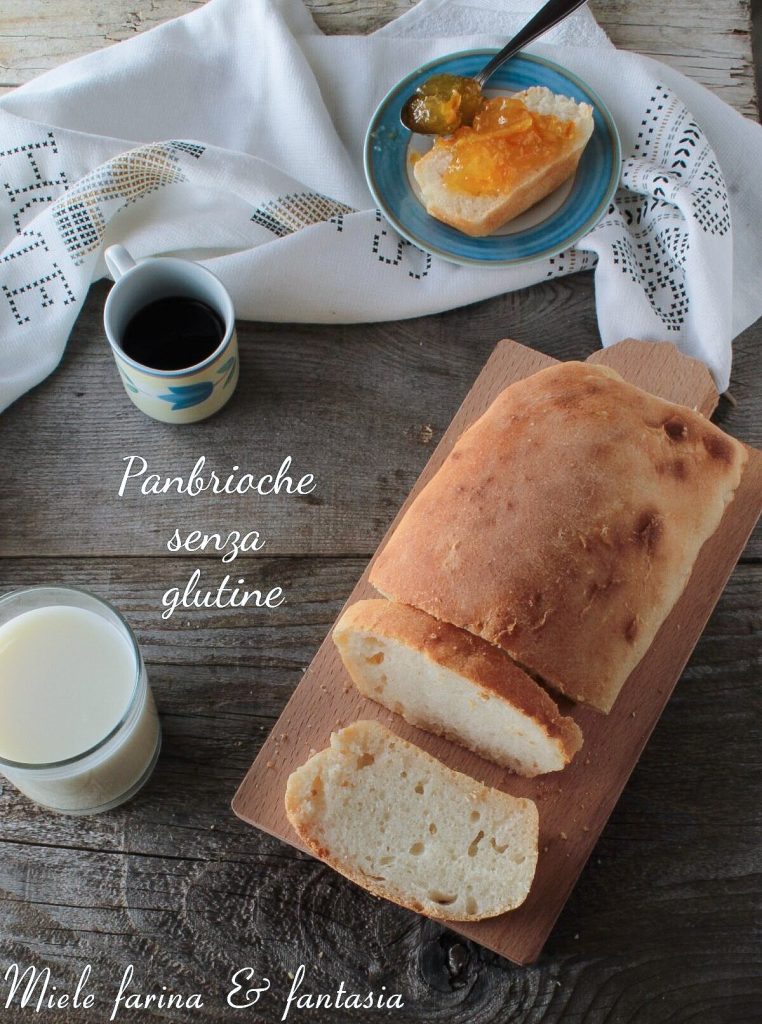
The pan brioche I’m offering today was made with a ready-made gluten-free flour mix specifically formulated for bread and pizza. It’s a soft enriched bread with a mild sweetness, so it can be paired with savory fillings and won’t become cloying with creams or jams. It’s also delicious eaten on its own or dipped in milk and coffee at breakfast or snack time. In addition to being gluten-free, this pan brioche contains no lactose or eggs. It’s easy to make; within the procedure you’ll find all the step-by-step explanations to make it without any trouble. Thanks to the three leavenings and the very small amount of fresh brewer’s yeast, it will be much more digestible and will retain softness for longer compared to a product made with a single rise and a larger amount of yeast.
- Difficulty: Very easy
- Cost: Economical
- Rest time: 18 Hours
- Preparation time: 30 Minutes
- Portions: 10
- Cooking methods: Oven
- Cuisine: Italian
- Seasonality: All seasons
Ingredients
- 1/4 cup warm lactose-free milk
- 1/4 tsp fresh gluten-free baker's yeast
- 1/3 cup gluten-free mix for bread and pizza
- fermented starter
- 2 cups gluten-free mix for bread and pizza
- 7/8 cup warm lactose-free milk
- 2.1 oz granulated sugar (or a heaping tablespoon of wildflower honey)
- 1 tsp fine salt
- to taste grated orange zest
- 1/4 tsp ground cinnamon (or another powdered spice of your choice)
- 1 tsp Strega liqueur (optional)
- 1 2/3 tbsp light vegetable oil
Tools
- 1 Loaf Pan
Steps
To make our gluten-free, lactose-free, egg-free pan brioche, let’s start by preparing the pre-ferment or starter.
In the bowl of a stand mixer (you can also work it with electric beaters, but not by hand, since the dough will be very soft), put the fresh yeast and, using a fork, dissolve it with the milk, which should be at room temperature or just barely warm. Immediately add the gluten-free flour mix for bread and pizza, stir and let it rise at room temperature, away from drafts or excessive heat sources, well covered with plastic wrap.
The amount of milk may vary slightly depending on the type of gluten-free flours used and on ambient temperature and humidity. This means you may need to add a little more or a little less milk.
I haven’t indicated exact rising times because they are also affected by temperature and humidity.
When you notice that the starter has increased in volume, you can move on to the actual dough.
Warm about 2/3 cup (150 ml) of milk (it should not be boiling, just slightly warm) and pour it little by little onto the starter while mixing with the paddle attachment at low speed (or with electric beaters) until it is completely dissolved, with no lumps.
Add the already sifted flour mix, mix for a few more seconds and stop. The dough should be coarse and lumpy (as in the photo below); seal with plastic wrap and let it rest for 30 minutes.
After the resting time, add little by little the remaining 1/4 cup (60 ml) of milk (also slightly warmed), then the fine salt, the granulated sugar, the spices, the liqueur and, finally, the oil.
Mix everything keeping a low speed so as not to overheat the dough, which will become creamy (similar to cake batter). From time to time stop the mixer, collect the dough spread on the sides of the bowl with a spatula, bring it back to the bottom and continue, until the dough is smooth, without lumps, and all ingredients are fully absorbed (5-6 minutes max).
Cover the bowl again with plastic wrap and let it rest for 90 minutes at room temperature (photo 4).
After an hour and a half, uncover the bowl and, using a spatula or a “rubber scraper,” fold the dough (which will remain creamy) from the bottom to the top, making a full turn of the bowl. Repeat this operation three times; this will incorporate air into the mixture and give it a sort of structure that will help it rise well in height and keep it very soft over time.
After completing this operation, you can decide to leave it in the same bowl (to dirty as few dishes as possible) or transfer it to another (photo 5). Cover perfectly with plastic wrap and place in the fridge in the least cold part. Let it rest and mature for 12 hours.
After twelve hours (it’s not necessary to be exact; it could be 10 or 14 hours depending on your needs) take the bowl out and let it come to room temperature for one to two hours (depending on ambient temperature and the season).
After this time, line a small loaf pan (about 8 inches) with parchment paper and very, very gently turn the dough into it. It’s important that the dough that was at the bottom of the fermentation bowl ends up on top in the pan.
Let it proof for the last time, covered with a tea towel, until it almost reaches the edges of the pan.
When the pan brioche is almost to the edges of the pan (about one finger from the rim), preheat the oven to 356°F and bring it to temperature.
Bake the pan brioche in the center of the hot oven for about 20-25 minutes, depending on whether you use a conventional or fan-assisted oven.
As soon as the pan brioche is baked, turn off the oven and take it out immediately to avoid it drying too much from residual heat. Let it cool completely before slicing.
Store it in a well-sealed food bag.
Bon appétit
