
Roccocò are typical Neapolitan sweets, prepared for Christmas festivities. Tradition dictates that this sweet has a doughnut shape, hard consistency, and a dark amber color. They can be enjoyed alone, dipped in milk, or paired with sweet wines and liqueurs. They keep for many days when stored in tin boxes or food bags and become even tastier over time. The basic recipe does not include eggs, butter, or other fats. Instead, it uses coarsely chopped nuts within the dough, the peel and juice of oranges and mandarins, and, most importantly, a crucial ingredient that must not be missing, the “pisto“, a blend of spices skillfully measured to maintain a perfect balance between flavors, ensuring no spice overpowers the others. It is generally bought in pre-packaged sachets. The characteristic flavor of roccocò is given precisely by the “pisto”. Each family has its own personal recipe for roccocò, differing from others by greater or lesser amounts of sugar (more sugar for harder roccocò, less sugar for a softer consistency, so they don’t become “tooth-breakers”), the presence of only oranges or only mandarins, Strega liqueur instead of anise, etc. It is a very, very easy dessert to prepare. The only precaution is to measure the liquids carefully because the dough needs to be hard and firm so that the classic doughnuts can be formed and retain their shape during baking. I enjoyed making them with my son. He made smaller roccocò, while I made larger ones. If you decide to prepare half the dose, only half a sachet of pisto will be needed.
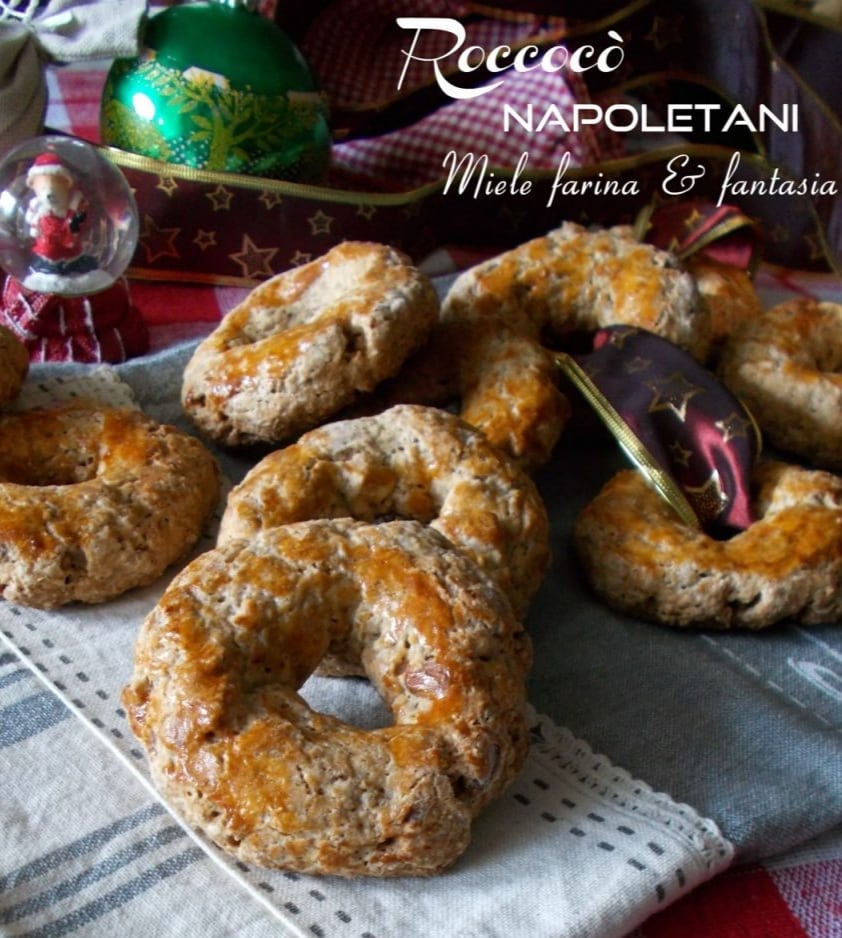
- Difficulty: Very Easy
- Cost: Medium
- Preparation time: 10 Minutes
- Portions: 50
- Cooking methods: Oven
- Cuisine: Italian
- Seasonality: Christmas
Ingredients
- 2.2 lbs all-purpose flour
- 3.5 cups granulated sugar
- 1 small cup of anise (or Strega liqueur)
- 1 orange (both zest and juice)
- 1 mandarin (both zest and juice)
- 1 packet pisto
- 1 tablespoon wildflower honey
- 1.1 lbs mix of hazelnuts and almonds (coarsely chopped)
- 1 g fine salt
- 1 glass warm water (scant)
- 1 beaten egg yolk for brushing
- 1 packet baking ammonia
Steps
Prepare the baking sheets we will use for the roccocò, line them with parchment paper, and preheat the oven to 350°F.
The amount of sugar in this recipe is for a result that is not overly hard, a good compromise in my opinion. If you want them even softer, do not go below 3 cups of sugar per 2.2 lbs of flour; if you want very hard roccocò as tradition dictates, grandma’s recipe calls for 4 cups of sugar per 2.2 lbs of flour.
1) In a large bowl, sift the flour and add all the dry ingredients, including the baking ammonia and pisto, and mix them well. Then add the grated peel of an orange and a mandarin, their juice, and the anise (or Strega). Start mixing (this can be done by hand or with a mixer using the paddle attachment).
2) Start pouring in one tablespoon of warm water at a time, mix, and pour another, continue until you achieve a firm, compact consistency. The dough should incorporate all the ingredients and remain firm in the bowl. Don’t worry if the dough seems hard, that’s how it should be. It takes less than 10 minutes to prepare them.
3) Now transfer the dough onto a floured cutting board; keep a bowl of additional flour nearby to help form the roccocò if needed. Cut small pieces of dough, lightly flour them, and with your hands, form thick ropes about a finger width and 5 inches long, shaping them into doughnuts.
4) Place the roccocò doughnuts on the baking sheet as you form them, spacing them about a finger apart because they will expand a bit during baking (but not excessively). Continue until the dough is used up. Brush the surface of the roccocò with beaten egg yolk and bake them for about 35 minutes, remembering that baking times and temperatures vary from oven to oven. Roccocò are ready when a wonderful aroma fills the house, and they take on a dark amber color on the surface and have a very soft consistency. Remove them from the oven and bake the next trays. Meanwhile, the already baked roccocò will cool and harden. Store them tightly in food bags or tin boxes. They will keep for a long time, becoming tastier over time.
