
Caponata is a typical Sicilian dish made with fried vegetables and tomato sauce, characterized by its sweet and sour flavor.
Many variations exist, and like in every respectable Sicilian family, we also have our own recipe, passed down from generation to generation.
Our caponata is made with homegrown vegetables, our own brined olives, and homemade tomato sauce, according to the grandparents’ and great-grandparents’ recipe.
Many years ago, even the vinegar was homemade — just to show you how much we care about traditions!
Obviously, this is our version, but you can prepare it by purchasing ingredients at the market: always choose organic and seasonal products if possible to achieve an authentic and genuine flavor.
- Difficulty: Easy
- Cost: Very Cheap
- Preparation time: 15 Minutes
- Portions: 10
- Cooking methods: Stove
- Cuisine: Italian Regional
- Region: Sicily
- Seasonality: Summer
- Energy 92.83 (Kcal)
- Carbohydrates 11.39 (g) of which sugars 5.13 (g)
- Proteins 1.57 (g)
- Fat 2.90 (g) of which saturated 0.34 (g)of which unsaturated 1.89 (g)
- Fibers 3.06 (g)
- Sodium 276.21 (mg)
Indicative values for a portion of 5 g processed in an automated way starting from the nutritional information available on the CREA* and FoodData Central** databases. It is not food and / or nutritional advice.
* CREATES Food and Nutrition Research Center: https://www.crea.gov.it/alimenti-e-nutrizione https://www.alimentinutrizione.it ** U.S. Department of Agriculture, Agricultural Research Service. FoodData Central, 2019. https://fdc.nal.usda.gov
Ingredients
- 2 eggplant (about 1.1 lbs)
- 1 green pepper (or 2 if they are small)
- 1 onion (medium or large)
- 15 green brined olives (pitted)
- 1 stalk celery
- 1 carrot
- 1.1 lbs tomato sauce
- 1 glass water
- 1/2 glass white wine vinegar
- 1 tablespoon sugar
- salt
- to taste sunflower oil
- to taste basil
Preparation of Caponata
Start by peeling the eggplants, cut them into coarse cubes and sprinkle them with salt for about 30 minutes to remove bitterness.
If you prefer, you can leave the skin on: it depends on your taste.
Meanwhile, clean the peppers, cut them into pieces and set aside.
Clean the onion, cut it into wedges about half an inch thick, and set it aside as well.
Clean and dice the celery, then slice the carrots into rounds. If the carrot is too large, cut the rounds in half to form half-moons.
As for the olives, you can choose whole or chopped, but remember to remove the pit.
In a large pan, heat plenty of oil and fry the eggplants until soft and slightly golden.
In another pan, fry the peppers with a pinch of salt.
Once ready, remove them and, in the same oil, sauté celery, carrots, and onions for a few minutes. If necessary, add a little more oil.
After a few minutes, add the peppers and eggplants back (along with their cooking oil) and add the olives.
Mix and let cook over medium heat for a couple of minutes.
At this point, pour the tomato sauce along with a glass of water.
Mix well, bring to a boil, and cover with a lid. Let it cook for about 12 minutes, stirring occasionally.
Adjust with salt, add some fresh basil leaves, and let it cook for a couple more minutes.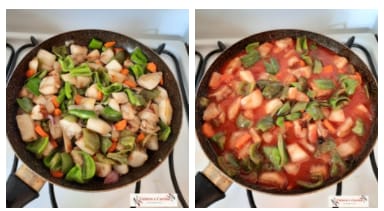
Fill a glass halfway with white vinegar and add a tablespoon of sugar.
Stir until the sugar dissolves, then pour the liquid into the pan with the caponata.
Turn up the heat, stir, and let it cook for a few minutes without a lid, allowing the strong vinegar smell to slightly evaporate.
Turn off the heat and serve the caponata hot, warm, or even cold — it will be good in any case.
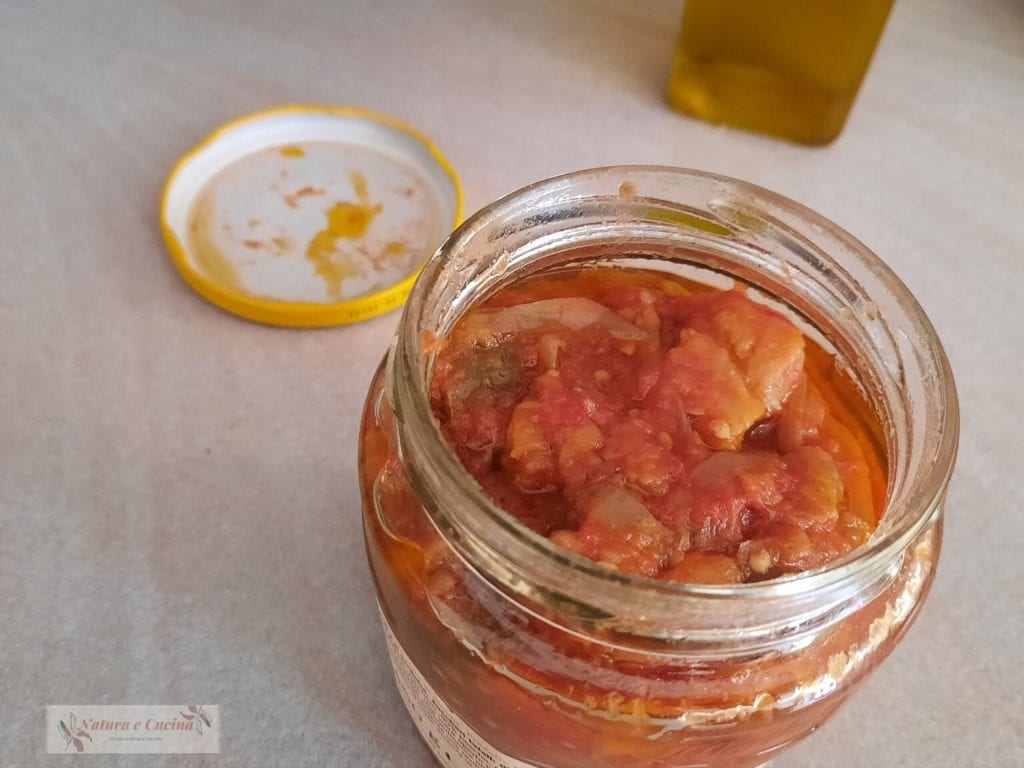
To preserve it: as soon as you turn off the heat, you can fill twist-off lid jars, previously sterilized (find out how here), leaving about an inch of space from the rim.
Flip them and cover them with a dish towel, letting them cool completely (even for a day).
Ensure the vacuum has formed, checking that the lid no longer makes the classic “clip clap” sound when pressed: if you still hear it, the jar is not properly sealed.
Once cool and sealed, store the jars in a dark and cool place, so you can enjoy the caponata during the winter.
