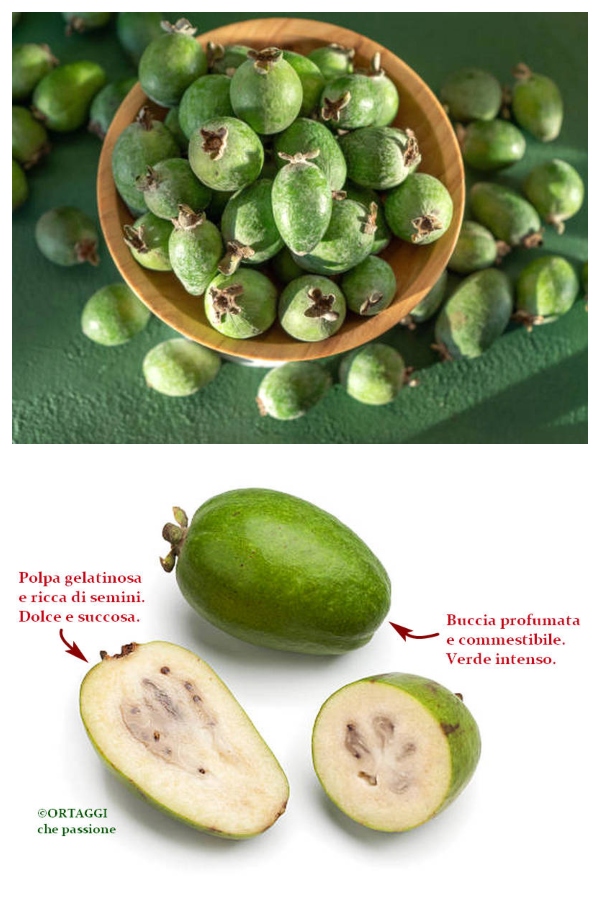
Feijoa fruit: a delightful tropical discovery increasingly appreciated in Italy for its unique taste and properties. Originally from South America, the feijoa (or Pineapple Guava, Guavasteen) is the fruit of the Acca sellowiana plant, an evergreen shrub easy to cultivate in mild climates. It resembles a kiwi but is smaller, with a matte green peel and fragrant light pulp. Its flavor, between pineapple, strawberry, and guava, is sweet, aromatic, and slightly tangy, ideal to enjoy fresh or in jam.
Besides the pleasure of the palate, this fruit offers significant benefits: it is rich in vitamin C, antioxidants, and fibers, which contribute to the body’s well-being. In Italy, the price of feijoa varies according to the season and origin, but it remains a small natural luxury to indulge in to discover new flavors.
#Feijoa SEASON: In Italy, it is harvested from September to December.
Where to add feijoa:
- Difficulty: Easy
- Cost: Medium
- Cuisine: Healthy
- Seasonality: Autumn
- Energy 61.00 (Kcal)
- Carbohydrates 15.21 (g) of which sugars 8.20 (g)
- Proteins 0.71 (g)
- Fat 0.42 (g) of which saturated 0.10 (g)of which unsaturated 0.19 (g)
- Fibers 6.40 (g)
- Sodium 3.00 (mg)
Indicative values for a portion of 100 g processed in an automated way starting from the nutritional information available on the CREA* and FoodData Central** databases. It is not food and / or nutritional advice.
* CREATES Food and Nutrition Research Center: https://www.crea.gov.it/alimenti-e-nutrizione https://www.alimentinutrizione.it ** U.S. Department of Agriculture, Agricultural Research Service. FoodData Central, 2019. https://fdc.nal.usda.gov
Feijoa Fruit
- 3/4 cup fresh feijoa
Recipes with Feijoa
What does feijoa taste like?
The feijoa has a sweet, aromatic, and slightly tangy flavor, truly unique and hard to compare to a single fruit. It recalls pineapple for its freshness, but also apple, banana, strawberry, and guava for the softer and fruitier notes, with a slight menthol touch that makes it unmistakable. The pulp is soft and fragrant, while the peel is more bitter and resinous.
How to use feijoa in the kitchen?
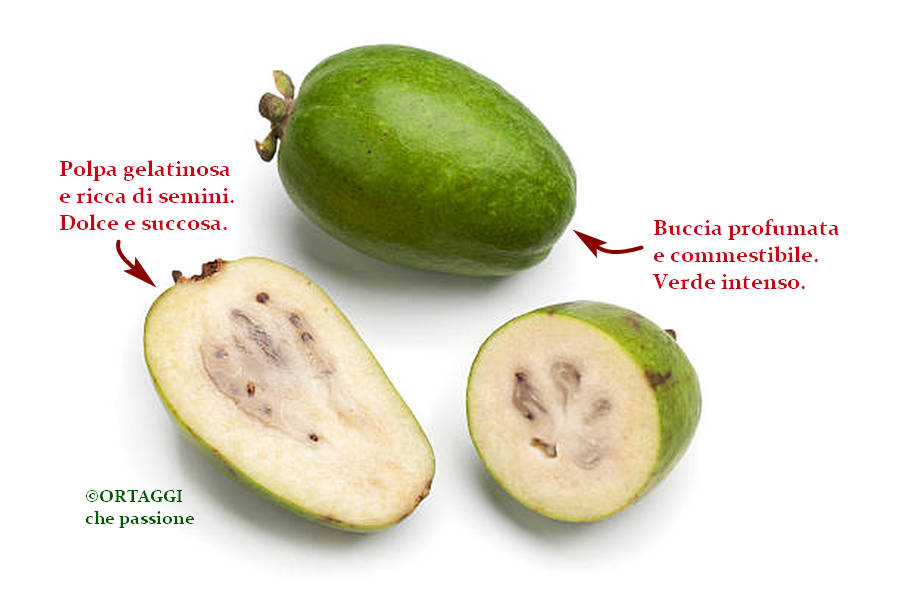
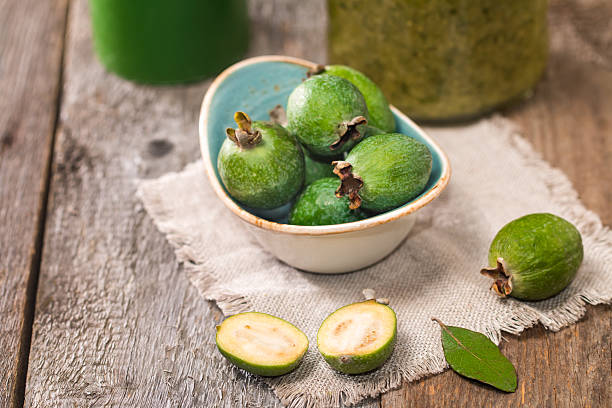
It can be enjoyed fresh, cut in half and eaten with a spoon, just like a kiwi. You can also consume the peel, which has a more intense and bitter flavor, and the small internal seeds, completely edible.
Alternatively, it is used to prepare desserts and pastries with an exotic fragrance. Its aromatic pulp also pairs well with yogurt, fruit salads, and smoothies.
In some savory recipes, it is used to accompany vegetable dishes or sweet and sour sauces. In pastry-making, it’s excellent for tarts and soft cakes, while feijoa jam retains all its intense aroma and is perfect for breakfast or paired with aged cheeses.
Use well-ripe fruits, cut them in half, and extract the pulp with a spoon (or peel and chop them) until obtaining about 2 lbs of pulp. Combine the pulp in a saucepan with 14-17.5 oz of sugar (its proportion, relative to the fruit, partly determines its preservability) and the juice of one lemon to preserve the color and promote the right density.
Cook gently for 30-40 minutes (or longer), stirring regularly to prevent sticking.
To taste, add: apple, grated fresh ginger, vanilla, or organic citrus zest.When the jam has reached a thick and glossy consistency, blend it for a finer texture, then pour it while still hot into sterilized jars and seal them tightly. Let them cool upside down to create a vacuum.
🍀 Feijoa and Avocado Salad
Dice feijoa and avocado, add arugula, lemon juice, and sesame seeds.
🍀 Cous Cous with Feijoa and Vegetables
Mix cooked couscous with diced feijoa, cooked pumpkin, and other seasonal vegetables with a drizzle of oil.
🍀 Feijoa Sauce for tofu
Blend feijoa with ginger, soy sauce, rice vinegar, and a teaspoon of honey.
🍀 Baked Feijoa with Potatoes
Combine sliced feijoa, potatoes, and onion, season with oil, salt, rosemary, and bake.
🍀 Feijoa Risotto
Sauté onion and chopped feijoa, add and toast the rice, deglaze with white wine, and cook with vegetable broth.
🍀 Savory Feijoa Tartines
Spread fresh cheese on wholemeal bread and top with thinly sliced feijoa.
🍀 Quinoa and Feijoa Salad
Mix cooked quinoa, diced feijoa, chickpeas, carrots, apples, and parsley with oil and lemon.🍀 Feijoa Porridge
Cook oats with plant-based milk, add diced feijoa and a teaspoon of honey.🍀 Feijoa and Banana Smoothie
Blend two ripe feijoas with a banana, half a glass of milk (dairy or plant-based), and, if desired, a teaspoon of sugar and/or honey.
🍀 Jam Tart
Prepare a shortcrust pastry base, roll it out, and fill it with feijoa jam. Bake in the oven at 350°F for about 35 minutes.
🍀 Caramelized Baked Feijoa
Halve the feijoas, sprinkle with brown sugar and a pinch of cinnamon, then bake at 390°F for 10 minutes. Serve warm with Greek yogurt or vanilla ice cream.Wash thoroughly 18 oz of feijoa, scrub them under running water to remove any residue, and chop them without peeling, discarding only the more bitter ends. Finely chop 1 red onion and let it soften in a pot with 1 tablespoon of extra virgin olive oil.
Add the feijoa, 1 green apple diced, 1 piece of ginger about 0.8 inches grated, and 1 garlic clove chopped.
Add a pinch of chili, 1 teaspoon of mustard seeds or powder, 1/2 teaspoon of turmeric, and, if desired, 1/4 teaspoon of cinnamon.Pour 5 fl oz of apple cider vinegar and 3.5 oz of brown sugar. Mix well, bring to a boil, and let it simmer on low heat until the mixture becomes thick and glossy.
Transfer to sterilized jars and store in the refrigerator.Consume after 2-3 days to allow the flavors to meld. When stored correctly, it keeps in the refrigerator for up to 3 weeks, sometimes a bit longer.
How to store fresh feijoa?
At room temperature, it lasts a few days; in the fridge, in a closed container, it keeps up to a week. The pulp can also be frozen for later use.
FAQ
Is the feijoa peel edible?
Yes, it is edible, but it has a bitter taste and a thick texture. Many prefer to consume only the sweet and fragrant inner pulp.
What are the properties of feijoa?
According to Dr. Trevisan: “Feijoa, thanks to its fibers and antioxidants, protects the colon from tumor development. It’s very rich in vitamin C, which strengthens and boosts the immune system, and improves bone and skin structure. It also contains folic acid, and its sugars do not spike blood glucose levels: for these reasons, it’s a recommended fruit for diabetes or weight loss. It contains arginine, an essential amino acid for growth and sought after by athletes; finally, it acts as a gastroprotective.”
Are there any contraindications in consuming feijoa?
Feijoa is generally safe, but should be consumed in moderation. It contains natural sugars and many fibers, which in excess can cause mild intestinal disturbances. Allergies are rare, but those sensitive to tropical fruits should try it cautiously.
What is the seasonality in other countries?
Feijoa ripens in autumn, but the season varies depending on the hemisphere: from April to June in southern hemisphere countries like New Zealand, Brazil, and Argentina, and from October to December in the northern hemisphere, such as in Italy, Spain, and California. In tropical areas, it may bear fruit twice a year, but with more limited production.
What is the price of feijoa?
In Italy, it is a rather rare fruit and can cost more than other tropical fruits.
The price of feijoa can vary significantly depending on the season and origin. In Italy, being still not widely spread and cultivated in limited quantities, it has a slightly higher cost, especially if it comes from organic or local farming. On average, it can range from 7 to 12 USD per kilo in specialized stores or tropical product markets. In countries where it is more common, like New Zealand or Brazil, the price is much lower, and the fruit is easily available during the season.Cultivation of feijoa in Italy?
Learn how to cultivate it.
In Italy, it is mainly cultivated in coastal and southern regions, where the climate is mild and sunny. It grows well in Liguria, Calabria, Sardinia, and Sicily (especially in lemon-producing areas), but also along the coasts of Tuscany and Lazio. It’s a hardy plant, resistant to light cold and can be grown both in gardens and pots, provided it receives plenty of light and the soil is well-drained.How to tell if it’s ripe?
Feijoa is ripe when it slightly yields to touch and emits a sweet, intense fragrance. Inside, the pulp should be soft, juicy, and translucent, with an inviting aroma. A sure sign that the fruit is ready to eat is when it spontaneously falls to the ground.
What does it look like?
Feijoa is a small-sized fruit, usually oval, about the size of an egg. It has a matte green peel, smooth or slightly rough, which remains that color even when the fruit is ripe. Inside, the pulp is clear and gelatinous, with a translucent core rich in juice and small edible seeds.
What color are feijoa flowers?
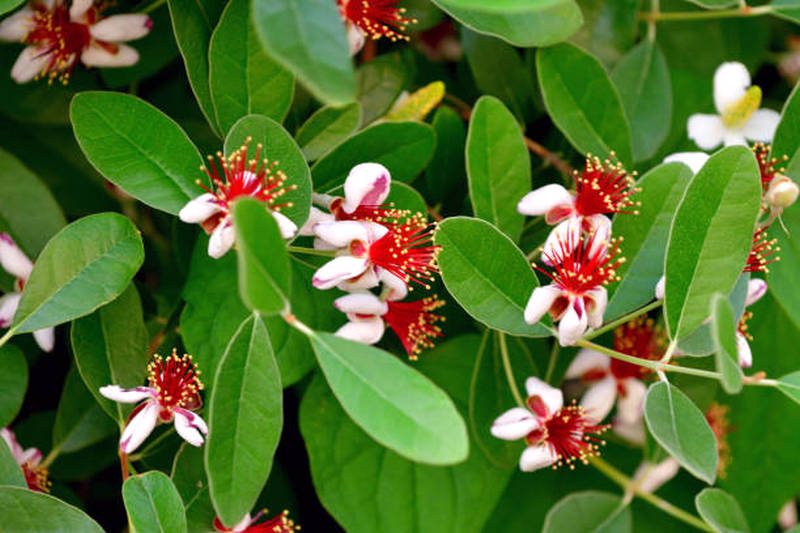
What is it called in Italian?
The fruits of the feijoa can also be known by other names:
🍀 Feijoa – the most common name, used both for the fruit and the plant.
🍀 Acca sellowiana – the official botanical name of the species.
🍀 Pineapple Guava – a name inspired by the taste and texture, reminiscent of a mix between guava and pineapple.
🍀 Guavasteen – another common name, used in some English-speaking countries.