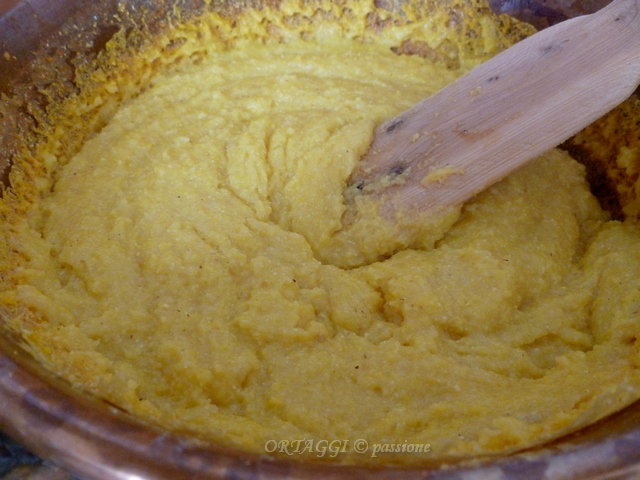
How do you prepare real grandma’s polenta? POLENTA is a classic recipe from northern cuisine. For its preparation, it’s best to use high-quality, coarse stone-ground flour, excellent the one from Storo, Spinato corn, Marano corn, Spin corn, from Valsugana…
In the past, in Trentino – Alto Adige, it was considered a poor, good, and hearty dish, while now it is a dish for gourmets. Have you ever tasted it cooked on a wood-burning stove? A real delight. Perfect for celiacs, cornmeal is gluten-free (gluten-free).
For a quick preparation, with more refined flours (fioretto or bramata), I recommend pressure cooker cooking, an easy and no-stir recipe. For ready-to-grill polenta (like the store-bought one), once cooked, pour it into a glass or ceramic mold and let it cool inside.
SEASONALITY: polenta is considered a cold-season dish. In the mountains, it is also consumed in summer.
MAIN COURSES to accompany with polenta:
- Difficulty: Easy
- Cost: Very cheap
- Preparation time: 5 Minutes
- Portions: 8 people
- Cooking methods: Stove
- Cuisine: Italian
- Seasonality: All seasons
- Energy 213.13 (Kcal)
- Carbohydrates 45.94 (g) of which sugars 0.94 (g)
- Proteins 5.44 (g)
- Fat 1.69 (g) of which saturated 0.22 (g)of which unsaturated 1.44 (g)
- Fibers 1.94 (g)
- Sodium 398.21 (mg)
Indicative values for a portion of 190 g processed in an automated way starting from the nutritional information available on the CREA* and FoodData Central** databases. It is not food and / or nutritional advice.
* CREATES Food and Nutrition Research Center: https://www.crea.gov.it/alimenti-e-nutrizione https://www.alimentinutrizione.it ** U.S. Department of Agriculture, Agricultural Research Service. FoodData Central, 2019. https://fdc.nal.usda.gov
POLENTA
optionally, you can add half a stale roll in the water
- 4 cups cornmeal (different corn flours can be mixed)
- 2 quarts water
- to taste coarse salt
Necessary Tools
- 1 Copper Pot with wooden handle
- Hand Whisk
- Ladle wooden (or Canarola or tarello or trisa)
- Cutting Board for polenta (tabiel)
- Knife wooden – polenta spatula
POLENTA
regional recipe – traditional cooking
Pour the water into the copper pot and immerse the half roll in pieces (optional, this trick makes the polenta more compact). Bring the water to a boil, when it reaches a boil, salt it (if using a copper pot, add the salt only just before the cornmeal).
Turn off the heat or lower the flame (the colder the water, the fewer lumps will form). Slowly and steadily pour the cornmeal while stirring well with a whisk. When there are no more lumps, turn the heat back on under the pot and cover with a lid for about 5 – 10 minutes.
Uncover and continue cooking, stirring occasionally (about every 5 – 8 minutes) with a sturdy wooden ladle or polenta canarola.Cook over medium heat for about 40 – 60 minutes (the longer the polenta cooks, the more digestible it becomes).
For optimal cooking, a nice crispy crust should form on the sides of the pot, and a good burnt smell should waft through the house, both signs that the cooking time is almost up.
Once ready, turn it out decisively onto a large round wooden cutting board. Serve it hot and slice it with a polenta cutter or kitchen string tied and wrapped around the handle of the polenta cutting board.

If it turns out too
LIQUID: to thicken the polenta, add semolina or instant cornmeal towards the end of cooking. Or extend the cooking time to improve consistency.
DENSE: to make it creamier, add white or red wine, milk, or oil at the end of cooking and stir.
HOW TO KEEP IT WARM before serving
Cover the cutting board with a tea towel, pour the hot polenta over it, and fold the tea towel into a bundle until it’s time to serve.
It can be accompanied and served with
mushrooms: mixed, honey mushrooms, chanterelles, porcini, sanguinelli.
cooked vegetables in a pan: cabbage, kale, sauerkraut, leafy greens, squash, grilled vegetables
cheese: fried, melted, gorgonzola, fresh tosella
fish: squid, shrimp, baked sea bream, stewed octopus, sardines, cuttlefish in ink, stewed cuttlefish, red mullet
meat: grilled, stewed, roasted, chops, braised beef, game, goulash, ragù, stew
POLENTA with dried porcini mushrooms
POLENTA with dried porcini mushrooms
Add minced dried porcini (crumbled or chopped) for 4 – 5% of the total weight of the flour. Example: for 500 g of flour (2 liters of water), use 20 – 25 g of dried mushrooms.
How much polenta per person?
Typically, you can consider a portion of polenta to be about 125-150 grams per person.
If, however, you are preparing an abundant meal with polenta as the central dish and your guests have a big appetite, you might consider increasing the amount of polenta. It’s always a good idea to have a few extra servings just in case.How to prevent lumps in polenta?
To avoid lumps in polenta: use uniformly ground and sifted cornmeal, add the flour off the heat and in already hot water, pour the flour steadily while stirring with a whisk, stir constantly during cooking, cook over low heat until fully cooked.
How should polenta be stirred?
To achieve smooth and lump-free polenta, it is essential to stir it constantly (in a circular or “8” motion) during cooking with a wooden spoon or whisk (the utensil should be long enough to avoid burning yourself). This process distributes the heat evenly, prevents lumps, and ensures a creamy consistency.
How do you know when polenta is cooked?
To check if polenta is cooked, taste it to ensure it has lost the raw flour taste. The polenta is ready when it easily detaches from the sides of the pot while stirring and has a tender, smooth, and creamy consistency. Cooking usually requires at least 40 minutes, and the longer it cooks, the better it is.