
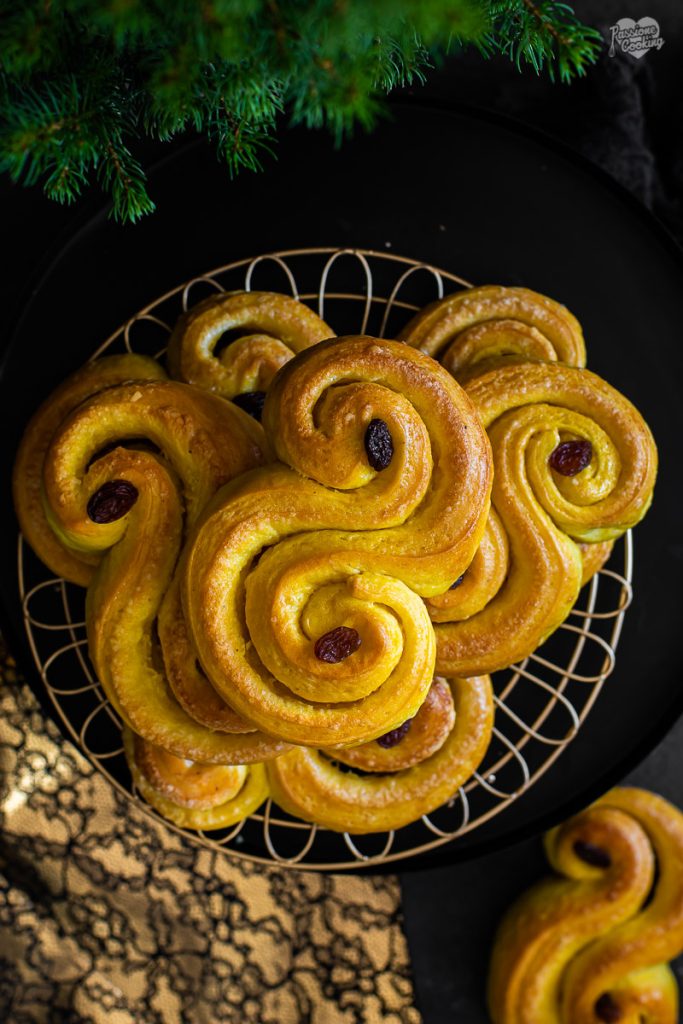
Lussekatter are traditional Swedish pastries made for St. Lucia’s Day, December 13th, with a leavened dough flavored with saffron. A unique feature, aside from their color, is certainly the “S” shape. In Sweden, the St. Lucia celebration, along with midsummer, represents one of the most important cultural traditions. The ancient figure of Lucia symbolizes light, being referred to as the bearer of light during the dark Swedish winters. It is said that this is also the reason for adding saffron to the dough, to achieve this beautiful yellow color, symbolizing light and warmth.
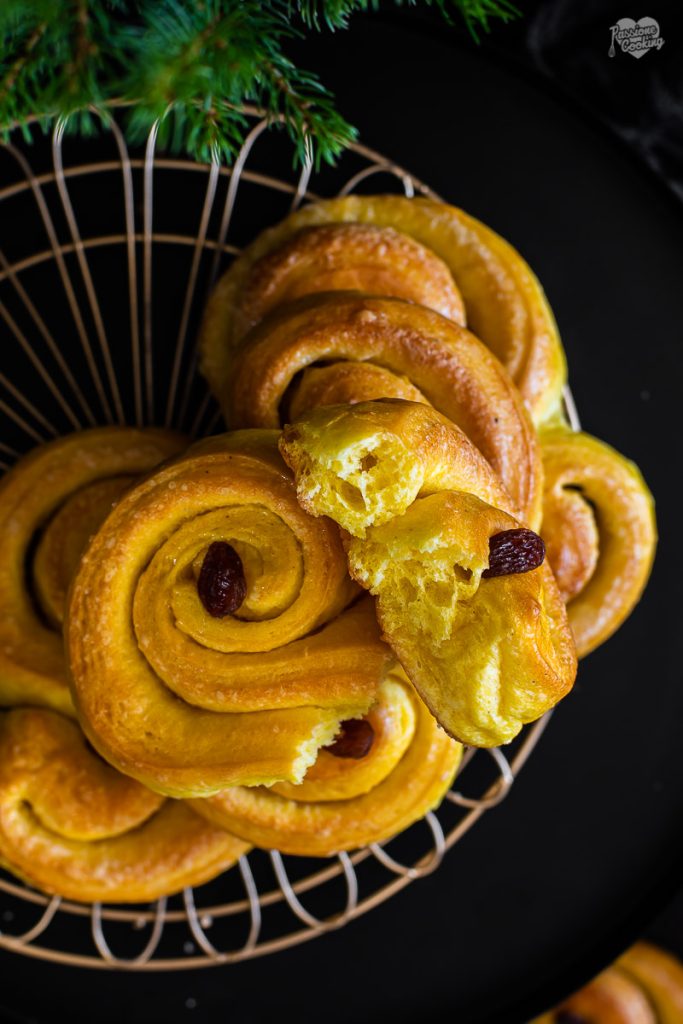
Traditionally, lussekatter are made without filling, but over the years, some delicious filled variants have emerged. I made them with a delicate filling of lemon zest and white chocolate.
If you prefer to make classic lussekatter, you can certainly use the same dough. In that case, instead of rolling out the dough and filling it, simply divide it into 16 equal pieces, form a rope with each piece of dough, and then roll it up as indicated to achieve the classic “S” shape.
Oh, and if you make them, don’t forget to also prepare the glögg, the Swedish mulled wine, which you can find the recipe for here on the blog, because lussekatter are often enjoyed together with glögg!
If you like Swedish dishes, also try these recipes of mine:
- Difficulty: Easy
- Rest time: 2 Hours 30 Minutes
- Preparation time: 35 Minutes
- Portions: 16 lussekatter
- Cooking methods: Oven
- Cuisine: Swedish
- Seasonality: Christmas
Ingredients
- 3 1/2 cups all-purpose flour
- 2 teaspoons instant dry yeast
- 1 1/8 cups milk (lukewarm)
- 1 packet saffron
- 7/16 cups sugar
- 1 tablespoon vanilla sugar
- 1/2 teaspoon salt
- 2 egg yolks
- 7 tablespoons butter
- 2 tablespoons butter
- 3 tablespoons sugar
- 1 unwaxed lemon (zest)
- 1/3 cup white chocolate
- 1 egg (for brushing)
- 32 raisins
Steps
To prepare the lussekatter, mix the flour with the instant dry yeast in the bowl of a stand mixer. In a cup, mix the lukewarm milk with the saffron. Then pour the saffron milk into the bowl with the flour and start the mixer. Add the sugar and vanilla sugar, then the salt and egg yolks. Continue kneading until the dough is cohesive, meaning it has come away from the sides and bottom of the bowl and has wrapped around the hook.
Transfer the dough to the stand mixer, make two folds, form a ball, and return it to the bowl. Let it rise covered, in a warm place, for 1.5 – 2 hours, until doubled.
In the meantime, melt the butter and mix it with the sugar. Also add the grated zest of the previously washed lemon and the grated white chocolate. Mix and set aside.
After the dough’s resting time, roll it out on a lightly floured surface to form a rectangle of about 12 x 16 inches. Spread the butter and white chocolate filling over the entire surface, then fold the dough in half lengthwise to obtain a rectangle of about 6 x 16 inches.
Roll over it lightly with the rolling pin just to adhere the two layers of dough slightly.
Then cut the dough into 16 strips about 1 inch wide.
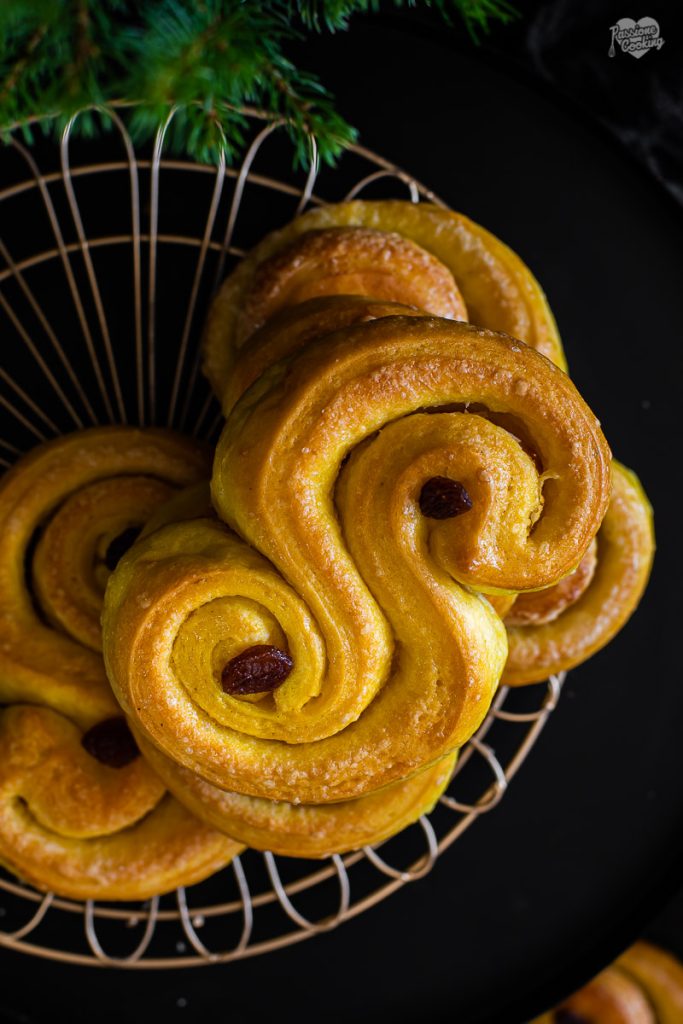
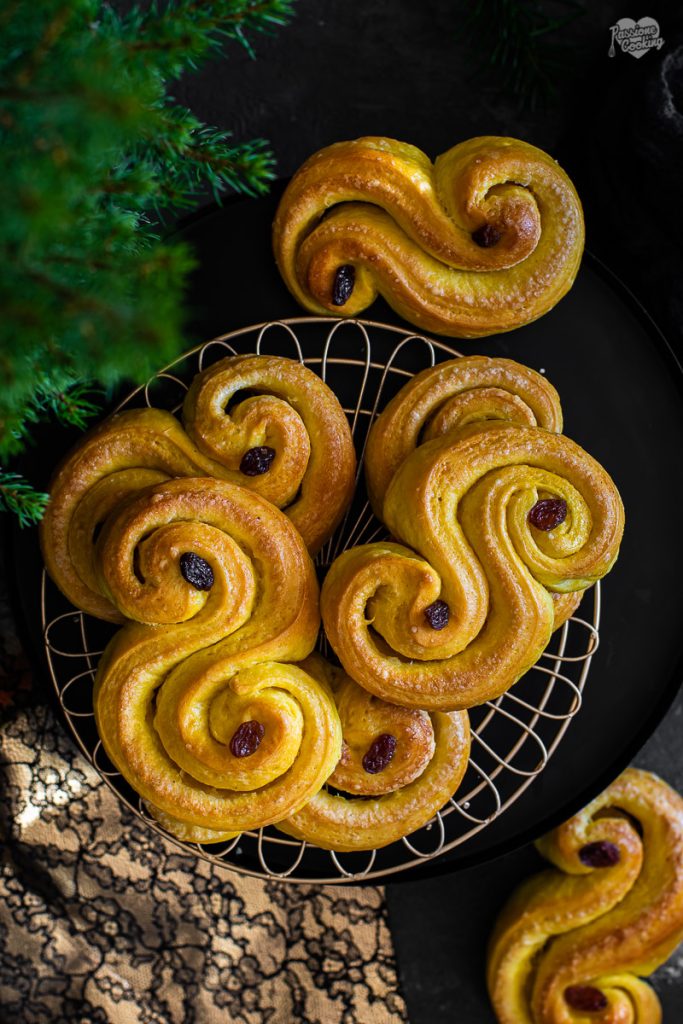
Take the first strip, roll one end to the middle, then flip it and roll the other end to the middle on the opposite side to achieve the classic “S” shape of the lussekatter. Lay on a baking sheet lined with parchment paper.
Proceed the same way with the remaining dough strips.
Let the lussekatter rise covered for 30 minutes.
Before the time is up, preheat the oven to 347°F (static).
After the resting time, brush the lussekatter with the beaten egg and garnish by placing the raisins at the center of each spiral (2 for each lussekatter). Bake at 347°F for 15-18 minutes until they are lightly golden.
Remove from the oven and let cool on a wire rack, or enjoy the lussekatter warm or at room temperature.
If any are left over, place them in a food bag and freeze them so you’ll always have lussekatter ready to enjoy after thawing at room temperature or even in a skillet.
Tips
If you want to prepare classic lussekatter, which are made without filling, you can use the same dough. In that case, instead of rolling out the dough and filling it, simply divide it into 16 equal pieces, form a rope with each piece of dough, and then roll it up as indicated to achieve the classic “S” shape.
