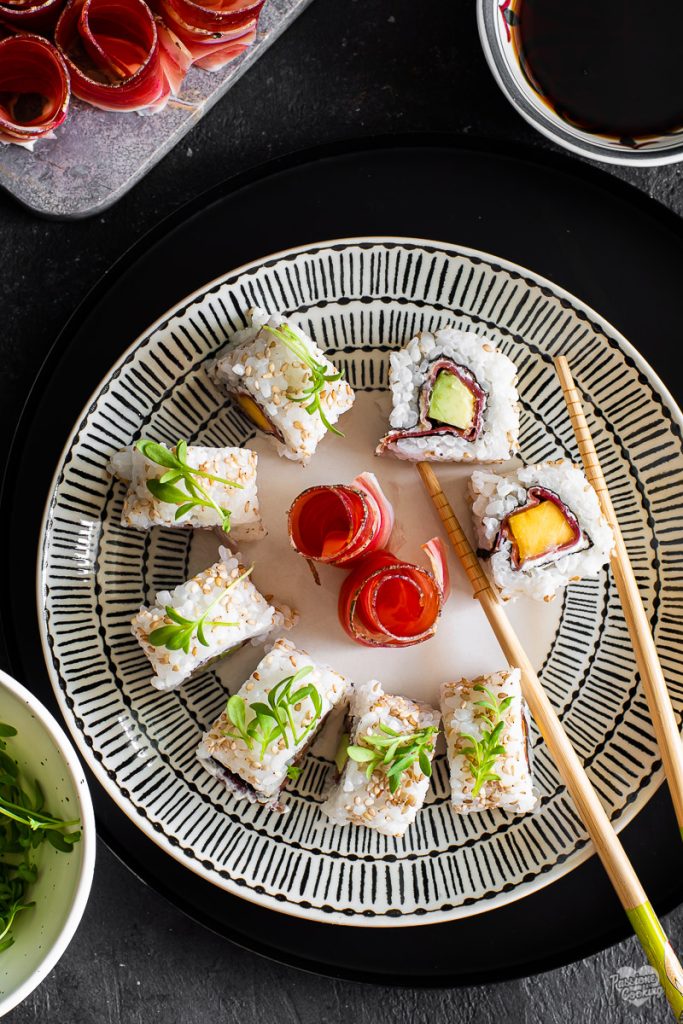
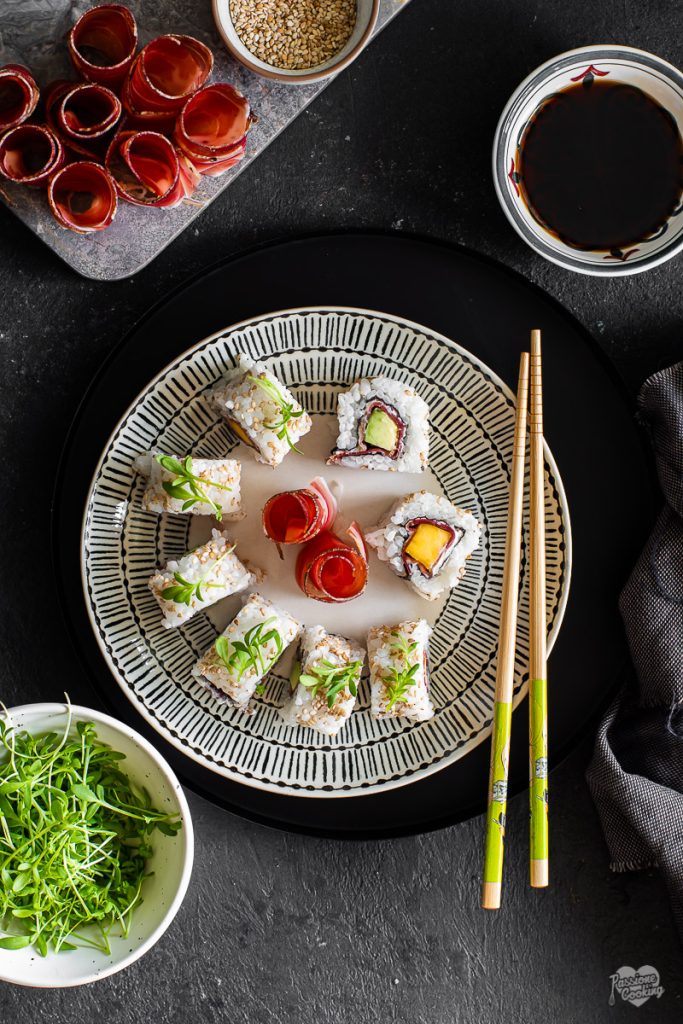
Ready for a fusion recipe? Here are the uramaki with Speck, a combination of Japanese and South Tyrolean cuisine, for a delicious mix of flavors, with the classic seasoned rice used for sushi, and, of course, Speck Alto Adige PGI. The perfect alternative to sushi, for all those who do not particularly like raw fish, or fish in general, and for those always seeking new flavors. A fresh main dish for the whole family… and preparing it together will be even more fun!
In fact, making uramaki with Speck Alto Adige PGI is not difficult. With a little practice, these inside-out rolls, with rice on the outside wrapping the filling, can be prepared in no time. On my Instagram page, you can also find the reel about them.
Besides Speck, for the filling I used fresh spreadable cheese and exotic fruits like mango and avocado. Of course, you are free to vary with other seasonal fruits like peaches, apricots, or raw apple sticks because fresh fruit and Speck Alto Adige PGI harmonize well together.
- Difficulty: Medium
- Rest time: 30 Minutes
- Preparation time: 40 Minutes
- Portions: 10 uramaki
- Cooking methods: Stove
- Cuisine: Japanese
- Seasonality: All Seasons
Ingredients
- 2 1/2 cups sushi rice
- 2 cups water
- 1/3 cup apple cider vinegar (or rice vinegar)
- 1 tbsp salt
- 2 tbsps sugar
- 1 mango
- 1 avocado
- 30 slices Speck Alto Adige PGI
- 5 sheets nori seaweed
- as needed fresh spreadable cheese
- as needed sesame seeds (for garnish)
- as needed cress (for garnish)
- as needed soy sauce
Steps
To prepare the uramaki with Speck Alto Adige PGI, start by cooking the rice, as it needs to cool before proceeding. Wash the rice several times in a bowl with cold water, rubbing it between your hands, and changing the water several times to remove all the starch. When the water remains clear, it is ready. At this point, transfer it to the pot with the indicated amount of water (ratio 1:1) and bring to a boil with the lid on. As soon as it boils, lower the heat and let it simmer gently for 10 minutes, without opening the lid. After 10 minutes, still without opening the lid, turn off the heat and let it rest for 10 minutes.
In the meantime, prepare the seasoning for the rice. Put the vinegar and salt in a small pan and bring to a boil, stirring to dissolve the salt. Then remove from the heat, add the sugar, and stir to dissolve it as well.
When the rice is ready, transfer it to a non-steel baking dish (those with a hangiri or another low and wide wooden container can, of course, use that). Then pour the vinegar and sugar mixture over the rice, not directly, but pouring it over the wooden spoon to spread it over all the rice. Mix gently, as if to incorporate the vinegar, so as not to crush the rice. When the rice is evenly seasoned, set it aside to cool.
In the meantime, prepare the filling for the uramaki.
Peel the mango and cut it into sticks about 1/2 inch thick. Do the same with the avocado.
Cover the makisu (bamboo mat) with cling film. Cut the nori seaweed sheets in half.
When you have prepared all the ingredients for the filling and the rice has cooled, you can assemble the uramaki.
Place the cling-film-covered makisu on the work surface and place a nori seaweed sheet on it. With wet hands, take some rice and place it on the nori seaweed. Distribute it evenly over the entire sheet of nori seaweed with the tips of your fingers, without pressing it too much. The rice layer should not be very thick. Sprinkle sesame seeds over the rice.
Gently lift the nori seaweed and flip it so that the rice is in contact with the makisu and the nori seaweed is facing you. Spread the entire surface of the nori seaweed with the spreadable cheese, then place 3 slices of Speck Alto Adige PGI, leaving about 1/2 inch free on the upper edge. Add a row of mango or avocado sticks along the lower edge.
Lift the mat from the bottom and roll the uramaki inside it, pressing well to compact everything once the roll is formed.
Open the mat, take the uramaki, and transfer it to a cutting board. With a wet knife, cut it in half. Then cut the two halves again in half to obtain 4 pieces, and finally cut these 4 pieces in half to obtain 8 pieces in total.
Proceed in the same way for the remaining uramaki.
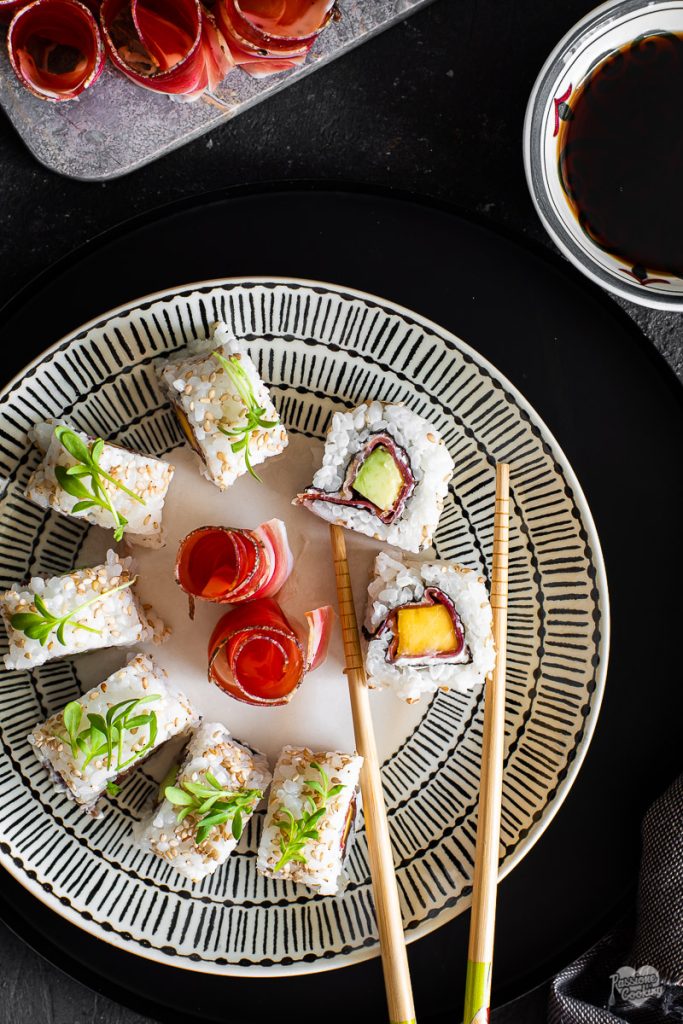
Once all the uramaki are ready, place them on trays or plates, garnish with cress, and serve accompanied by soy sauce to taste.