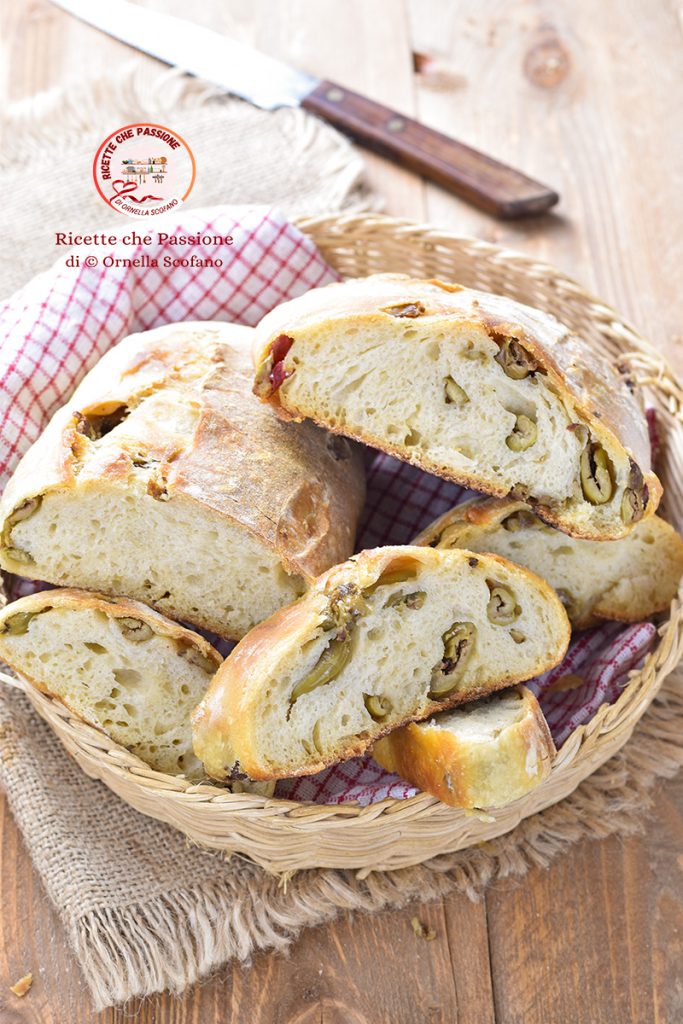
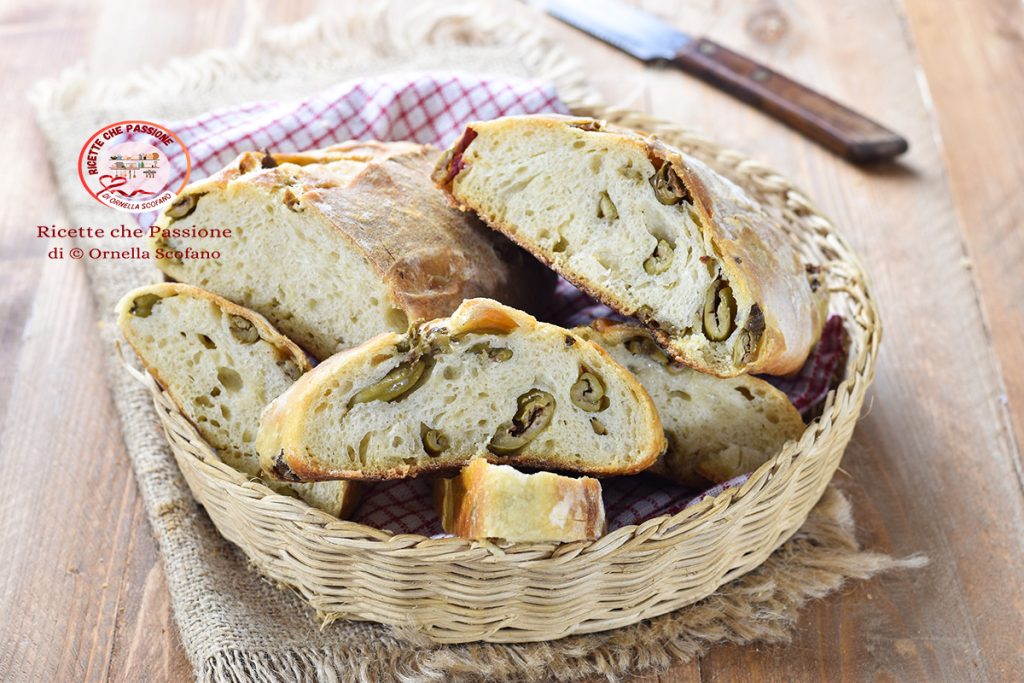
I’m back with a lovely sourdough recipe: semolina bread with crushed Calabrian olives made with sourdough starter. Alternatively, if you don’t have fresh sourdough starter you can use dried starter from a packet. I love making bread at home and I occasionally try new variations. This time I prepared a mixed semolina of re-milled durum wheat, adding homemade crushed olives that have a unique taste and flavor. Some time ago I made small baguettes, which were also delicious and perfect for aperitivo, great on their own. This time I made two large loaves to replace the usual bread at lunch and dinner with this fragrant and tasty olive bread, and the result is truly exceptional, enhanced by the use of sourdough starter which allows a natural rise that makes the bread really special — just like the one from your favorite baker.
- Difficulty: Medium
- Cost: Economical
- Rest time: 8 Hours
- Preparation time: 40 Minutes
- Portions: 2
- Cooking methods: Oven
- Cuisine: Italian
- Seasonality: All seasons
Ingredients for 2 loaves of semolina bread with olives
- 9 oz refreshed sourdough starter (or 1 1/2 tsp dried sourdough starter)
- 3 1/3 cups type 0 flour
- 2 1/2 cups re-milled durum wheat semolina
- 1 tbsp + 1 tsp tsp/tbsp salt
- 2 1/2 cups water (about 20 fl oz)
- 10.6 oz oz crushed olives
Tools to prepare the semolina olive bread with sourdough starter
- 1 Bowl
- 1 Baking sheet
- 1 Parchment paper
- 1 Work surface
Preparation steps for semolina bread with sourdough starter and olives
Let’s start with the dough. If you have refreshed and active sourdough starter you can proceed. Otherwise refresh it first and let it rise until at least doubled. In a large bowl mix 100 g of starter with 100 g of type 0 flour and 50 g of water, knead and let rise — this is the refresh. The extra 100 g of flour is in addition to the quantities indicated, to obtain the same amount of starter.
If you’re using dried sourdough starter or baker’s yeast, do this: put the yeast in a bowl with 50 g of water and 100 g of type 0 flour, mix and let rise. Again, the 100 g of flour is extra compared to the amount indicated. You will have 100 g less starter than in the original dough, but it’s not a big issue.
When the starter is ready, add the other ingredients to the bowl, starting with the water to soften the starter — you can also break the starter into pieces to work it better. Then gradually add all the flour and the durum wheat semolina until you obtain a homogeneous dough. Then add the salt and continue working. Make pauses so that in the end you’ll have a nice soft but not sticky dough, elastic and well developed; it’s ideal to make 2–3 pauses, even with 10 minutes between them, then resume working. Cover with plastic wrap and let rise.
An ideal rise is about 24 hours, but you can reduce it to 12 hours. It’s important to keep the dough at the right temperature for proper maturation: for long times use a lower temperature, for shorter rises a higher temperature. You can alternate refrigerator and room temperature depending on the season, or room temperature and an oven with a pot of hot water to have slightly higher humidity/temperature during cold months.
When the dough has risen well, take it and transfer it to a lightly floured work surface. Stretch it and perform 2 series of strengthening folds spaced apart.
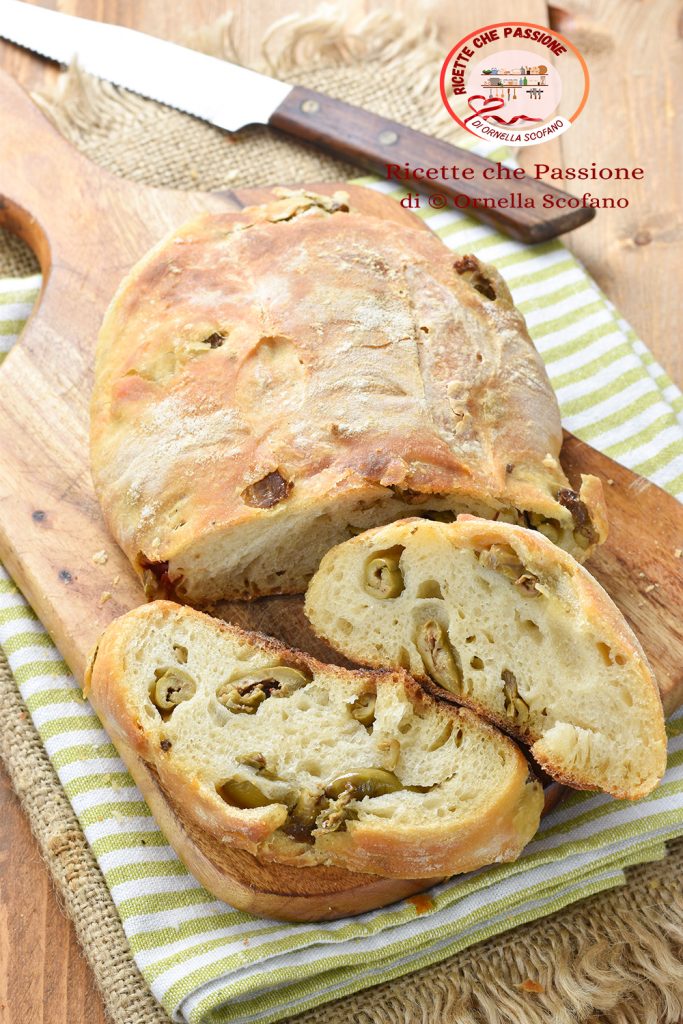
Then divide the dough into 2 equal parts. Let them rest briefly, then stretch into rectangles and season with crushed Calabrian olives, then close to form loaves by rolling the dough.
Place the loaves on the baking sheet lined with parchment paper, spaced apart.
Let them rise in the oven with the light on and a small pot of boiling water for 1–2 hours.
Remove the bread from the oven and preheat the oven using convection (fan) to the maximum temperature — mine is 482°F. You can sprinkle a little semolina over the loaves and make lengthwise slashes before baking. Bake the bread with the small pot of water at 482°F (fan) for 15 minutes; after this time begin lowering the temperature: another 15 minutes at 428°F, then another 15 minutes at 392°F — then dry it well by leaving it in the oven for an additional 15 minutes at 320°F. Of course, adjust according to your oven. In the final minutes you can also remove the water pot. This method gives the bread a beautifully crispy crust.
Remove from the oven and enjoy. It’s delicious right out of the oven and still warm, but also great cold — it stays soft and flavorful for several days, thanks to the combination of durum semolina and sourdough starter which allows longer preservation.