
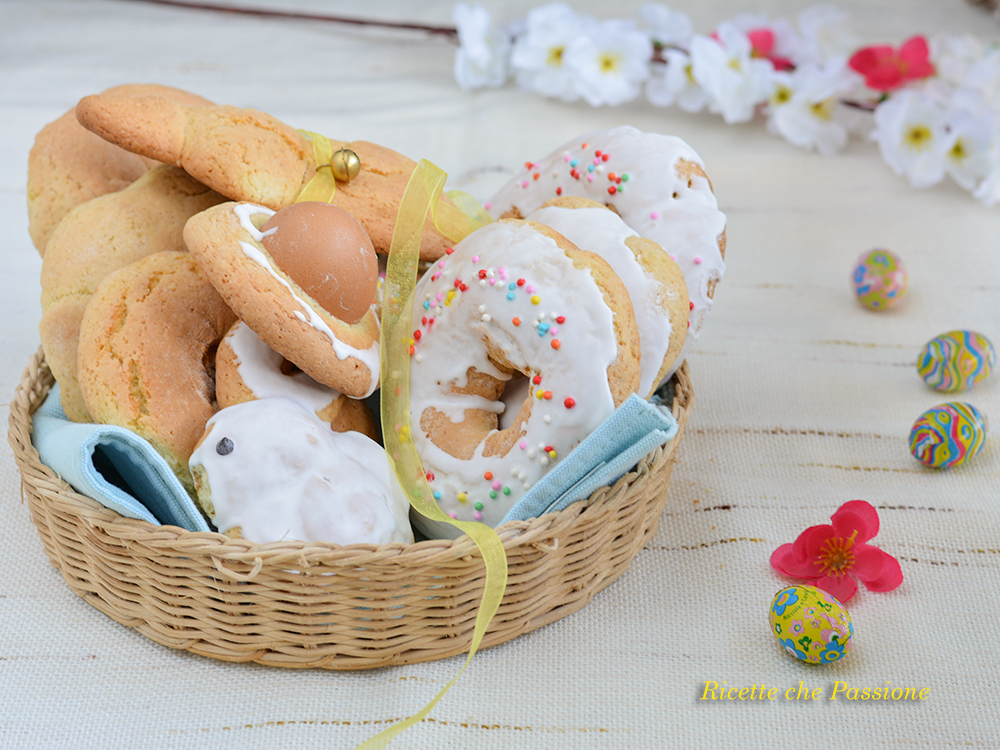
Calabrian cuzzupe, typical Easter sweets, traditionally baked in a wood-fired oven. They are large cookies made with simple ingredients: flour, milk, eggs and lard, although you can also use oil or butter. What really makes them special is the egg that is braided into the cookie dough. They are generally known as cuzzupe, but in Calabria they take different names depending on the area. In my village, in the Cosenza area, they are called cuddureddi or cuddhura, with or without sugar glaze; if you add the egg, or rather the eggs, because usually more than one was used, they become cannaleri. They are also called vuta, sguta, pizzatola, cuddhuraci depending on the town. They are widespread in Southern Italy: other regions have similar versions sometimes with the same names, like the Sicilian cuddhuri, and sometimes very different like the Apulian scarcelle. They are also excellent when baked in a home oven rather than a wood oven. At Easter they must not be missing: cuzzupe and Easter bread are a tradition not to be given up; also present are the mythical ‘mpignulata, stuffed Easter pie‘ or the fraguni.
- Difficulty: Very easy
- Cost: Very inexpensive
- Preparation time: 40 Minutes
- Cooking time: 20 Minutes
- Portions: 20 pieces
- Cuisine: Italian
Ingredients
- 8 cups All-purpose flour
- 2 cups Granulated sugar
- 6 Medium eggs
- 2 packets (about 2 tbsp) Baking powder
- as needed Lemon zest
- 2/3 cup Milk
- 5.3 oz Lard ((or butter or 1/3 cup vegetable oil))
- as needed Eggs (For decorating, optional)
- as needed Powdered sugar (at least 2 cups (about 250 g))
- 1 Egg white
- as needed Lemon juice
- as needed Colored sprinkles (optional for decorating)
Preparation
On a pastry board place the flour, or if you prefer in a large bowl. Add the sugar. Make a well in the center and put in the eggs, the milk, the melted butter or lard, the baking powder and the grated lemon zest. Start working the liquid ingredients in the center with a fork, and gradually incorporate the flour; it is easier to finish working by hand quickly. Move to a floured surface to knead the dough better, and as you go use a little flour to keep your hands clean; you should end up with a compact, non-sticky dough ball.
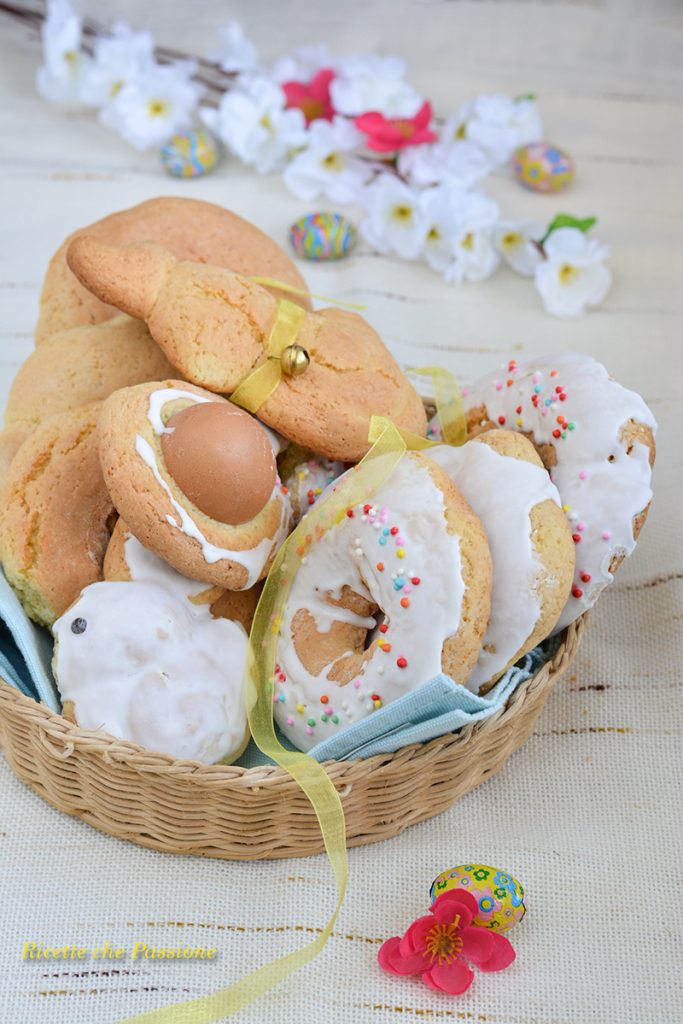
Work the dough quickly, as if it were shortcrust, then shape the cuzzupe. There are several forms: a ring with a hole, a narrow ring that will lose the central hole during baking, and a shape that resembles a key: in practice you make a small rope, create a kind of bow in the center and braid the two ends. Some give them the shape of a dove, a fish, or other decorative shapes; this year I also made little bunnies, as you can see in the video.
You still need to decide whether to put an egg on the cuzzupa. Some do and some don’t. The egg is placed on top of the ring and tied with extra dough—two small ropes crossed to hold the egg. In braided cuzzupe it is placed in the hole formed by the bow. It is not strictly necessary to add the egg: if you like it, add it, otherwise skip it. The egg is placed raw because it will cook in the oven and can be eaten once the cuzzupe are baked.
A charming tradition is tied to the cuzzupe in Calabria. At Easter the mother-in-law, in the name of her daughter, gives the cuzzupa to the son-in-law: with 9 eggs if the wedding is still some time away (which renews the promise), and if the wedding will take place within the year she gives a cuzzupa with 7 eggs, usually heart-shaped. This tradition also confirms that eggs are always placed in odd numbers.
Place the cuzzupe on a baking tray lined with parchment paper and bake in a hot oven at 356°F for about 20 minutes; in a fan-assisted oven keep it below 329°F. Obviously if you have a wood-fired oven even better; they will take just a few minutes.
Once the cuzzupe are out of the oven and nicely golden, you can glaze them while still warm with a little icing. The sugar glaze can be prepared with water and powdered sugar as shown here, or with egg white: just one egg white worked with powdered sugar using a whisk and a few drops of lemon juice until the glaze “writes”. If it seems too runny, add more powdered sugar.
As you take the cuzzupe out of the oven, brush the warm cookies with glaze using a pastry brush, sprinkle with colored sprinkles, and in a few minutes the glaze will have dried. Try the cuzzupe with the glaze: they are truly delicious cookies. I must say, after trying all versions, they are very soft with lard and have that typical homemade flavor, like grandma used to make.
There is also a brioche version of the Calabrian cuzzupe, soft anise cuzzupe, Calabrian Easter sweets a little different from the usual brioche, a bit firmer but with the unique anise flavor, using anise seeds or anise liqueur.
