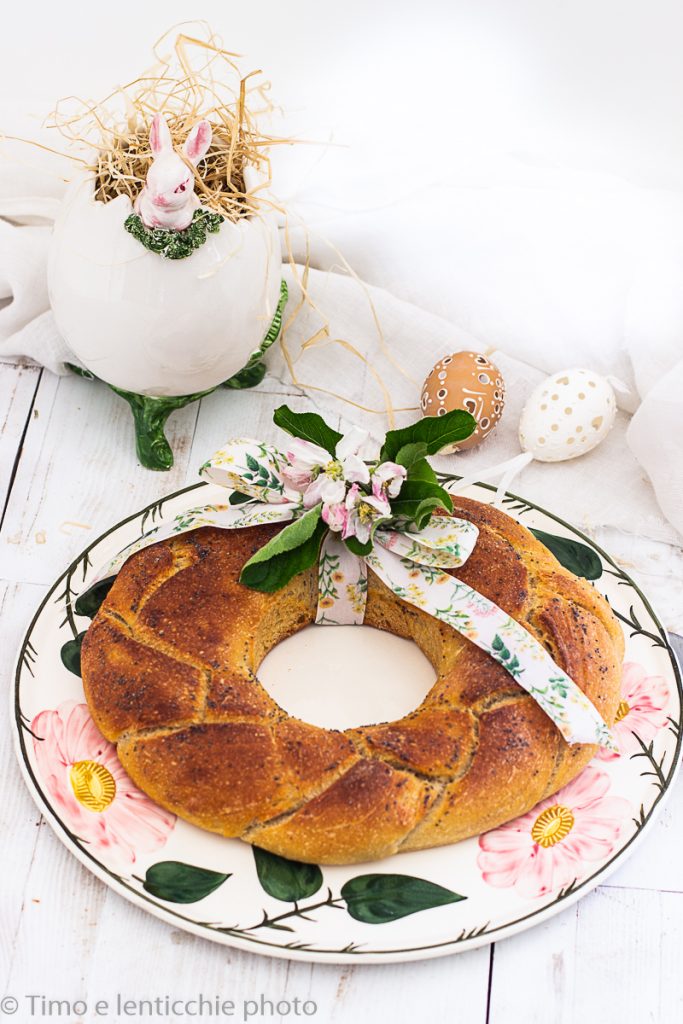
A festive and soft bread to share with your dearest ones, the Easter Bread Wreath.
A bread to present as a centerpiece and to break together to feel more united and serene.
In these dark times, it is easy to fall into pessimism when looking at what happens in the world. But even if it is difficult, hope for a nearby and lasting peace must always be with us.
I make mine a phrase by Alessandro Baricco mine:
“Humanism will become our daily practice and the only true wealth: it will not be an academic discipline, it will be a space of doing that we will never allow to be stolen from us.”

So on Easter Sunday I will prepare a beautiful flowered table, with fresh flowers from my garden. I will bring to the table the asparagus flans, a risotto with carletti (wild chard), a vegetable bavarois, and to finish the strawberry dove-shaped cakes.
I looked for a Venetian Easter bread but we don’t have this tradition like in the South. So I thought of an Easter Bread Wreath that unites all the people I love in a big hug.
You can also see the South Tyrol Easter bread.
For any information do not hesitate to contact me on my Facebook Timo e lenticchie page, you can interact and ask me any question. Or join my group.
Follow me also on Instagram, Twitter or Pinterest or YouTube or subscribe to the Telegram channel.
I leave you a few other Easter recipes you might be interested in:
- Difficulty: Medium
- Cost: Economical
- Rest time: 1 Day
- Preparation time: 30 Minutes
- Cooking time: 35 Minutes
- Portions: 2 wreaths
- Cooking methods: Oven
- Cuisine: Italian
- Seasonality: Easter
Ingredients for Easter Bread Wreath
I tried to make this wreath using surplus sourdough starter and, naturally, while it is crunchy outside and soft inside, if I had used well-fed sourdough starter or baker’s yeast it would have risen even more.
You can therefore use 250 g of refreshed sourdough starter or half a packet of dry yeast.
- 2 cups type 1 flour
- 3 cups re-milled durum semolina
- 1 cup sourdough starter (about 9 oz / 250 g)
- 1 7/8 cups water (about 450 ml)
- 2 tsp coarse sea salt
- 2 tbsp extra virgin olive oil
Preparation of the Easter Bread Wreath
In a stand mixer, combine the flour with the ready sourdough starter and a little water. Mix and let rest (autolyse) for at least 15 minutes.
Add the oil and the salt and knead until the dough is smooth and well developed.
On a lightly floured work surface, perform a few folds and shape the dough into a tight round, sealing underneath.
Place in a large oiled bowl, cover with plastic wrap, and put in the refrigerator for 24 hours.
Remove the dough from the refrigerator and let it come back to room temperature for at least one hour. Divide the dough into 6 equal parts and roll into logs about 30 cm long (about 12 inches).
Make two braids, form them into wreaths and seal the ends well.
Transfer the two wreaths to baking sheets lined with parchment paper, brush with a little water, sprinkle with poppy seeds, cover well with plastic wrap and place somewhere away from drafts to proof for at least another couple of hours until doubled in size.
Bake in the oven at 220°C for 10 minutes, then lower to 200°C and bake for about another 30 minutes. (220°C = 428°F; 200°C = 392°F). Use a conventional oven with a small pan of water placed low in the oven to keep humidity. In the last two minutes, open the oven slightly to let some of the humidity escape and to dry the bread a little.
Ingredients for the single-wreath version with dry yeast:
300 g all-purpose flour (about 2 1/2 cups)
200 g type 2 flour (about 1 2/3 cups)
5 g dry yeast (about 1 2/3 tsp)
1 teaspoon sugar
2 tablespoons extra virgin olive oil
1 teaspoon salt
1 teaspoon dried thyme
1 teaspoon poppy seeds
In a stand mixer, combine the flours with the dry yeast, sugar, water and dried thyme.
Mix and knead for a few minutes until the dough comes together. Add the oil and after a few minutes add the salt. Finish kneading for about 10 minutes.
Move the dough to a floured surface and perform a few more folds, then shape into a tight round sealing the bottom.
Gently place the dough in a large oiled bowl, cover with plastic wrap and put in a turned-off oven with the light on until doubled in size; this will take about 2 hours.
Divide the dough into 3 equal parts and roll into logs about 30 cm (12 inches) long.
Make a braid, form into a wreath and seal the ends.
Transfer the wreath to the oven tray lined with parchment paper, brush with a little water and oil, sprinkle with poppy seeds and more dried thyme, cover well with plastic wrap and move away from drafts (again in the turned-off oven with the light on) to proof for at least another hour until nicely risen.
Bake in the oven at 220°C for 10 minutes, then lower to 200°C and bake for about another 30 minutes. (220°C = 428°F; 200°C = 392°F). Use a conventional oven with a small pan of water placed low in the oven to keep humidity. In the last two minutes, open the oven slightly to let some of the humidity escape and to dry the bread a little.
INGREDIENTS AND INSTRUCTIONS FOR A SINGLE WREATH WITH DRY YEAST
Daniela’s Tips
Storage: Keep the wreaths in a paper bag for a couple of days; you can slice and toast the bread.
How do you keep it perfectly round and prevent the hole in the center from closing?
I use an inverted small bowl oiled and placed in the center during proofing and baking; it helps to maintain the shape. You can also use a well-oiled ring mold.
If I wanted a shinier, more golden result?
I didn’t want to use egg to glaze the surface, so I brushed only with plant milk and sprinkled chia seeds, but you can proceed as you prefer.
Can it also be made as a sweet version?
Certainly — just add sugar to the dough and perhaps orange zest or candied fruit.
How long does it keep? Does it stay soft the next day?
The Easter bread wreath stays soft for a few days, like any bread. With sourdough it lasts longer. You can always warm it slightly and it will become soft again.