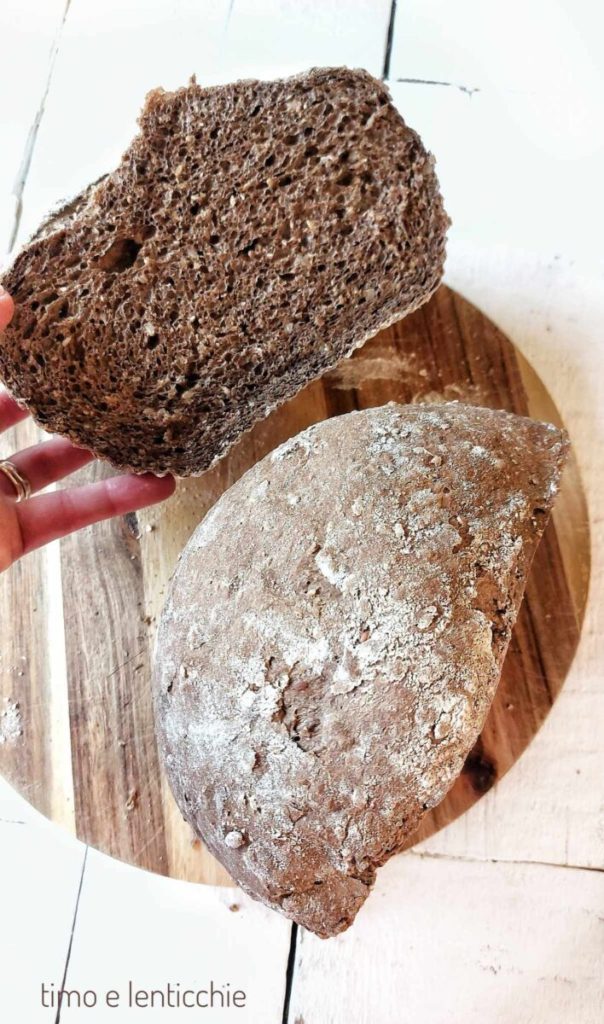
Baking bread at home always brings me great peace, like this Mixed Bread with Oats, Rye, and Barley, super soft and whole grain.
Kneading is relaxing, waiting for the dough to rise, baking, the aroma filling the kitchen. Finally enjoying this bread, sliced, even just with oil or with an hummus, with a jam… I also love it with thyme and lemon, give it a try.
And the leftover slices I either freeze, or toast to make rusks, or even croutons sautéed in a pan with herbs to use in evening soups.
Here I used a mix called Tyrolean bread by Cuore di Macina: rye flour, oats, barley with flax seeds, sunflower seeds, sesame seeds, and dried sourdough.
On the blog, you’ll find many breads and loaves, kneaded by hand, in the stand mixer, baked with a bread machine, baked in the oven, steamed.
As for the flours I use, they can be pure, or I also like to try the cereal mixes offered by companies like in this case.
On the blog, you’ll find gluten-free breads, savory rolls, sweet buns, donuts, legume buns… all kinds of bread. I’ll leave you some examples below
- Difficulty: Very easy
- Cost: Very cheap
- Rest time: 2 Hours
- Preparation time: 10 Minutes
- Portions: 1 loaf
- Cooking methods: Oven
- Cuisine: Italian
- Seasonality: All seasons
Ingredients for Mixed Bread with Oats, Rye, and Barley
- 3 3/4 cups cereal flour
- 1 1/8 cups water
- 4 tbsps extra virgin olive oil
- 2 tsp instant yeast
Tools
- 1 Stand Mixer
- 1 Proofing Basket
- 1 Metal Scraper
- 1 Pastry Board
- 1 Bowl
How to Prepare Super Soft Mixed Bread with Oats, Rye, and Barley
In the stand mixer, pour the flour mix, yeast, lukewarm water, and oil. Start with the hook and let it knead for about ten minutes.
Transfer the dough to a bowl, cover, let rise for about half an hour.
Move the dough onto a floured pastry board and do three folds, then shape into a round loaf by pinching underneath. (This step is called dough shaping).
Lightly flour the proofing basket (I like using silicone ones because I can place them directly in the oven).
Cover with plastic wrap and place in an off oven with the light on.
Let it rise for a couple of hours until it’s nicely puffed up.
Take it out and keep it warm while preheating the oven to 375°F. When the oven reaches temperature, gently remove the plastic wrap, optionally sprinkle some flour on the dome, make a cut with a blade on the bread, and place the risen bread on the lowest rack. Conventional oven.
Place a small pot with a little water next to it to create steam.
Let it bake for 45 minutes, but after 15 minutes cover with parchment paper, or it will get too dark for my taste.
Once baked, remove from the oven, flip it out of the container, and place it on a rack to cool.
Storage Tips for Mixed Bread with Oats, Rye, and Barley
Storage Tips for Mixed Bread with Oats, Rye, and Barley
Store the bread in a paper bag inside a plastic bag. You can slice, portion, and freeze it. You can turn it into rusks or croutons.
Recipe Variations
You can use other types of flour, paying attention to the amount of water as each flour absorbs liquids differently.
You can add seeds to enrich your bread.
You can form small loaves instead of one large bread, then reduce the baking time by 10 minutes.
Leavening Tips
In winter, I recommend using a bowl for the first rise to keep the bread warm.
Lately, when I am in a hurry, I also like the silicone basket, because I cover it and leave the dough to rise there, then transfer directly to a hot oven. But the wicker proofing basket is also fine, just can’t put it in the oven, so you need to turn the dough onto the baking sheet.
At this point, I recommend using a baking stone that you will heat in the oven and turn the bread onto at the last moment. The heat of the stone will immediately give the bread the strength to stay nice and round. If it comes into contact with a cold plate, it tends to sag a bit.
At this point, I recommend using a baking stone that you will heat in the oven and turn the bread onto at the last moment. The heat of the stone will immediately give the bread the strength to stay nice and round. If it comes into contact with a cold plate, it tends to sag a bit.
FAQ (Questions and Answers)
Can I change the flour mix
Of course, you can change the flour mix as you like, always remembering to use strong flours if you want a soft bread. And be careful with the water you add because each flour absorbs water differently.
If you want, there are very good flour mixes on the market, even the organic mills near you if you inquire offer them, also with pre-measured ingredients to add.Can I use gluten-free flours?
Of course, you can use gluten-free flours. If you use commercial gluten-free mixes, the recipe for water, yeast, and rising is already marked on the label. However, I advise against these mixes because they contain a lot of starches. So it depends, if you are just intolerant, get informed about natural gluten-free flour mixes. If you are celiac, ask your doctor for advice.
Remember though, that natural gluten-free flours need thickeners to rise. So you will never achieve the softness of a bread like this recipe unfortunately.How long does this type of bread last?
This mixed, dark, whole grain bread keeps for 3 or 4 days well-packed in a paper bag. You can freeze it in slices and heat as needed.