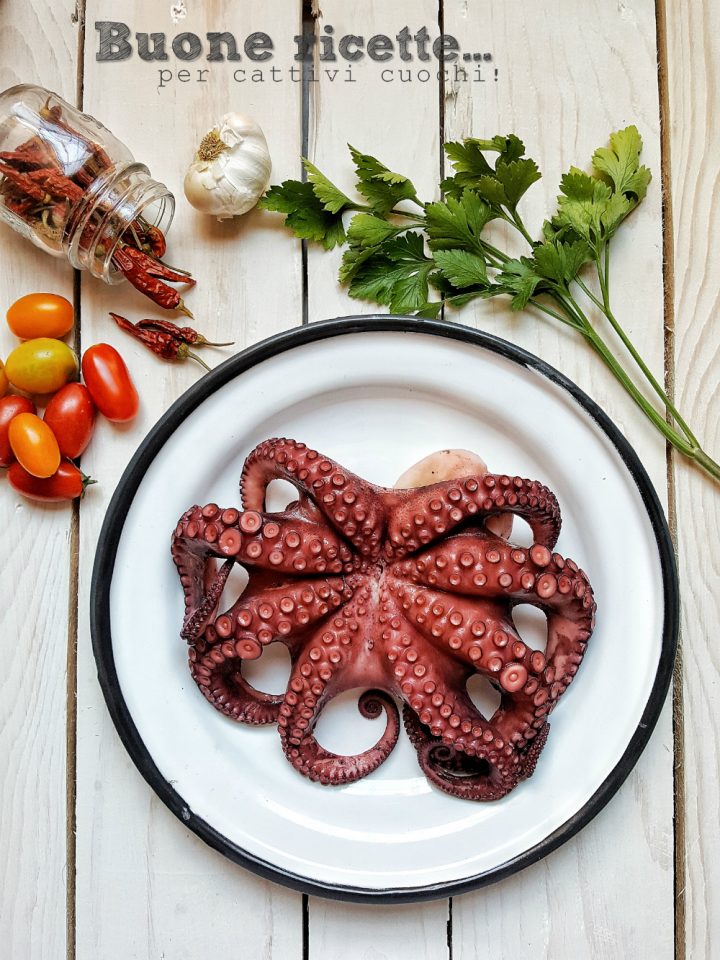
If you’re looking for how to cook frozen octopus, you’ve come to the right place! Here you will find the recipe to cook frozen octopus to perfection. Cooking octopus to perfection is almost a religion in some regions of Italy, with various schools of thought and many recipes. It’s a very simple cooking process, in its pure form without adding aromas or spices, relying on the natural water in the octopus and the sea flavor it releases during cooking. If you want to cook the octopus faster in just 12 minutes, you can use a pressure cooker.
Don’t forget to read the recipes
- Difficulty: Easy
- Cost: Medium
- Rest time: 10 Minutes
- Preparation time: 5 Minutes
- Portions: 4
- Cooking methods: Oven, Stove
- Cuisine: Italian
- Seasonality: All seasons
- Energy 149.63 (Kcal)
- Carbohydrates 5.07 (g) of which sugars 4.26 (g)
- Proteins 26.70 (g)
- Fat 2.55 (g) of which saturated 1.05 (g)of which unsaturated 1.52 (g)
- Fibers 0.55 (g)
- Sodium 18.63 (mg)
Indicative values for a portion of 7 g processed in an automated way starting from the nutritional information available on the CREA* and FoodData Central** databases. It is not food and / or nutritional advice.
* CREATES Food and Nutrition Research Center: https://www.crea.gov.it/alimenti-e-nutrizione https://www.alimentinutrizione.it ** U.S. Department of Agriculture, Agricultural Research Service. FoodData Central, 2019. https://fdc.nal.usda.gov
Ingredients for 4 People
- 2.2 lbs octopus
- 1 carrot
- 1 stalk celery
Tools
- 1 Knife
- 1 Cutting Board
- 1 Pot
- 1 Spoon
Procedure
This technique for cooking octopus is different from all others because it is very simple but at the same time fully enhances the taste and flavor.
Start by defrosting the octopus. I recommend putting it in the refrigerator for at least 12 hours. If you’re in a hurry, you can speed up by immersing the packaged frozen octopus in lukewarm water. Change the water frequently until completely defrosted
When the octopus is defrosted, start cleaning it. Peeling the octopus is a bit tedious but necessary. Wash it under plenty of running water and if present, remove the internal parts of the intestine. To peel the octopus easily, start from the head and flip it inside out, pulling the outer skin until reaching the tentacles.
Remove the internal tooth located at the inner part where all the tentacles converge. Use a knife or scissors.
Remove the skin from the tentacles as well; the suckers are almost impossible to peel when the octopus is raw, so remove most of the skin and wash them well to remove any sand that might remain.
If you’re using frozen octopus, I recommend defrosting it completely before cooking. Put everything in the refrigerator overnight, and you’re done. If using fresh octopus, you don’t need to tenderize it. Commercial octopuses are already tenderized with machines that break the fibers to make it tender at the end of cooking. In frozen octopus, the fibers have been broken by freezing, so there’s no need to tenderize it here either.
Cut the celery and onion into large pieces and sauté them in a pan with a little oil. When the sauté is cooked, add a cup of water. Immerse the octopus tentacles three times in the water to make them curl.
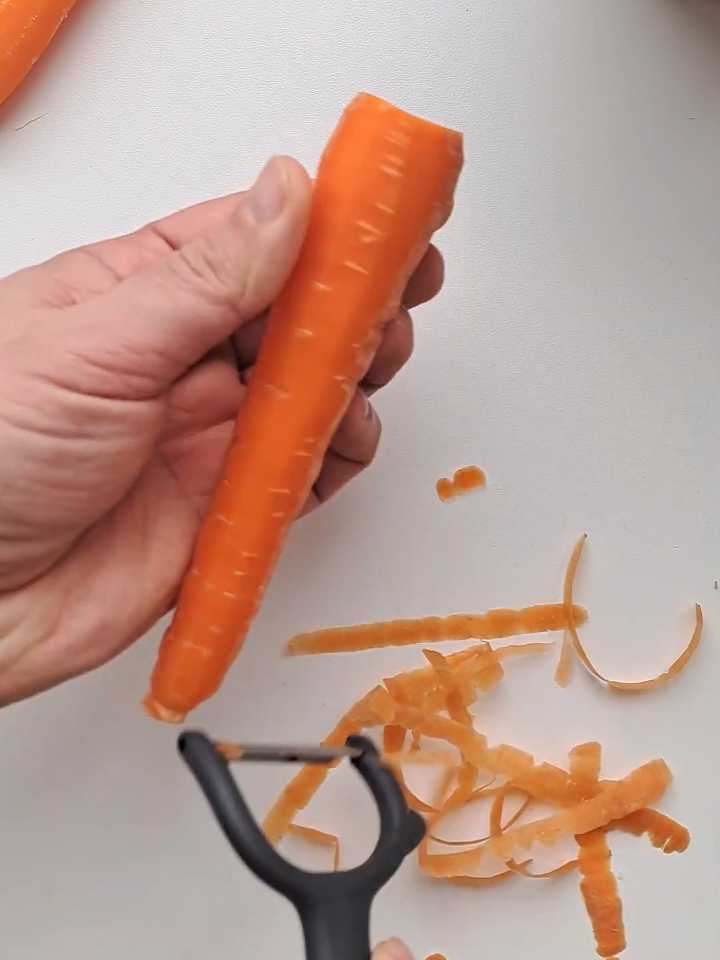
Now that the tentacles are curled, put the octopus in the pot. You don’t need to add anything, cover the pot well, and cook for 35 minutes with the pot covered. Trust me, you don’t need to add liquid or broth if the pot is cast iron or non-stick because the octopus will release its water.
After 35 minutes (for a 1.1 lbs octopus), check the cooking status: take a fork and pierce the octopus at the base of the tentacles. If the fork offers a bit of resistance and then easily goes all the way in, the octopus is cooked, and you can remove it from the pan.
The octopus takes about 50 minutes for 2.2 lbs of octopus.
In the end, you’ll find the octopus in a dense and colored cooking liquid; don’t throw it away but use it to flavor risottos and pasta. The liquid, when put in the fridge, will tend to solidify and become gelatin, which is the secret to making a delicious octopus carpaccio.
If you wish, you can also use this liquid to prepare a delicate mayonnaise!
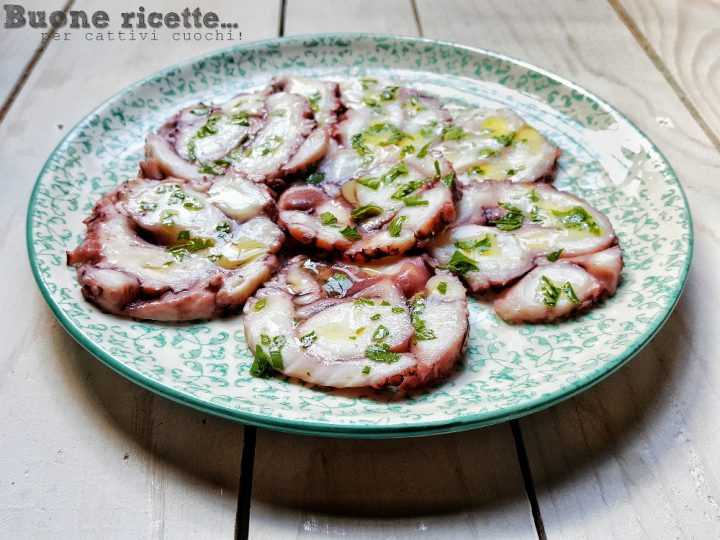
You have finished cooking the octopus in the pan; now all that’s left is to finish cleaning the octopus, using paper to remove the skin you haven’t removed earlier.
Your octopus is ready!