
Recipe of the legendary Romagna Flatbread
A love story and flatbreads: my culinary journey in Romagna
There are moments in life that remain etched in memory not only for the emotion they represent, but also for the flavors that introduce us to new cultures.
My adventure with Romagna flatbread began over forty years ago, precisely in Lugo, a charming town that would later play a fundamental role in my life.
It was my first time in Romagna, a trip undertaken to meet my future in-laws, and amidst the excitement and curiosity, I did not imagine that I would discover a dish that would become a symbol of my culinary experience in this new land.
The memory of my first taste of Romagna flatbread is still vivid in my mind. It was in that small town of Lugo that I first experienced the authentic taste of the flatbread, an experience that marked the beginning of my indissoluble bond with Romagna.
Thin, crispy dough wrapped around simple yet flavorful ingredients, the flatbread was a revelation for me, a new but familiar taste, that made me feel immediately at home.
I soon learned to repeat the recipe…I brought some home and from there it became one of my favorite meals…
Flour, lard, and baking soda…
Read below…
- Difficulty: Easy
- Cost: Economical
- Preparation time: 1 Hour
- Portions: 6
- Cooking methods: Stovetop
- Cuisine: Italian
- Seasonality: All seasons
Ingredients
Flour, lard, water, and salt…
- 4 cups all-purpose flour
- 3.5 oz lard
- 1 tsp baking soda (1 coffee spoon)
- to taste salt
- to taste water
Tools
You’ll need a bowl for mixing, a rolling pin and a non-stick pan…
And I could suggest some shopping tips by clicking Here
Steps
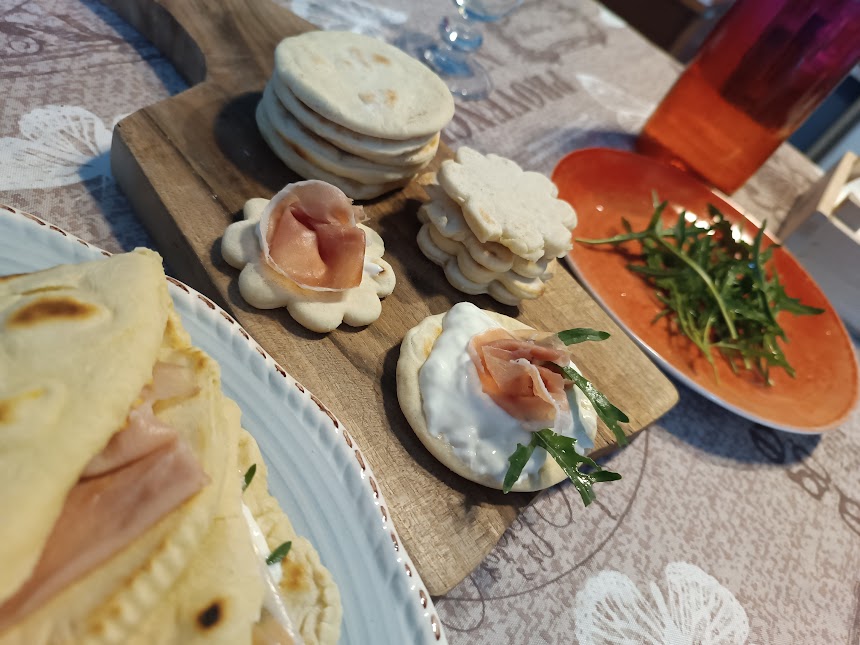
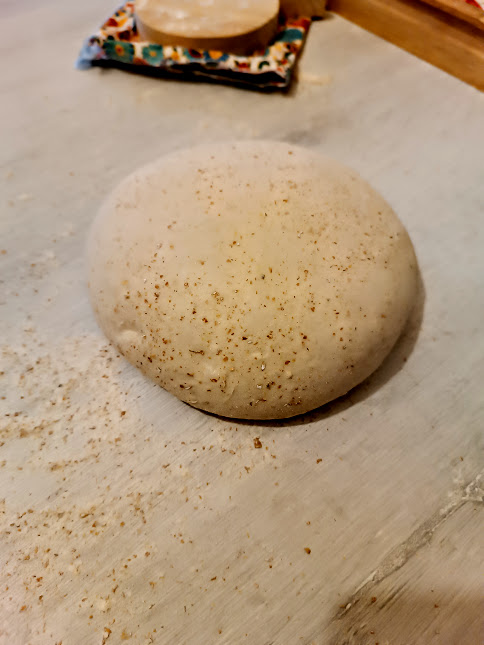
First of all, you need to start with the dough. (In the photo, the dough I make with rye and spelt flour, I occasionally forget to take some pictures.) I usually prepare it in the morning, so if possible, it’s preferable. Put the ingredients in the bowl, flour, and baking soda together, and mix, then add the lard and salt; and finally the water; each flour absorbs differently, add little by little. Knead until you get a firm and elastic dough, which you then cover with a plastic wrap or closed in a container and left in the refrigerator until its use; for me, in the evening…This is a tip for a better result, otherwise, skip this step, they will still be delicious!
Removed from the refrigerator, divide into portions of about 3.5 oz each and roll them out with the rolling pin; do not make them too thin, keep a thickness of about 1/8 inch, If it is more convenient, you can make a single sheet and cut the flatbreads as in the photo…
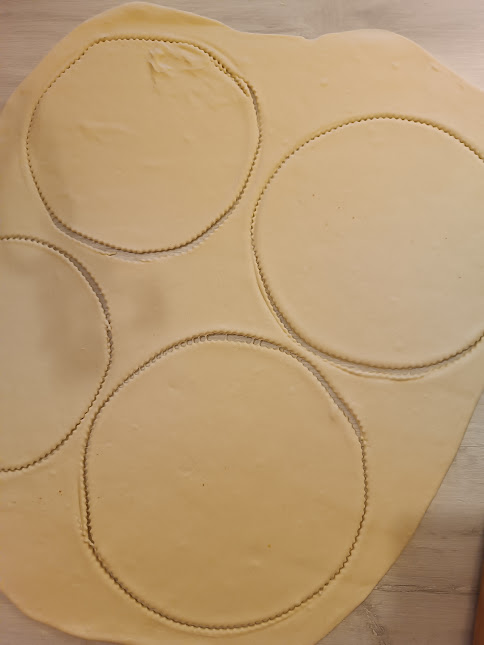
Shape them classically or as you wish, for appetizers I prepare them in small discs or flower shapes by rolling out the dough into a single sheet and cutting with appropriate cutters

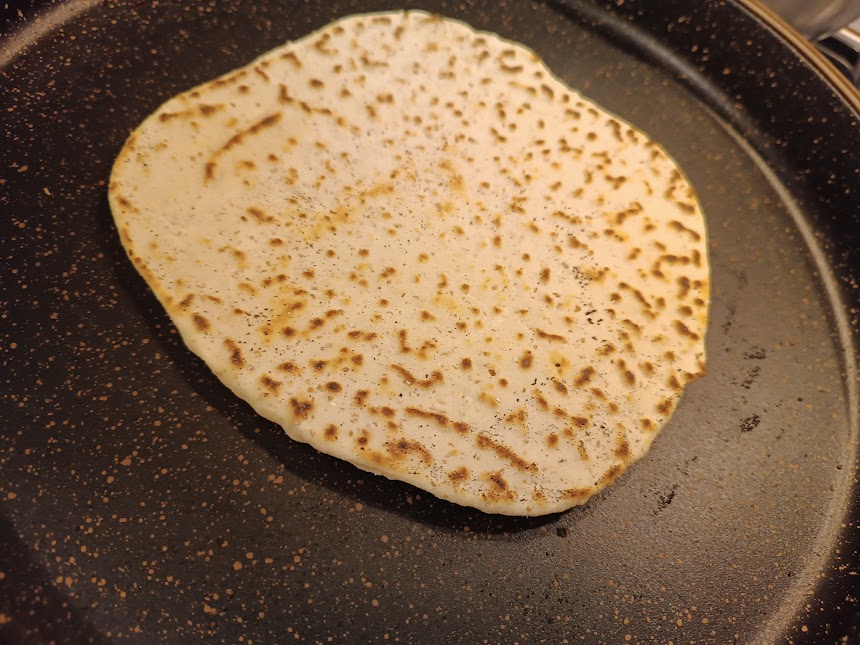
At this point, you just need to cook them using a well-heated non-stick pan; turn them on both sides until cooked through.
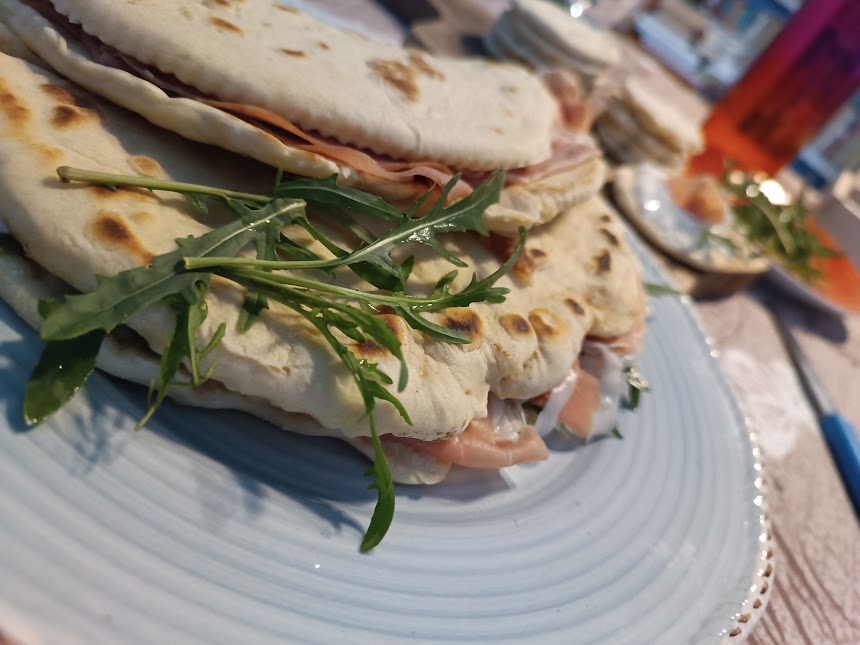
Fill with prosciutto, mortadella, arugula, squacquerone, and whatever you like
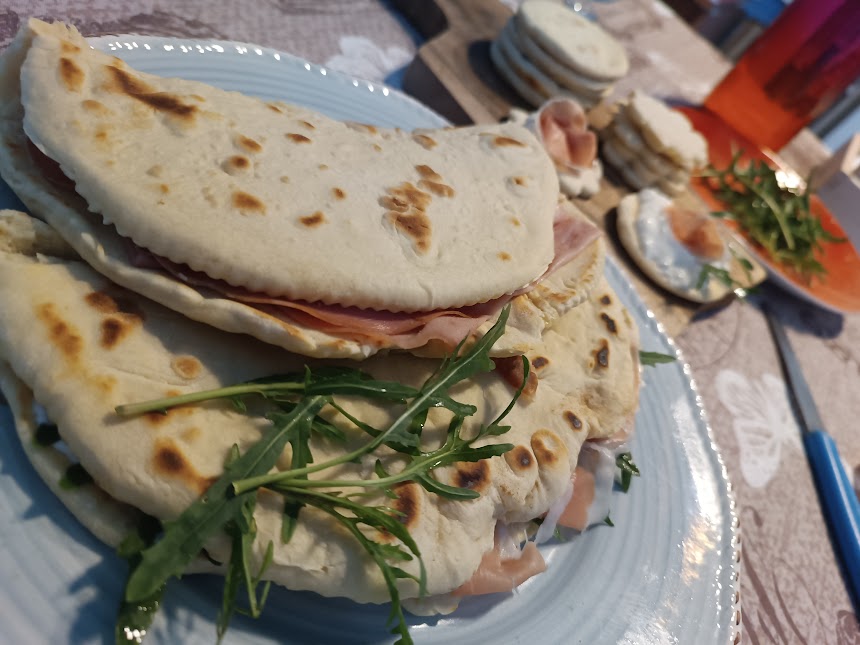
The mini flatbreads with cheese, prosciutto, and arugula…And many other tasty combinations
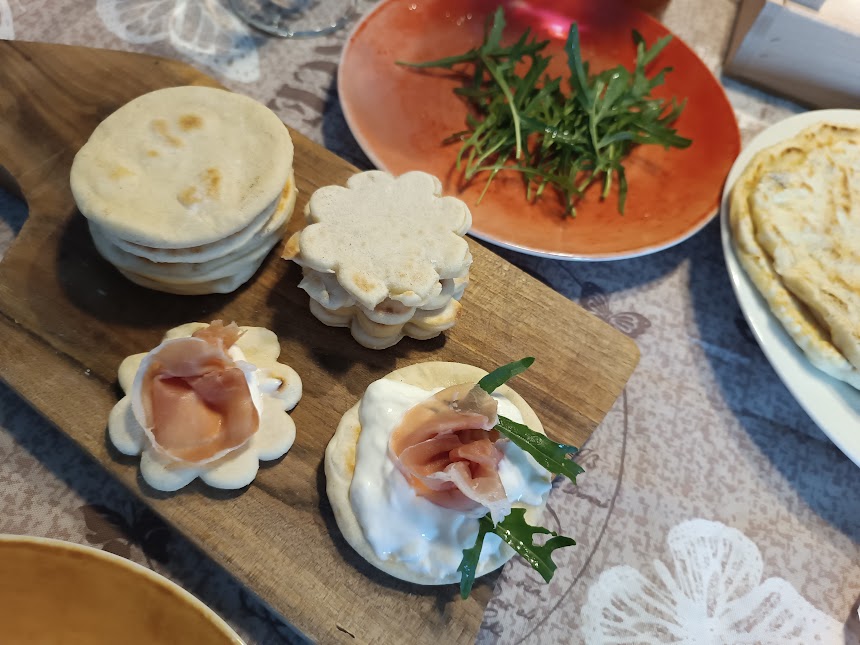
Once you have cooked your flatbreads and let them cool, you can store them in the refrigerator, closed in a container to prevent them from drying out, or in the freezer. When ready to eat, you just need to heat them on a well-heated griddle for optimal results. The flatbread has now become part of street food, so we can really pair it with many dishes…Try also cutting them into smaller sizes, small discs to serve for an aperitif, or outdoor dinner…
Once you have cooked your flatbreads and let them cool, you can store them in the refrigerator, closed in a container to prevent them from drying out, or in the freezer. When ready to eat, you just need to heat them on a well-heated griddle for optimal results. The flatbread has now become part of street food, so we can really pair it with many dishes…Try also cutting them into smaller sizes, small discs to serve for an aperitif, or outdoor dinner…
Once you have cooked your flatbreads and let them cool, you can store them in the refrigerator, closed in a container to prevent them from drying out, or in the freezer. When ready to eat, you just need to heat them on a well-heated griddle for optimal results. The flatbread has now become part of street food, so we can really pair it with many dishes…Try also cutting them into smaller sizes, small discs to serve for an aperitif, or outdoor dinner…
Once you have cooked your flatbreads and let them cool, you can store them in the refrigerator, closed in a container to prevent them from drying out, or in the freezer. When ready to eat, you just need to heat them on a well-heated griddle for optimal results. The flatbread has now become part of street food, so we can really pair it with many dishes…Try also cutting them into smaller sizes, small discs to serve for an aperitif, or outdoor dinner…
The importance of Lugo and Romagna in my life
Lugo, with its history-filled alleys and welcoming people, was not only the gateway to my discovery of flatbread, but also the beginning of a profound relationship with Romagna.
This corner of Italy, with its varied landscapes, from the coast to the hills, and its vibrant culinary tradition, quickly became a place I would call home.
Life there taught me to slow down, to savor every moment and every bite, understanding that food is much more than nourishment; it’s history, it’s culture, it’s love.
The Romagna cuisine naturally entered my world, driven by the desire to understand more deeply the land that had welcomed me.
And who better than my mother-in-law to introduce me to the secrets of this rich culinary heritage?
She, with patience and love, began to pass on the basics, teaching me not only the technique for rolling out the perfect flatbread but also the importance of choosing quality, seasonal ingredients, respecting tradition while also being open to experimenting…Read below…
