
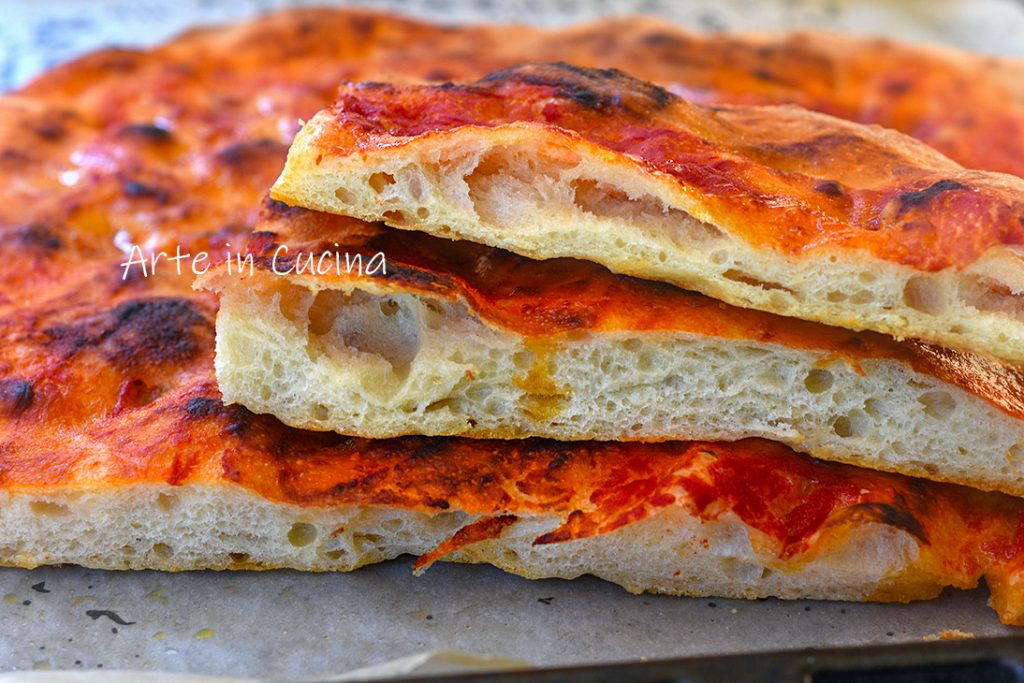
ROMAN SHEET-PAN PIZZA with TOMATO, with slow cold fermentation in the fridge, an easy recipe, a complete dish perfect as an appetizer or main for dinner, very soft, a low focaccia.
The recipe for the Roman sheet-pan pizza taken here is absolutely perfect: soft, rich in holes, easy to digest and really tasty — a focaccia great as a main dish for Saturday night.
Obviously we are talking about a thick pizza or low focaccia, not the Neapolitan pizza which is completely low in the center with a high rim, but it was loved at home.
I prepared a rather large amount of dough for the 4 of us; from this dough for the Roman sheet-pan pizza I made 3, although you can get 4 medium-low ones.
A pizza to try: the dough is simple, the preparation is a bit long because it needs some work but it’s worth it, and if you don’t like tomato you can always leave it white, the classic HERE.
At my home they don’t love focaccia much so I was a little hesitant to make it, but dividing the dough I achieved the result I wanted.
Follow me in the kitchen — today there’s Roman sheet-pan pizza with tomato!
- Difficulty: Medium
- Cost: Very economical
- Rest time: 1 Day 3 Hours
- Preparation time: 1 Hour
- Portions: 4 baking trays or 2 tall ones
- Cooking methods: Oven
- Cuisine: Italian
- Energy 421.40 (Kcal)
- Carbohydrates 87.34 (g) of which sugars 2.25 (g)
- Proteins 14.88 (g)
- Fat 3.17 (g) of which saturated 0.51 (g)of which unsaturated 1.02 (g)
- Fibers 3.88 (g)
- Sodium 975.81 (mg)
Indicative values for a portion of 200 g processed in an automated way starting from the nutritional information available on the CREA* and FoodData Central** databases. It is not food and / or nutritional advice.
* CREATES Food and Nutrition Research Center: https://www.crea.gov.it/alimenti-e-nutrizione https://www.alimentinutrizione.it ** U.S. Department of Agriculture, Agricultural Research Service. FoodData Central, 2019. https://fdc.nal.usda.gov
Ingredients
- 12 cups type 0 flour
- 4 cups + 1 tbsp water (for the autolysis)
- 1 cup minus 1 tbsp water (for the dough)
- 2 tbsp extra virgin olive oil
- 4 tsp fresh baker's yeast
- 5 tsp fine salt
Preparation
P.S. I used frozen yeast; for room-temperature fermentation it took me almost a full day, with an excellent result: a light, easy-to-digest pizza.
Put the flour and the 975 ml of water into the mixer and work with the dough hook; of course you can do this by hand if you don’t have a stand mixer.
Work at the lowest speed (speed 1) for 5 minutes, then let the dough rest for 20 minutes.
Afterwards add half of the remaining water (for the dough) with half of the yeast dissolved and the salt, and work at speed 1 for 7 minutes.
Then add the salt, the other half of the water with the other half of the yeast, the oil and work for 5 minutes.
Take the dough and perform a few reinforcing folds, then let it bench rest — folds and rest for a total of 15–20 minutes.
At this point place the dough in the fridge; I divided it into two bowls because it was quite large.
Let it rest for 24 hours; after that time take the dough and divide it into 2 balls, i.e. for two baking trays of 16 x 24 inches
Do a few turns of folding: form a rectangle, bring the short side toward the center, cover with the other short side and repeat.
Don’t overwork the dough; always handle it gently, we’re not making shortcrust pastry.
Make dough balls, dust them with semolina and let them rest in airtight containers or covered with cling film for 2–3 hours.
After the time has passed, turn the dough balls out onto a floured surface, dust with semolina flour and press along the edges to seal the dough — that is, to lock it.
Stretch starting from the center downward and then from the center upward, always pressing with your fingers.
Flip and repeat on the other side as well, stretch it to a size slightly smaller than the baking tray.
Oil the baking tray, lift the dough placing it on your forearm to remove excess semolina and let it slide into the tray.
At this point arrange it well in the tray, always pressing the dough with your fingers.
Top with oil and tomato purée using your fingers and not a spoon, or leave it white with an emulsion of water and oil; sprinkle with coarse salt and rosemary if you like.
Bake in a preheated conventional oven at 482°F–572°F (250°C–300°C) for 10 minutes.
Bon appétit
If you like the recipe click the stars at the bottom of the article. THANK YOU!
