
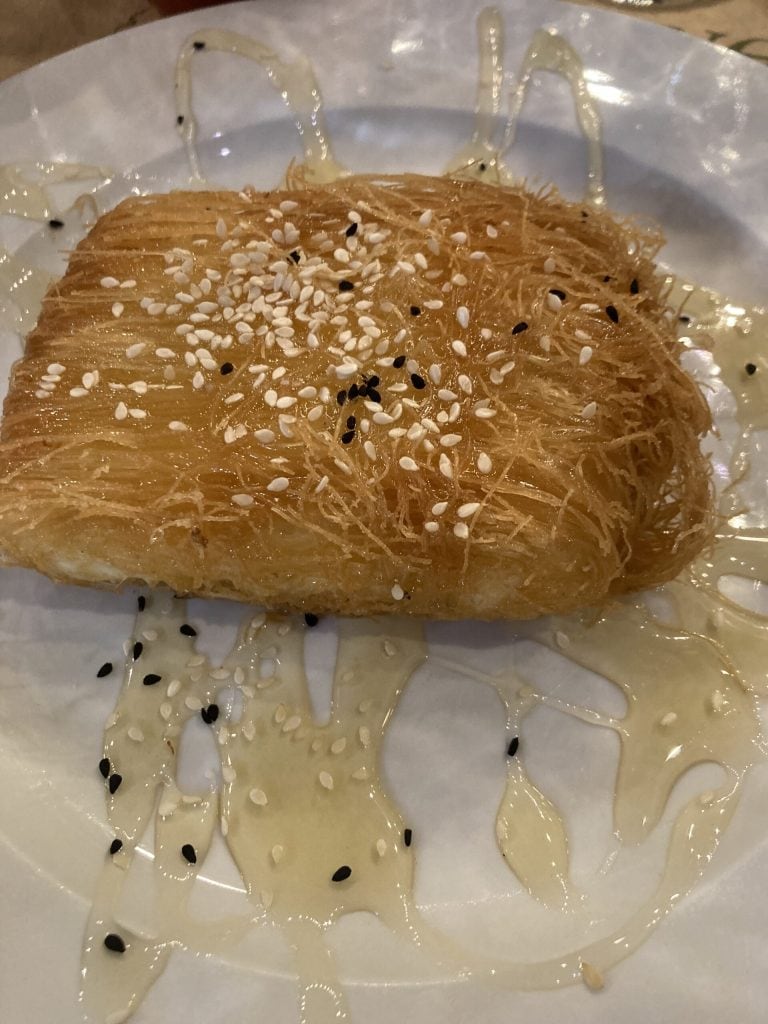
The Kiounefe (Κιουνεφέ) or kunefe or kataifi, was one of the many excellent dishes we tasted during our dinner at the “Nostimon Imar” restaurant, in Zakynthos during our trip.
It consists of cheese, usually goat’s cheese, enclosed between two layers of very finely shredded phyllo dough, known as kataifi.
Note: The phyllo dough (called Yufka in Turkey, the origin land of this dessert) is used in its shredded form, i.e. kataifi.
Kataifi is the base for many sweet recipes in Turkey and Greece, such as the well-known Greek dessert that bears the same name.
Kiounefe is the king of Levantine desserts. Unlike the purely Turkish version, this variant follows the tradition of cities like Nablus or Beirut, where the balance between sweet and savory is more pronounced.
It often has a different name in each country (for example Künefe).
The final touch is the Attar, the syrup perfumed with orange blossom or rose water.
This is the Khishnah version, characterized by the kataifi left intact for maximum crunch, as opposed to the ‘Na’amah’ version which is smoother.
The beauty of Kiounefe is that it escapes classic definitions. Thanks to the contrast between the saltiness of the cheese mix (feta and mozzarella) and the buttery note of the kataifi dough, it can be served in two opposite ways:
– as a Meze: Served hot and ‘plain’ (or with very little syrup), it makes an extraordinary starter that accompanies other Middle Eastern specialties.
– as a Dessert: Generously drenched with Attar (the perfumed syrup), it becomes a crunchy grand finale.
- Difficulty: Medium
- Cost: Economical
- Preparation time: 10 Minutes
- Cooking time: 45 Minutes
- Portions: 4 people
- Cooking methods: Oven
- Cuisine: Middle Eastern
- Seasonality: All seasons
Ingredients
- 17.6 oz kataifi (shredded phyllo dough) (or phyllo dough)
- 10 1/2 tbsp butter ((about 5.3 oz / 150 g))
- 14.1 oz goat cheese (such as feta or kasseri *)
- to taste sesame seeds (white and black)
- 2/3 cup sugar ((150 ml))
- 1/2 cup water ((100 ml))
- 1/2 lemon
- 2 tablespoons rose water
Steps
Cut the phyllo dough into pieces, shredding it (kataifi).
Slice the cheese into very thin slices.
Melt the butter in a saucepan.
Pour the melted butter over the kataifi and mix.
Divide the kataifi into four portions.
Butter an 8-inch (20 cm) pan and spread half of the kataifi.
Press firmly with your hand so that it takes the shape of the pan.
Distribute 1/4 of the cheese to form a cheese layer.
Cover with the other half of the kataifi and press again so that it is as compact as possible.
Drizzle with a little melted butter.
Bake in a preheated oven at 320°F for about 45-50 minutes, until the surface is golden.
Prepare the syrup: boil the water, sugar and the lemon in a saucepan for 2-3 minutes (counting from when it starts boiling). Finally add the rose water and continue cooking for about 8 minutes.
Remove from the oven and pour the syrup over the hot pastry.
Sprinkle with white and black sesame seeds.
Serve hot or warm.
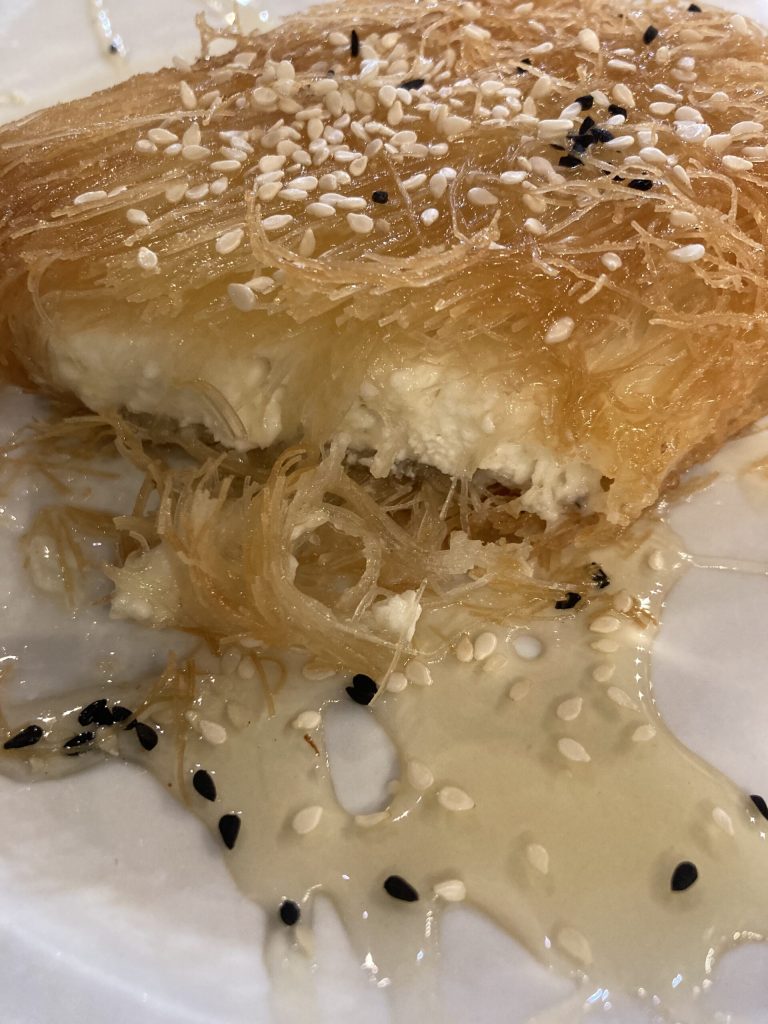
There is a version of Knafeh (very famous in the Levant, especially in Palestine) that does not use the “threads” (Kataifi), but a base called Mfarakeh.
You obtain it by blending or crushing the phyllo dough (or the kataifi itself) together with the butter until it becomes a sort of coarse semolina or sand.
The visual result is a smooth, compact and orange crust, very different from the “nest-like” appearance of the recipe above.
*Greek cheeses:
Greece is best known for feta, but there are many other Greek cheeses, such as:
Anthotiro
A white, semi-dry cheese made with goat’s and/or sheep’s milk. Produced both salted and unsalted, suitable for breakfast or salads.
Mizithra
Similar to ricotta, it is a fresh cheese made from sheep’s and/or goat’s milk and whey, often used as a dessert together with honey and dried fruit.
For further information click HERE.
FAQ (Questions and Answers)
Are there different variants of phyllo dough, and which ones?
1. Yufka (The artisanal version)
In Turkey, the “true” hand-made phyllo, slightly thicker than the industrial one, is called Yufka. It is rolled out with a very long rolling pin (oklava) until it becomes almost transparent. It is used for Börek (savory pies) but is technically the base from which all phyllo sheets derive.
The term “Fillo” (from the Greek phyllo, leaf) is the one that has been adopted in international marketing and Western supermarkets, while “Yufka” remains the technical and cultural term in Turkey.
2. Briouat or Warka dough
Typical of the Maghreb (Morocco), it is similar to phyllo but cooked quickly on a hot plate. It is more elastic and resistant, used for triangular sweet or savory rolls.
