
The People’s Democratic Republic of Algeria, is a state in North Africa, belonging to the Maghreb.
The history of Algeria has been strongly linked to the events of the Mediterranean area since ancient times. Controlled in succession by Numidians, Phoenicians, Carthaginians, Romans, Vandals, Byzantines, and various Berber dynasties, the region became part of the Ottoman Empire and later entered the French dominions during colonialism.
Like many other states, independence (obtained in 1962) was followed by a long period of political instability during the 1990s, which has now stabilized.
Algerian cuisine is typically Arab with typical dishes such as couscous, meswi, dolma, and various tajines.
Algerians prefer to season couscous, called Kseksou, with lamb, chicken, or fish, along with cooked vegetables such as carrots, chickpeas, tomatoes, and spicy stews.
Algeria has four famous traditional soups consumed throughout the country: chorba, harira, djari, and tchicha. They are served at the beginning of the meal as appetizers and are mainly prepared with lamb, mutton, or chicken, chickpeas, tomatoes, vermicelli, wheat, spices, and various vegetables and legumes.
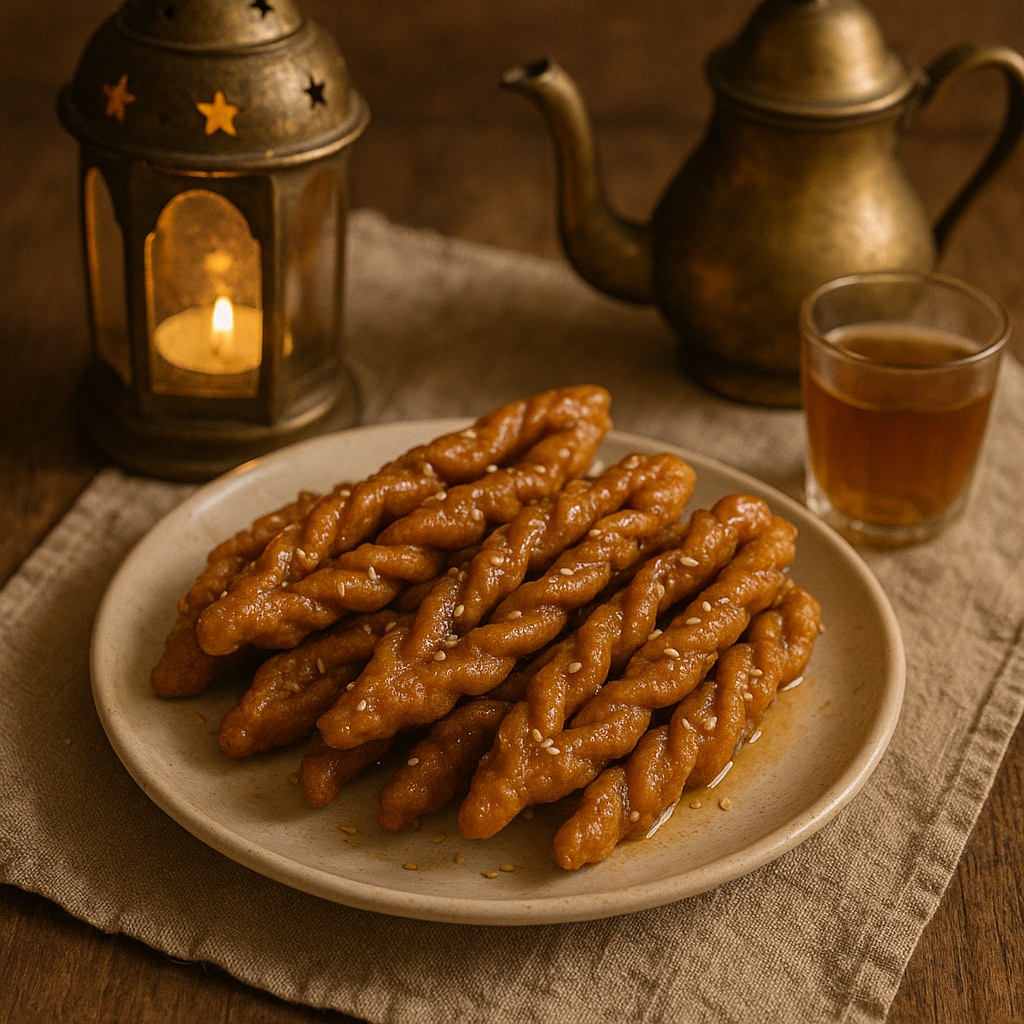
Among the common desserts, mainly eaten during Ramadan, we find Griwech: a dough shaped like a flower, fried, soaked in honey, and sprinkled with sesame seeds.
The Griwech, with their braided shape and sweet and spicy taste, are part of the large family of Algerian fried sweets called “el-qli”.
This term, widely used during Ramadan, refers to all those fried delights immersed in honey, served to accompany tea or break the fast.
Along with griwech, under the name el-qli, we also find other sweets like zlabia and fried makrout. Each family has its version, but they all tell the same festive fragrance.
- Difficulty: Medium
- Cost: Inexpensive
- Preparation time: 15 Minutes
- Portions: 6 people
- Cooking methods: Frying
- Cuisine: African
- Seasonality: Ramadan, All seasons
Ingredients
- 4 cups flour
- 1/2 cup butter (melted, but cold)
- 1 egg
- 1 tablespoon sugar
- to taste salt
- 1 1/2 teaspoon baking powder
- 1 1/2 tablespoon vinegar
- 1/4 cup water
- 1 1/2 teaspoon gum arabic * (blended with a little sugar)
- to taste saffron threads (diluted in a little orange blossom water)
- 2 tablespoons ground cinnamon
- 0.7 oz anise seeds
- 1 1/2 glass olive oil
- 2 cups honey
- to taste sesame seeds
- 1 tablespoon orange blossom water
- to taste vegetable oil
Preparation
Put all the ingredients in a bowl and start kneading by adding the water little by little until you get a smooth dough that should not stick.
Divide the dough into balls and then roll them out as thinly as possible, either with a rolling pin or a pasta machine, passing twice through a wide setting and then a medium one. You will get thin and very crispy griwech.
Cut into rectangles and then internally cut into strips, without reaching the edges, and give them the typical braided shape.
Meanwhile, boil the honey. Turn off the heat and add two tablespoons of orange blossom.
Fry the griwech and then place them on absorbent paper and let them drain.
Finally, when they have cooled, dip them in warm honey scented with orange blossom water, drain the excess, and sprinkle them with sesame seeds.
Let cool and serve.
Other names for Griwech:
The names, ingredients, and preparation methods may vary depending on the traditions of each region of the Maghreb.
In Morocco: in Rabat, it is called mkharqa or shebākia, often having a flatter or elongated and braided shape, sometimes similar to a flattened braid, often including orange blossom water, anise, cinnamon, and saffron.
In Ouezzane el-hlou.
In northern Morocco, it takes the name kwilesh.
In northern Morocco, it takes the name kwilesh.
In northern Morocco, it takes the name kwilesh.
What is gum arabic*?
Gum arabic is a natural gum also known as acacia gum as it is extracted from two sub-Saharan acacia species: Acacia senegal and Acacia seyal.
In commerce, gum arabic is distinguished according to its origin: Nile, Somalia, Senegal (the largest producer), Morocco, Australia, etc.
You can buy it here.
