
There are two places I’ve always dreamed of going, the Seychelles, which I’ve already talked about through the recipe for Kat Kat, and….
the Hawaii!!
Two destinations that are quite different in some respects but very similar in others: they are islands, they are wild (yes, even Hawaii has areas not yet touched by tourism!), they are expensive and exclusive!
The Hawaii, moreover, are the location of the TV series that introduced me to the wonderful world of television series (Lost) and are also one of the locations of the TV series I wrote (J e poi).
They are American and as you know, I make no secret of my deep love for the United States, and they are, at least on paper, a perfect blend of built and wild.
Lastly, and by no means least, in the collective imagination of us children of the ’80s, Hawaii has always been not just a myth, but THE myth.
The Hawaiian Islands are a volcanic archipelago located in the Pacific Ocean composed of eight main islands and many smaller islands.
The culture and religion of the archipelago are of Polynesian origin, in particular from one of the Society Islands called Havaiki.
On January 18, 1778, Captain James Cook of the British navy was the first European to reach these islands.
In 1898, after the United States’ war against Spain, in which the United States acquired the Philippines and Puerto Rico, the government of the Republic of Hawaii offered its annexation to the United States, which they accepted.
In 1959, the United States Congress accepted Hawaii as the 50th federated state of the Union.
If I had to choose the perfect itinerary, I would visit at least three islands: O’ahu, the set of Lost, where the capital Honolulu and Pearl Harbor are located, and where the majority of the island’s inhabitants live.
Maui because it’s the most famous (thanks in particular to a well-known brand) and finally Moloka’i, to enjoy the true Hawaii, those experienced by the locals, without tourism.
Even though it’s part of the United States, Hawaiian cuisine has its own local identity, born from a mix of other cuisines, particularly Chinese, Filipino, Japanese, Korean, Polynesian, but also European.
The taro is the local tuber, imported long before the potato, and it is found almost everywhere, as is the saimin, a dish so iconic that it is sold even in local McDonald’s: a sort of Japanese ramen with boiled eggs, kamaboko (a compressed fish puree), green onions, noodles, pickles, meat, and cabbage.
But my choice could only fall on the Poke (sometimes spelled Poké to help pronunciation which is “poh-kay”), a word that in Hawaiian means “to cut into pieces”.
The Poke, masculine singular, and not “la Poke”.
In recent years it has become a trend for us, but it has existed since the 1800s and, thanks to the recent trend towards healthy food, poke is spreading widely everywhere.
According to some nutritionists, it is a healthy dish because unlike other raw fish preparations, like sushi, it does not use sugar for marinating.
In Europe, the most common poke are those based on yellowfin tuna (ahu) or salmon, but what is eaten in Europe and America is not at all poke.
There is indeed an original poke, the Hawaiian one, and then numerous imitations exported abroad and adapted to local tastes.
Poke originated as a tradition among fishermen who used to eat raw fish cut into pieces and seasoned with the few things they had at their disposal, the original recipe does not include vegetables and much less fruit and the dish prepared by fishermen is certainly not “beautiful” and colorful to look at.
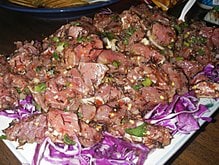
It involves seasoning with Hawaiian salt, seaweed, and grilled kukui nut pulp, fish skinned, gutted, deboned, and cut into crosswise fillets (see photo below aki poke).
The procedure for creating a poke is simple:
choose a grain base (sushi rice, basmati, black rice, or a mix of brown rice, farro, and barley, or quinoa) or a salad base.
Add the protein: raw fish – usually represented by tuna, salmon, octopus (he’e or tako – Japanese word) or shrimp – but also meat, or eggs, or tofu if you want to propose a vegetarian version.
Then add the vegetable and/or fruit side dish and an oil in the form of nuts and/or seeds.
Finally, the dressing: the base should always be soy sauce or ponzu sauce and sesame oil, to which you can add many ingredients to make it more special such as sesame seeds, bits of dried or fresh chili, seaweed, fish roe, fruit, and bits of onion…
It can be a marinade or the dressing once it’s ready.
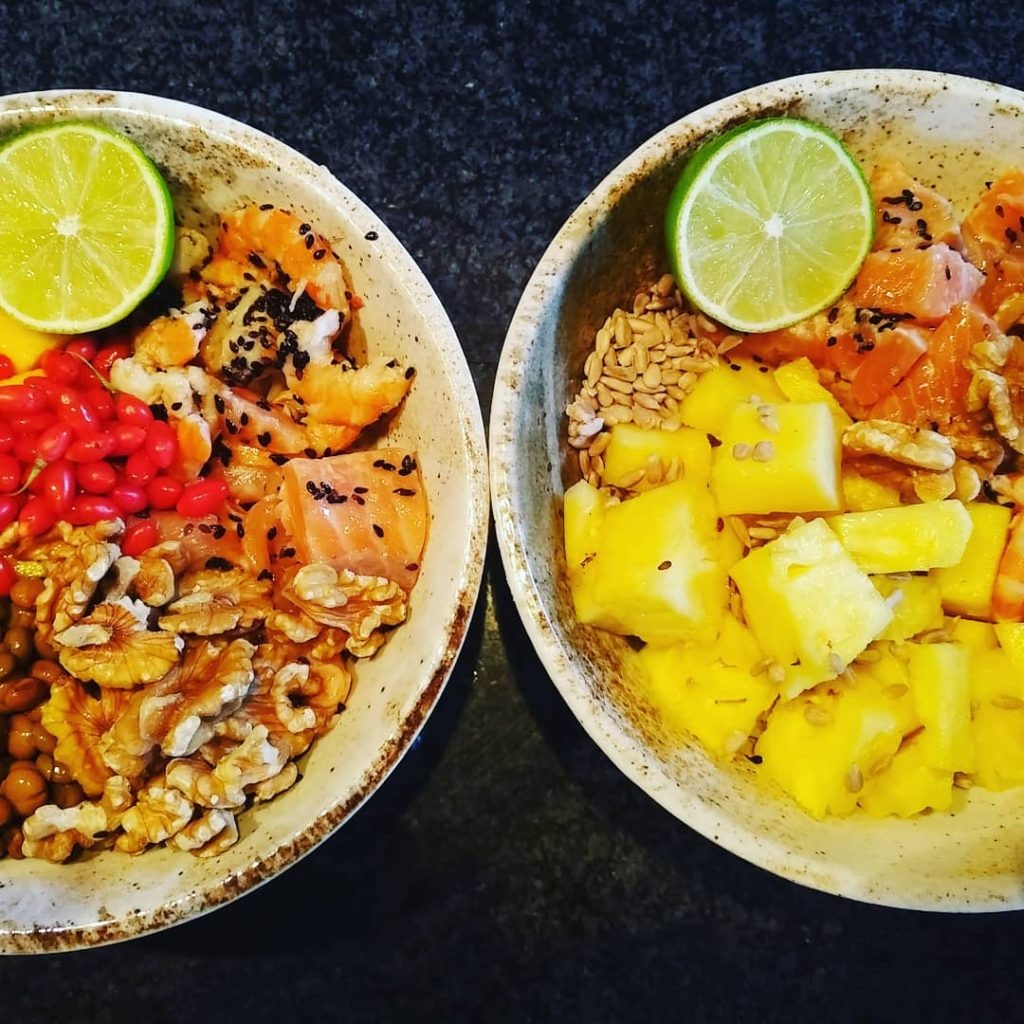
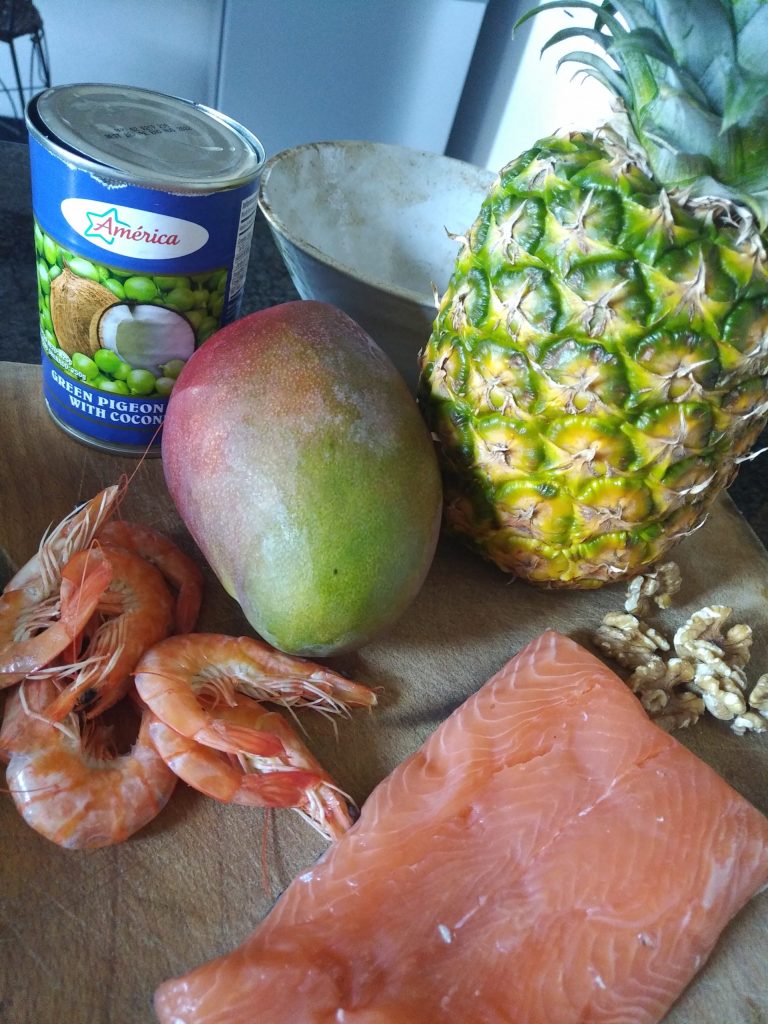
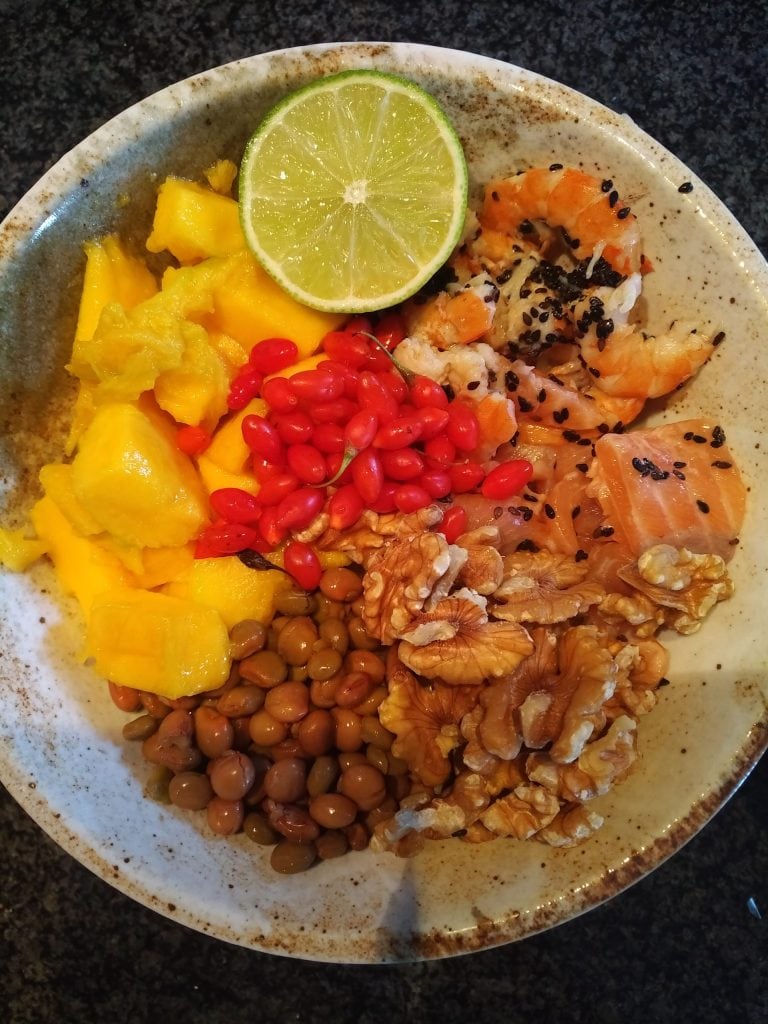
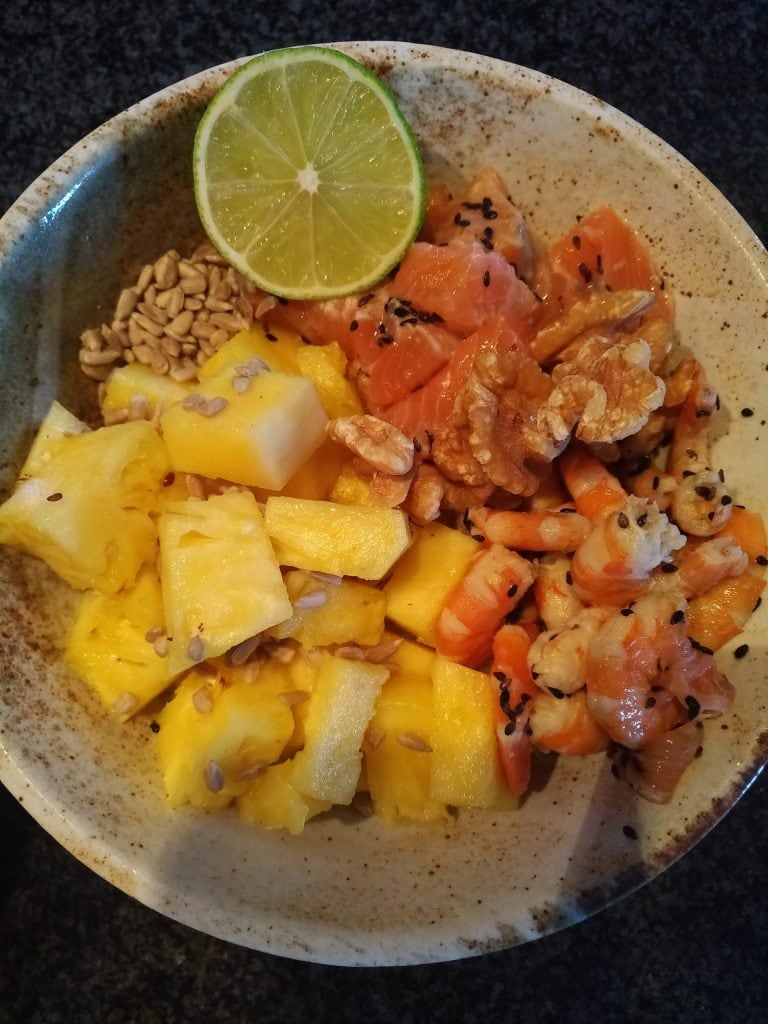
My double homemade version was with: rice, pineapple, marinated salmon and shrimp, nuts, sunflower seeds and rice, mango, marinated salmon and shrimp, nuts, goji berries and caiani beans.
But you can have fun as you like in composing it.
Here’s my recipe.
Poke was also the star of the ViaggiandoMangiando on air April 23, 2021 event, the live video HERE.
- Difficulty: Very easy
- Cost: Medium
- Rest time: 30 Minutes
- Preparation time: 10 Minutes
- Portions: 2People
- Cooking methods: Boiling, Steaming
- Cuisine: American
- Seasonality: All seasons
Ingredients
- 1 cup cup Basmati rice (or other small grain rice or quinoa)
- 1 1/2 pineapple
- to taste nuts
- 1 mango
- to taste goji berries
- 9 oz oz shrimp
- 9 oz oz salmon
- to taste sunflower seeds
- 0.88 oz oz caiani beans (or edamame)
- to taste soy sauce (or ponzu sauce)
- to taste sesame oil
- 0.035 oz oz lime (to accompany)
Preparation
Boil the basmati rice in a pot with plenty of boiling water. Once cooked, drain it and let it cool.
Combine in a small bowl: soy sauce and sesame oil (if unavailable, you can create – as I did – an emulsion of extra virgin olive oil with black sesame seeds), add the salmon and shrimp and let them marinate for 30 minutes in the refrigerator.
Cut the fruit.
Compose your “bowl”: first put the rice, then arrange the mango, salmon, shrimp, nuts, goji berries and caiani beans or, in the other version, pineapple, salmon, shrimp, nuts, sunflower seeds.
Aki poke original, as it was served in Hawaii, before it became a “trendy food”.
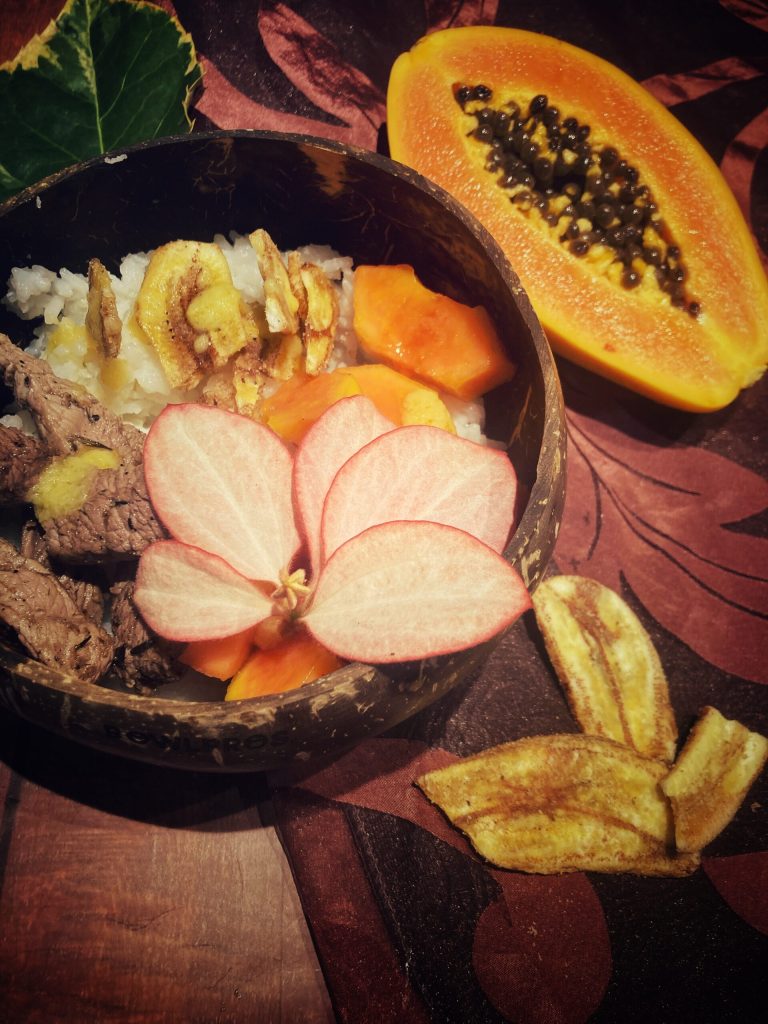
This is my Brazilian version:
🟡 RICE
🟡 BEEF, strips sautéed in a pan with black pepper and rosemary
🟡 PAPAYA, which in Brazil is called Mamão
🟡 BANANA CHIPS
🟡 Dressing: MANGO AND SOY SAUCE
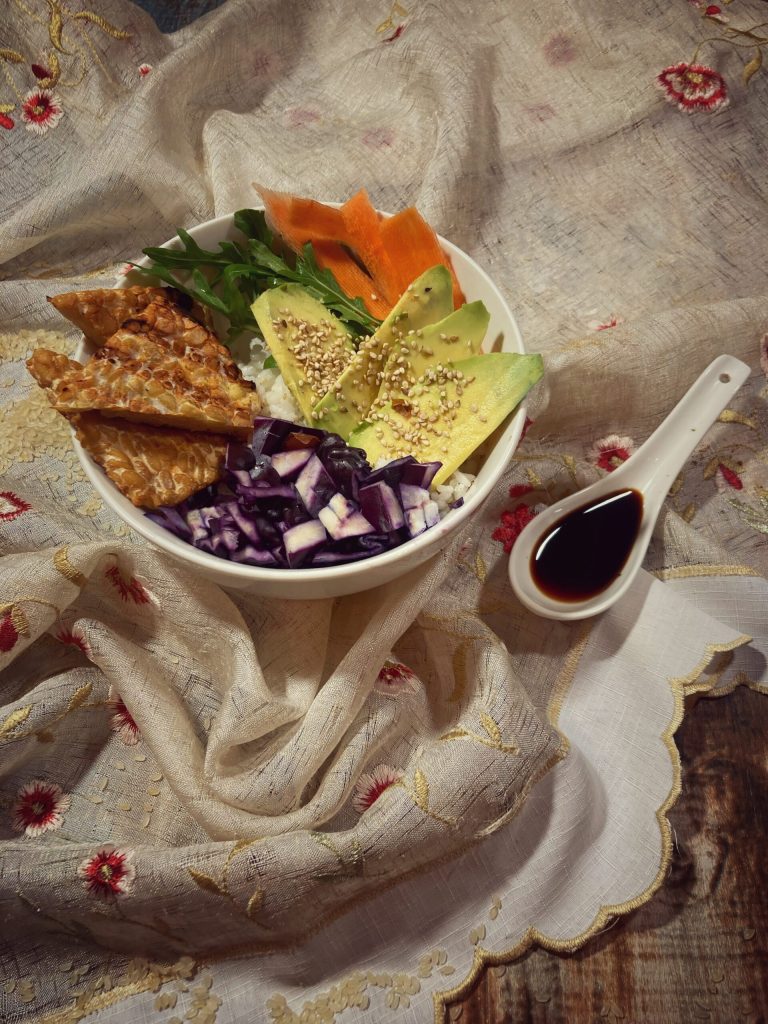
Vegetarian poke:
PROTEIN, tempeh marinated with soy sauce, coconut oil, lime, ginger, and maple syrup, then grilled;
VEGETABLE, arugula, and red cabbage
GRAIN, gohan rice (steamed rice)
FAT, avocado
Dressing: soy sauce
Affiliate link #adv
Online you can also find many beautiful bowls suitable for poke!
When will “Getting LOST” be released in Italy?
The documentary film “Getting LOST,” which, 20 years after the first episode of Lost, reunites the original cast and reveals some ‘hidden secrets’ of the legendary series, was released on Netflix (USA) on September 22 and has been distributed in several theaters in Canada, the United States, and London.
However, at the moment, “Getting LOST” does not yet have an official Italian release date.
For now, we can only watch the trailer on YouTube and follow the updates on the website: Gettinglost .
