
Nigeria is the most populous country in Africa.
Between the 17th and 19th centuries, European travelers and traders founded port cities to increase the growing slave trade destined for the Americas.
Nigeria was granted full independence on October 1st, 1960, as a federation of three regions, each maintaining a substantial degree of self-governance. In 1966, two consecutive coups by different groups of military officers brought the country under military control. To this day, true democracy has not been established.
Nigeria is the sixth most important state in the world for oil extraction, with most of it sold to the American market.
Local conflicts of a political, social, or religious nature can arise at any time in Nigeria. The crime rate is particularly high in urban agglomerations.
The risk of terrorist acts and kidnappings for political or criminal purposes exists throughout the country.
Another place I will only ever know through its cuisine.
Nigerian cuisine is spicy and hot. Main dishes are based on spicy soups, meat, and potatoes. There is not much distinction between fish, meat, or vegetable dishes. In the most important Nigerian dishes, all these elements are almost always found together, amalgamated by broths, sauces, spices, and aromas. The culinary culture of Nigeria and the entire West African coastal strip (from Senegal to Angola) is the culture of palm oil, coconut milk, and chili.
Numerous products are unknown to us, such as Uzaki leaves (climbing plant), Atma leaves (annual herb cultivated with a tarragon-like aroma), yam, and cocoyam, which are tubers very similar to potatoes.
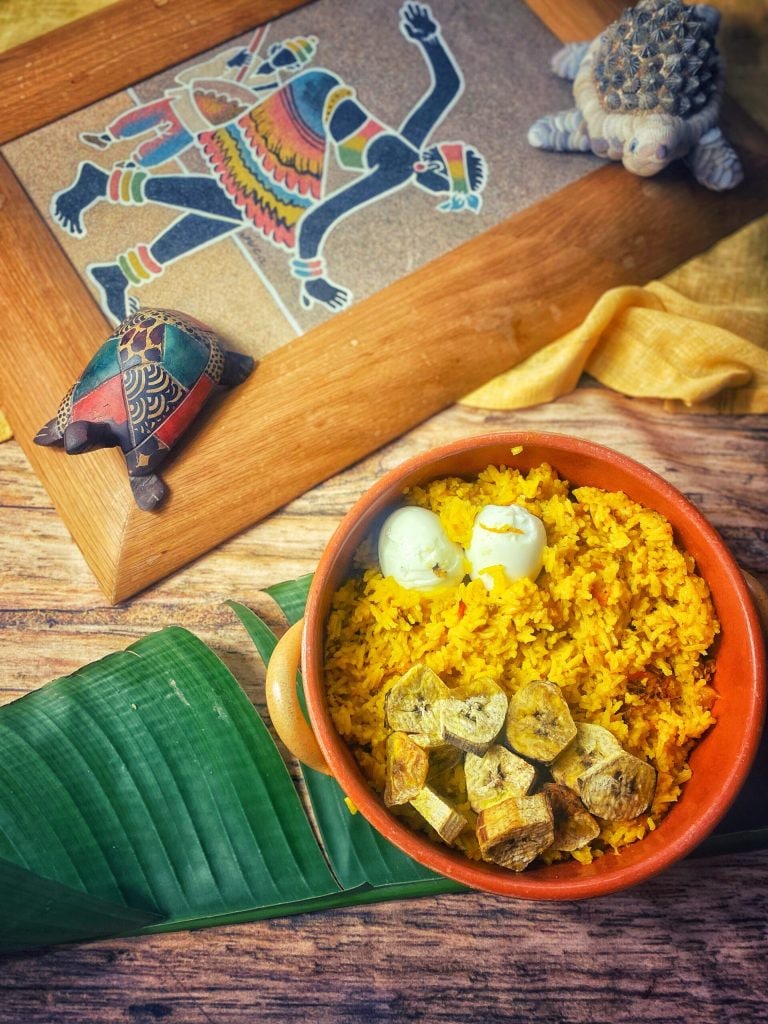
Jollof rice, also known as benachin or by the English name jollof rice, is a popular recipe throughout Sub-Saharan Africa.
Nigeria, Ghana, Senegal, and Gambia all lay claim to its origin.
It is a rich and flavorful single dish made of long-grain rice – often accompanied by chicken (sometimes turkey, beef, lamb, or fish, eggs) – vegetables, and various spices like cumin, turmeric, chili, ginger, and coriander, which give it the typical orange color, prepared in one pot.
It’s similar to Jambalaya but with distinctive African spices.
- Difficulty: Easy
- Cost: Affordable
- Preparation time: 10 Minutes
- Portions: 4 People
- Cooking methods: Stovetop, Boiling
- Cuisine: African
- Seasonality: All Seasons
Ingredients
- 1.5 cups long-grain rice
- 3.2 cups chicken broth (thighs or breast)
- 2 Scotch Bonnet chili peppers
- 2 onions
- 3 tomatoes
- 2 cloves garlic
- 1 tbsp thyme
- 1 tsp spices (turmeric, coriander, cumin seeds)
- to taste fresh ginger
- to taste tomato paste (optional)
- 1 bell pepper (to make broth with chicken)
- to taste palm oil (or olive oil)
- to taste salt
Preparation
Blend the tomatoes, red bell pepper, and Scotch Bonnet peppers in a food processor or blender.
Meanwhile, put 2 or 3 tablespoons of oil in another pot.
Once the oil is hot, add the onions and fry until they become golden. Add the tomato paste (optional) and the blended tomato mixture (set aside about 1/4 cup) and cook for about 30 minutes.
Season with salt.
Lower the heat to medium and add the chicken broth. Stir and add the spices. Continue to boil for 10 minutes.
Add the rice.
Stir and cook until the rice is ready (30 minutes).
Remove from heat and let rest for 10 minutes.
Serve accompanied by chicken (or other meat or fish or boiled eggs), fried bananas or plantains, or moi-moi (bean pudding) or steamed vegetables.
In French-speaking West Africa, a variant of the dish is known as riz au gras, in Mali it’s called zaamè.
Coconut jollof rice is particularly often eaten by riverine Nigerians and some Igbo.
Nigerian Drinks
Palm wine, a natural juice derived from palms, is the preferred drink throughout Nigeria, as its ease of production has facilitated its spread and use.
Kunu is a popular drink made from millet, sorghum or corn.
Fura da nono is a popular drink, especially in northern Nigeria, millet or sorghum pounded and cooked with cow’s milk.
Fura da nono is a popular drink, especially in northern Nigeria, millet or sorghum pounded and cooked with cow’s milk.
Fura da nono is a popular drink, especially in northern Nigeria, millet or sorghum pounded and cooked with cow’s milk.
