
After China in 2000, I only returned to the East 7 years later and chose Thailand.
I spent only one night in Bangkok, which I found interesting but chaotic, and in hindsight, compared to other Eastern cities I have visited (Singapore, Hong Kong, Tokyo, and Shanghai), not particularly noteworthy.
Then I moved to Phuket, which I found overly touristy, fortunately, I stayed in a wonderful hotel outside the center, away from the chaos of Bangla, otherwise, I couldn’t have withstood such a frenzy!
Finally, I went to Phi Phi Island (Koh Phi Phi Don) and, to this day, I believe it’s one of the most beautiful seaside places I’ve ever seen, although it has changed over the years.
A dream, just like in the famous film “The Beach” (2000) that at the time gave so much publicity to the archipelago.
The downside then was the food, which is why I waited another 9 years before returning to the East.
Thailand completely disappointed me gastronomically, tasteless fish with sweet-and-sour sauces, bland rice, and little else, but back then I didn’t have the knowledge and adaptability I’ve gained over the years and travels…
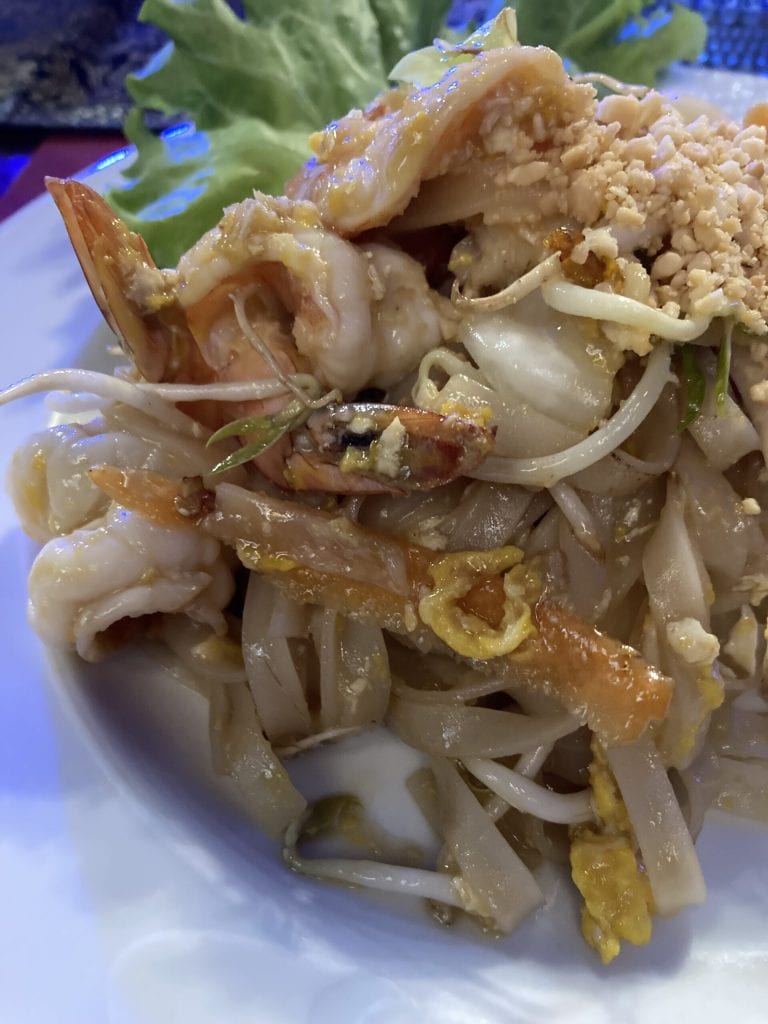
The recipe I chose is a classic of Thai cuisine, which I had the pleasure of trying at the excellent Thai restaurant “Royal Orchid” in Alassio on Dante Street 122… and on the subsequent trip to Thailand in October/November 2024: the Pad Thai.
Typical Thai street food made with rice noodles (they should be 3/5 mm) stir-fried in a wok with eggs, shrimp or meat and/or tofu, as well as vegetables, peanuts, spices, and seasonings like tamarind juice and fish sauce.
It is a dish that was born and spread in Thailand in the early 1930s as a national dish.
The influence, however, is markedly Chinese, thanks to the centuries-old immigration to the country: stir-fried noodles are a classic in Chinese cuisine, while tamarind, cane sugar, and chili pepper are the sweet-spicy touch typical of Thai cuisine.
Today, it is eaten with various types of meat (very often chicken), but traditionally, it was made with tofu and dried shrimp, which is the recipe that follows.
In the main photo is the one from the “Royal Orchid” restaurant in Alassio.
Following is the revamped version tasted at the restaurant Techo vayo in Ao Nang presented wrapped in an omelette with peanut powder on the side.
- Difficulty: Easy
- Cost: Cheap
- Preparation time: 5 Minutes
- Portions: 4 People
- Cooking methods: Stove
- Cuisine: Thai
- Seasonality: All Seasons
Ingredients
- 10.5 oz rice noodles (should be 3/5 mm)
- 2 tablespoons vegetable oil
- 1 clove garlic
- 2 eggs
- 1 lime
- 2 tablespoons brown sugar
- 2 tablespoons fish sauce
- to taste chili
- 3 scallions
- to taste coriander
- to taste tamarind sauce (or tamarind paste)
- 3 tablespoons peanuts (unsalted)
- 5.3 oz bean sprouts
- 3.5 oz tofu
- 0.5 oz dried shrimp (optional)
Preparation
Bring a pot of lightly salted water to a boil and cook the noodles following the cooking time on the package. Rinse them under cold water and set aside.
In a bowl, mix lime juice, sugar, fish sauce, tamarind sauce, and chili.
In a wok or large pan, heat the vegetable oil over medium heat, add the garlic and let it brown.
Add sliced scallions, shrimp (optional), and diced tofu.
When cooked, remove from the pan and set aside.
Return the wok to the heat, add eggs, bean sprouts, noodles, add the rest of the preparation and sauces (if needed, a glass of water).
Stir-fry for a few minutes, moving everything with a spatula, being careful not to break the noodles.
Serve with chopped peanuts on the plate and chopped coriander, with chili and lime on the side, which everyone can “dose” to taste.
Travel Photos in Thailand (here Phi Phi Island) October-November 2007
Travel Photos in Thailand (here Phi Phi Island) October-November 2007
Affiliate Link #adv
The difficulty in Italy is finding fish sauce.
A cream produced from fermented fish, and that of tamarind, or the paste, which is instead a sweet and sour cream obtained from the tamarind pulp.
Why use a wok?
The wok is an iron pan that transmits heat evenly, at the bottom as well as on the sides. This is why it is particularly suitable for stir-fried dishes, which can cook at any point in the pan ‘searing’ without getting soggy.
What is the difference between noodles used for pad see ew and pad thai?
Noodles have a long history in Thailand.
It is believed they were introduced by Chinese traders in the 1700s, but they gained popularity during World War II when rice was scarce.
With the war and floods devastating the rice fields, the government pushed noodles to become a new popular staple.
Pad Thai is made with thin rice noodles,
Pad See Ew has a wider and flat rice noodle.

Noodles have a long history in Thailand.
It is believed they were introduced by Chinese traders in the 1700s, but they gained popularity during World War II when rice was scarce.
With the war and floods devastating the rice fields, the government pushed noodles to become a new popular staple.
Pad Thai is made with thin rice noodles,
Pad See Ew has a wider and flat rice noodle.
