
I visited Kenya in February 2004, and once I returned home, I experienced what is called “Africa’s longing”.
I spent a week at the then Ventaclub Temple Point, on the most famous and beautiful beach in Kenya, namely Watamu, and went on a safari in the Tsavo East National Park. It was a wonderful experience, and I promised myself to return many times, because the safari lasted only one day, and I would have liked to spend at least one night in the lodges to see the animals when the sun sets and it is cooler, and they reach the streams to drink, making them easier to see, but I never did.
The Kenya I experienced, within the golden walls of a tourist village, was full of sunshine, heat, and wild, white beaches. Africa could sustain itself through tourism, but unfortunately, there are too many interests keeping it poor and ignorant.
Outside the tourist village, everything is different, as we all know, but to truly experience Africa, one should join humanitarian organizations; otherwise, one is content to see the beautiful parts, which attract you precisely for their “wildness”.
Viaggi della Ventaglio was a well-known Italian tour operator, and its tourist villages had an Italian imprint in terms of entertainment, organization, and food.
Back then, I traveled this way, thanks to discounts as a travel agent, and I liked it… Today I travel very differently, and I still enjoy it…
I remember the Kenyan night, with a dinner based on local specialties and an evening show with the Masai, and a dish in particular struck me because it reminded me of our polenta; that dish was ugali.
To obtain this traditional African dish, which is the national dish in Kenya and Tanzania, you only need cornmeal, water, and salt, although some of the populations are accustomed to adding (or replacing the cornmeal) with sorghum or millet, grains cultivated before the introduction of corn in the 16th and 17th centuries.
This dish is usually accompanied by stew, but it can be used for dipping in fish sauces or vegetables.
Some of the vegetables in Africa that are most often used to create an energetic dish include pumpkin and lettuce, and sometimes certain types of peanuts.
It is a humble dish that allows the population to feed themselves without needing refined ingredients, using a product that has been cultivated in Africa since ancient times, namely corn.
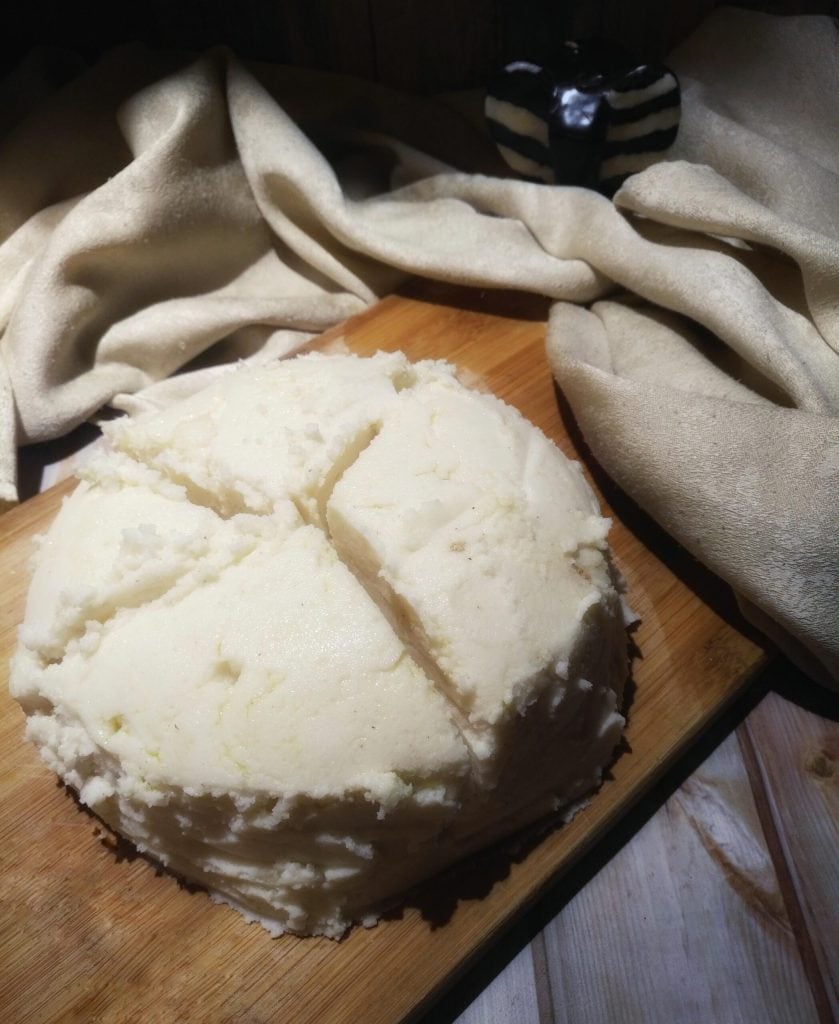
- Portions: 4 people
- Cooking methods: Boiling
- Cuisine: African
Ingredients
- 14 oz white cornmeal
- 3.5 cups water
- to taste salt
Preparation
In a deep pot, pour the water, add the salt.
Once it reaches a boil, add the white cornmeal and cook over low heat, stirring constantly for about 15-20 minutes.
The cornmeal must cook until it completely absorbs the water. Cover and cook on very low heat for five minutes. Check the consistency of the porridge, and if completely solid, turn it onto a tray. Cover with a damp cloth and serve warm.
Ugali should have a dense and lump-free consistency.


Some photos from the trip to Kenya from February 15th to 23rd, 2004
CURIOSITY:
Unlike our polenta, ugali is white in color. It has a firm and compact consistency, almost as if it were a loaf, and is traditionally eaten with hands.
Usually, ugali is poured onto a plate, which is then placed in the center of the table and shared with the family. Everyone takes a portion. A piece is torn off with the hands. A small indentation is made with the thumb to create a sort of scoop, which is used to dip into meat stews (beef, mutton, goat, chicken, oxtail, fish, vegetables, beans).
Usually, ugali is poured onto a plate, which is then placed in the center of the table and shared with the family. Everyone takes a portion. A piece is torn off with the hands. A small indentation is made with the thumb to create a sort of scoop, which is used to dip into meat stews (beef, mutton, goat, chicken, oxtail, fish, vegetables, beans).
The brand of white cornmeal I find best for making this and other recipes using this product is: Pan Pre-Cooked White Cornmeal .
Why does Kenyan cuisine have Indian culinary influences?
Kenyan cuisine has been influenced by Indian cuisine due to colonial history and cultural and trade exchanges between Kenya and India.
Here are some reasons why there are Indian culinary influences in Kenya:
British colonization: During the British colonial period, many Indians were brought to Kenya as workers and traders. These Indians brought their culinary traditions with them and adapted them to the local context.
Indian community in Kenya: The Indian community in Kenya has been present since the 19th century and has maintained its culinary traditions. Many Indian restaurants and grocery stores in Kenya offer typical Indian dishes and products.
Trade exchanges: Kenya and India have had significant trade exchanges, with India exporting food products and spices to Kenya.
Examples of Kenyan dishes with Indian influences
Chapati: A type of Indian flatbread that has become popular in Kenya.
Samosas: Pastries filled with vegetables or meat, originally from India, but now common in Kenya.
Curry: Curry dishes are common in Kenya, often prepared with meat or vegetables and served with rice or bread.
Use of spices: Kenyan cuisine uses many spices common in Indian cuisine, such as cumin and coriander.
In general, the Indian culinary influences in Kenya are the result of a long history of cultural and trade exchanges between the two countries.
