
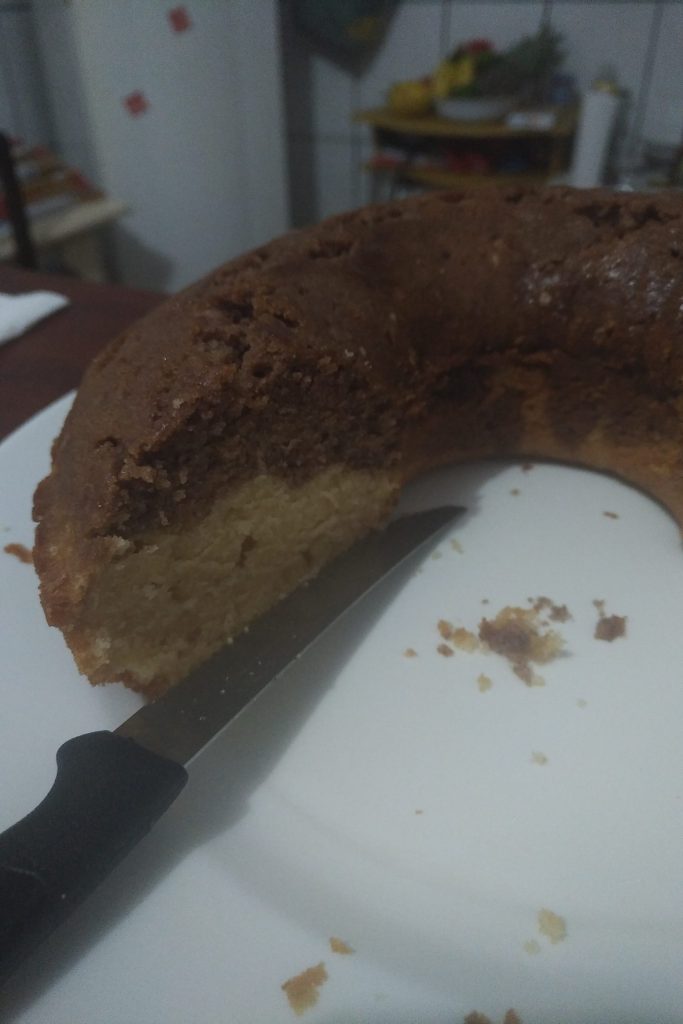
“Mesclado” in Portuguese means mixed; this cake, typical of Brazilian breakfast, is indeed a mix of white and black.
Bolo mesclado, therefore, can be translated as: marble bundt cake.
Soft, easy to make, it’s always present in Brazilian pousadas buffets.
It originated in Germany in the 19th century with the name “marmorkuchen” and in English it is called “Marble cake” achieved by mixing two different batters: one vanilla-based and the other chocolate-based.
Its name comes from the black streaks in the white batter, making it vaguely resemble marble.
According to some, the idea of preparing cakes by mixing two different batters took hold in Germany during the 19th century and was based on spices and molasses.
Later, the so-called marmorkuchen, which had spread in Germany, will become popular in the United States thanks to German immigrants.
During the Victorian era, the so-called “Harlequin cake” (“Arlecchino cake”), which was decorated with checkered patterns, gained some prominence.
Also very popular in Denmark, it is called “marmorkage” in Danish.
Brazilian measurement unit: 1 tea cup = 165 gr.
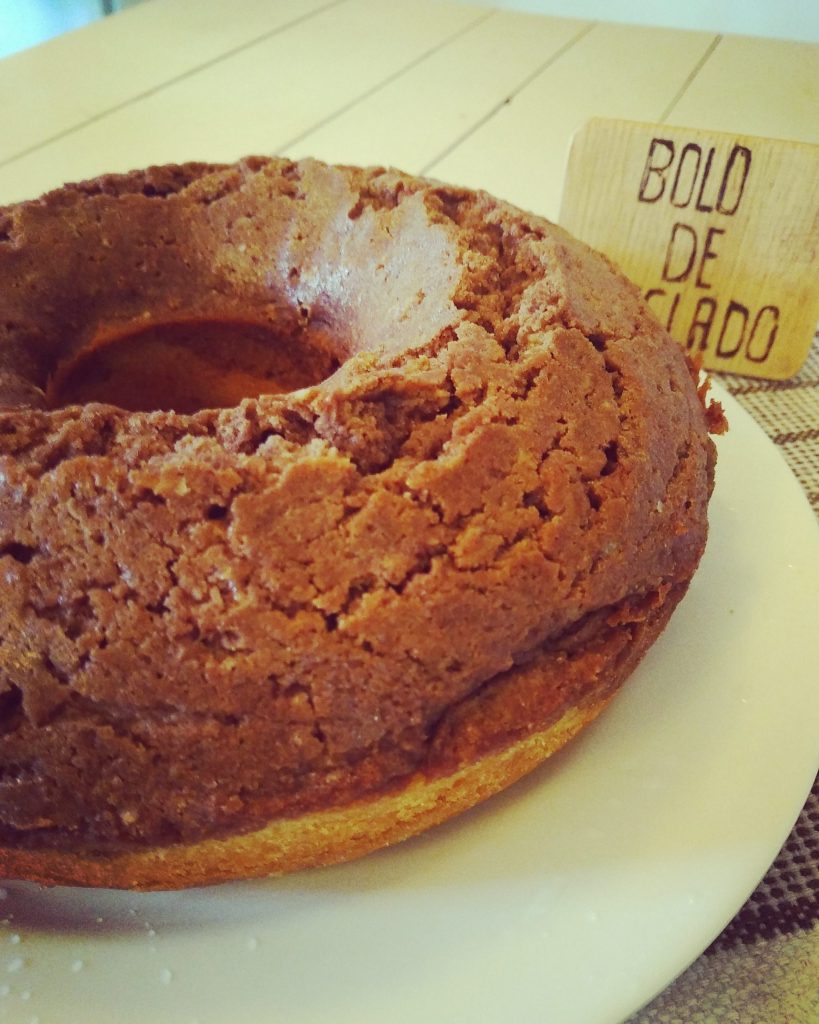
- Difficulty: Very easy
- Cost: Very economical
- Preparation time: 5 Minutes
- Portions: 8 servings
- Cooking methods: Oven
- Cuisine: Brazilian
- Seasonality: All seasons
Ingredients
- 3 cups Wheat flour
- 2 cups Sugar
- 4 Eggs
- 4 tablespoons Cocoa or chocolate
- 160 g Butter
- 1 cup Milk
- 4 tablespoons Baking powder
- 1 packet Vanillin
Preparation
Beat the butter with the sugar for 10 minutes in the mixer.
Add the eggs, flour, vanillin, and milk.
Turn off the mixer and incorporate the baking powder.
Separate 1/3 of the batter and add the cocoa (or chocolate).
In a greased and floured bundt pan, place half of the white batter, then place the dark batter (you can make “designs”) and cover with the rest of the white batter.
Bake in a preheated oven at 350°F for 45-50 minutes.
Affiliate Link #adv
The advice is to always use a high-quality flour.
As in other recipes related to Brazilian breakfast sweets, “wheat flour” is indicated among the ingredients (for them “farinha de trigo“), but what is it?
Common wheat flour or soft wheat flour is a product obtained from milling the grain or wheat kernel.
Depending on the percentage of the grain kernel that will constitute the final product, it is possible to distinguish different degrees of refinement of soft wheat flour:
– 00 Flour: the most refined, obtained through modern milling with steel rollers. In this flour, all the best parts of the wheat are removed nutritionally, all that is left is the starch (simple carbohydrates) and a few proteins (gluten).
– 0 Flour: slightly less refined than the previous one, but still deprived of much of its nutrients.
– Type 1 Flour: through stone milling, the entire grain is ground without removing any part. Type 1 flour contains a greater amount of bran and wheat germ, the parts richest in nutrients.
– Type 2 Flour: Also known as “semi-wholemeal” flour, it is characterized by large granules and a greater quantity of fibrous components and seed germ compared to the previous ones. It is a flour with excellent nutritional characteristics and is easier to work with compared to wholemeal flour.
– Wholemeal Flour: the best nutritionally, wholemeal flour contains the entire grain in all its parts, starch, bran, and wheat germ, and is, therefore, a complete food.
Type 1 and Type 2 flours are excellent for making bread, pizza, sweets, and bakery products.
– Manitoba flour: comes from the fields of Canada, in North America, from the region of the same name, Manitoba. It is a soft wheat flour, rich in gluten and consequently richer in protein compared to other flours. Manitoba flours are the strongest flours known (i.e., resistant to yeast), thus suitable for long fermentation.
From durum wheat flour, semolina is obtained instead.
Among the most popular durum wheat flours is the Kamut Flour.
