
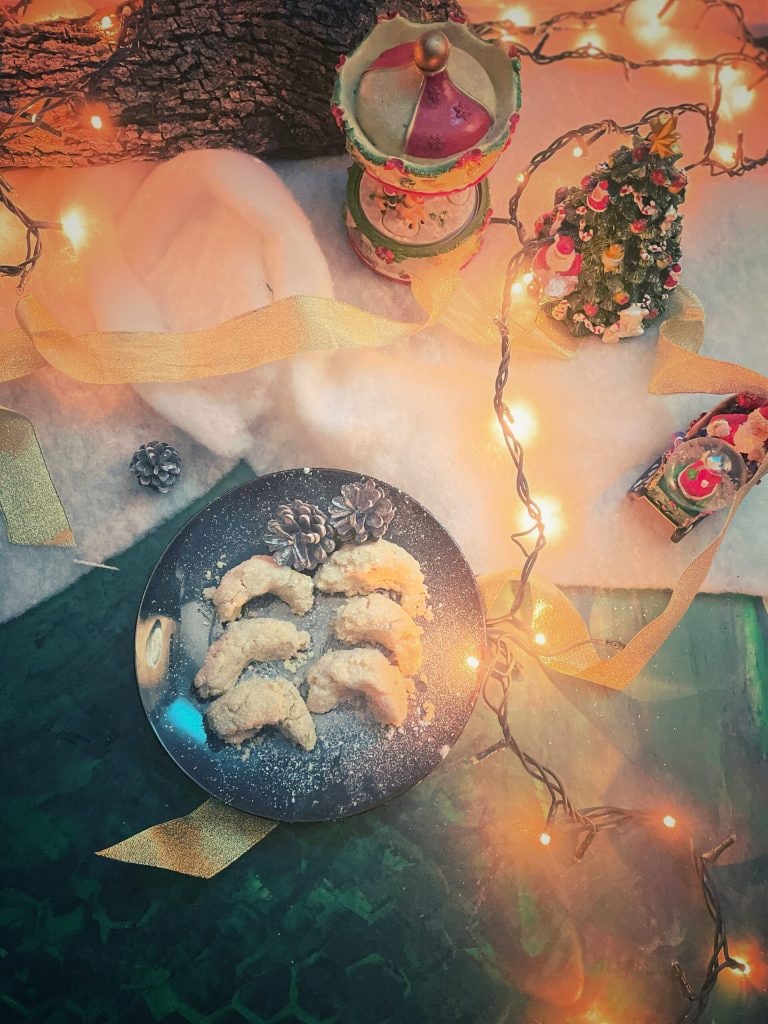
The vanilkové rohlíčky are one of the classic Czech Christmas sweets: crescent-shaped cookies.
They come from a Central European tradition (similar to the “vanillekipferl”), but are well rooted in Czech home cooking.
The fundamental ingredients are: butter, flour, nuts, vanilla, and powdered sugar for dusting.
They are one of the cookies that are never missing from homemade Christmas trays, along with other sweets like perníčky (spiced cookies) and linecké (filled cookies). They are prepared in advance because they improve with resting, becoming softer and more aromatic.
“Rohlíčky” is a generic Czech term, it is the diminutive plural of “rohlík”, which indicates a crescent or croissant shape.
In the kitchen, it can refer to:
• crescent-shaped rolls (like the typical breakfast rolls in the Czech Republic) similar to kipferl, but savory
• pastries or cookies with the same shape
So, “rohlíčky” literally means “little croissants” or “little crescents” and is used descriptively for the shape, not just for the type of dough.
My version of Vanilkové rohlíčky is gluten-free, with rice flour, and sugar-free because it uses erythritol.
- Difficulty: Medium
- Cost: Inexpensive
- Rest time: 2 Hours
- Preparation time: 5 Minutes
- Portions: 40Pieces
- Cooking methods: Oven
- Cuisine: Czech
- Seasonality: Christmas
Ingredients
- 2 1/2 cups rice flour
- 1 cup nuts
- 1/3 cup erythritol (and to be ground into powder for decoration)
- 13 tbsp butter
- 2 egg yolks
- to taste lemon zest (optional)
Steps
1. In a bowl, mix rice flour, chopped nuts, erythritol, and lemon zest (if using).
2. Add the softened butter in pieces and the egg yolks; knead quickly until the dough is smooth and compact but not hard.
3. Wrap the dough in plastic wrap and let it rest in the refrigerator for at least 2 hours.
4. Preheat the oven to about 340-355°F (static oven).
5. Divide the dough into small portions, shape them into rolls about 1/2 inch thick and 1 1/2 to 2 inches long, then bend them into a crescent shape.
6. Place them on a baking sheet lined with parchment paper, leaving a small space between each one. Bake for about 10 minutes or until lightly golden at the edges (but they shouldn’t darken too much). [1]
7. Immediately after baking, while still warm, roll them in powdered erythritol. Let them cool completely.
8. Storage: in an airtight container, they will last several weeks and become softer over time.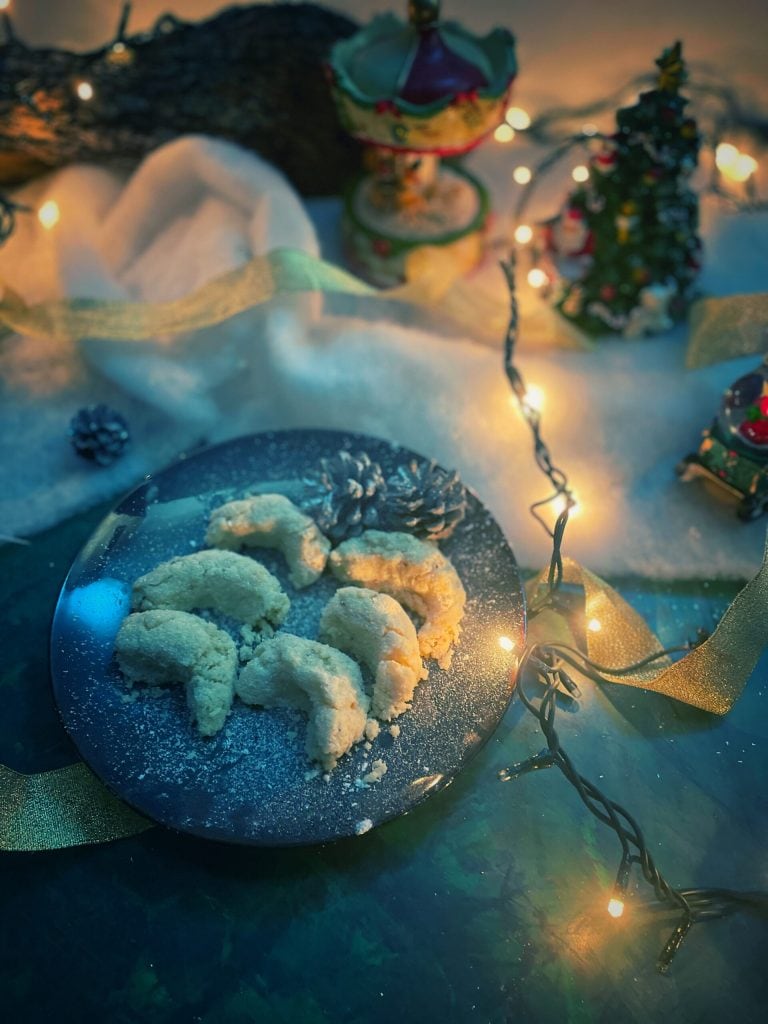
FAQ (Questions and Answers)
What’s the difference with vanillekipferl and kourabides?
Vanilkové rohlíčky, Vanillekipferl, and Kourabiedes are similar in shape and season (Christmas), but they have different origins, ingredients, and textures.
1. Vanilkové rohlíčky (Czech Republic/Slovakia)
• Origin: Czech and Slovak cuisine
• Shape: Crescent
• Typical ingredients: Flour, butter, chopped nuts (often common nuts or hazelnuts), egg yolks, vanilla sugar
• Coating: Vanilla powdered sugar
• Texture: Crumbly and slightly sandy
• Use: Typical Christmas cookie
• Note: Improve with resting
2. Vanillekipferl (Austria / Germany)
• Origin: Austrian and German cuisine (especially Viennese)
• Shape: Crescent
• Typical ingredients: Flour, butter, ground almonds, sugar, vanilla
• Coating: Vanilla sugar immediately after baking
• Texture: Very similar to rohlíčky but slightly more delicate and “buttery”
• Note: They are the “mother version” from which rohlíčky are derivedMain difference with rohlíčky: almost exclusive use of almonds instead of nuts.
3. Kourabiedes (Greece)
• Origin: Greek cuisine (also present in Cyprus)
• Shape: Crescent or ball
• Typical ingredients: Flour, clarified butter (ghee or beurre noisette), almonds, sugar
• Flavors: Sometimes brandy, mastika, rose water, or orange
• Coating: Abundant powdered sugar (until completely white)
• Texture: Very crumbly, often richer in butter
• Use: Typical Christmas and ceremonial sweet
• Note: More fragrant and aromatic recipeMain difference: use of intense flavors (brandy, rose water) and clarified butter, which changes consistency and taste.Where do the similarities between Vanilkové rohlíčky, Vanillekipferl, and Kourabiedes come from?
The similarity between Vanilkové rohlíčky, Vanillekipferl, and Kourabiedes arises from cultural and historical contacts between the regions of Central Europe, the Balkans, and the Eastern Mediterranean, especially between the 18th and 19th centuries.
1. Austro-Hungarian influence
• The Austro-Hungarian Empire included Austria, Hungary, the Czech Republic, Slovakia, and part of the Balkans.
• Recipes like Vanillekipferl spread as Viennese aristocratic pastries, then adopted in local forms (e.g., rohlíčky in Bohemia).
2. Ottoman spread
• Kourabiedes likely derive from similar sweets introduced during the Ottoman period (like Turkish kurabiye).
• Ingredients like almonds, clarified butter, and flavors like rose water reflect Middle Eastern influences.
3. Simple and widespread ingredients
• In all these regions, butter, nuts (almonds or walnuts), and sugar were available: simple but festive ingredients.
• Christmas or religious holidays were ideal moments to prepare these rich sweets.
4. Family transmissionWhat is erythritol?
Natural non-artificial sweetener.
Low-calorie content: Provides about 0.2 kcal per gram, compared to 4 kcal of regular sugar.
Zero glycemic index: Does not affect blood sugar levels, making it suitable for diabetics and people with glycemic issues.
Compared to other polyols, like xylitol, it is mostly absorbed by the body and less likely to cause intestinal disorders.
Widely used in the keto diet.
You can purchase it on www.erbotech.it
with my 15% discount code: VG15What if the shortbread melts and doesn’t hold the cookie shape?
The cause might be the absence of gluten
• Rice flour + nuts = very crumbly dough lacking elastic structure.
• Without gluten or additional binders (like xanthan gum or flax seeds), it tends to break or collapse during baking.
✅ Solution: you can add 1 teaspoon of psyllium powder or 1 flat teaspoon of xanthan gum to give cohesion.
If you cannot modify the recipe or add ingredients, and the shape is crescent and thick, here are the best strategies to try with what you already have:
✅ 1. Deep chilling
• After forming the crescents, place them in the freezer for at least 15-20 minutes before baking. They must be very firm to the touch. This delays butter melting in the oven.
✅ 2. Convection oven and lower temperature
• Bake at 320°F convection, already well preheated.
• This helps solidify the edges before the butter melts too much.
• Keep an eye on it: baking may take a few minutes longer (about 12-18 min, depending on size).Is erythritol suitable for a Low FODMAP diet?
Erythritol is generally considered suitable for a low FODMAP diet, but with moderation.
Because:
• It is a polyol, like xylitol, sorbitol, etc., but it is absorbed 90% in the small intestine and does not ferment in the colon like other polyols.
• Therefore, it does not cause bloating or fermentation in most people with IBS, unlike other similar sweeteners.
Limits:
• In high amounts (over 20-25 g at a time), it can still cause laxative effects or gastrointestinal discomfort, although it is much better tolerated than other sweeteners.
• Some very sensitive people may have discomfort even with lower doses.
Conclusion:
✔ Yes, it is allowed in the low FODMAP diet, but it is best not to overdo it.
Perfect for cookies or sweets if not used too much in a single serving.
