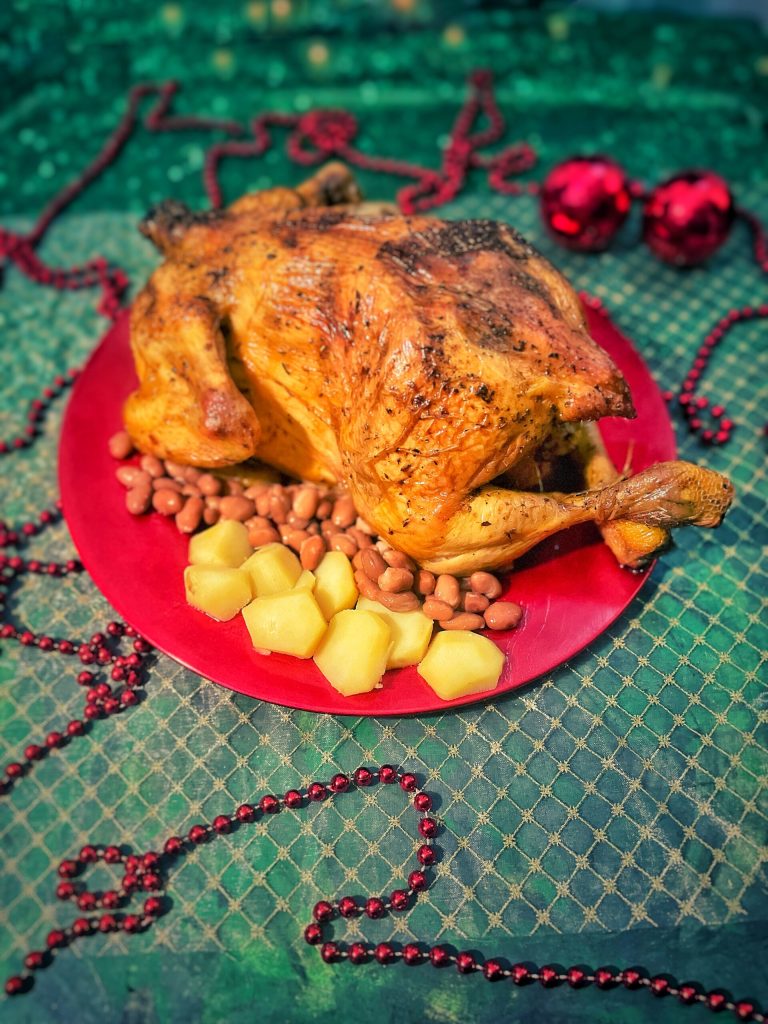
The Gallina Rellena is considered the main dish of Christmas Eve and New Year’s Eve in many Nicaraguan families.
In truth, it is a traditional dish widespread in various Latin American countries, with the main characteristics being:
• a whole hen (or sometimes free-range chicken), deboned or partially deboned.
• a flavorful stuffing and either baked or boiled and then browned.
Recipes vary greatly from country to country, from family to family, so there is no ‘universal and fixed’ version with always identical ingredients.
The recipe has roots in Spanish colonial traditions, where stuffed animals (such as capon or turkey) with complex, sweet and savory fillings were prepared for major religious celebrations.
Spanish colonists brought these habits with them to Latin America, where they were adapted to local raw materials.
In the absence of turkey, it became common to use hen or chicken, which were cheaper and more available.
It is a symbol of abundance, family, and sharing.
The rich stuffing, often with ground pork, or a mix of pork and beef, rice, vegetables, spices, hard-boiled eggs, nuts, and raisins, represents the generosity of the Christmas table.
The slow cooking, elaborate stuffing, and presentation at the center of the table make it an important dish, often prepared only on very special occasions like Nochebuena (Christmas Eve).
It is a dish to share: after dinner, if a neighbor passes by, they are often offered a plate — generosity is part of the Christmas tradition.
- Difficulty: Medium
- Cost: Economical
- Rest time: 2 Hours
- Preparation time: 20 Minutes
- Portions: 10 People
- Cooking methods: Oven
- Cuisine: Latin American
- Seasonality: New Year, Christmas
Ingredients
- 6.6 lbs hen
- as needed vegetable oil
- 1 cup citrus juice (or mojo criollo)
- 3 onions
- 2 leaves bay leaves
- 8 cloves garlic (crushed)
- as needed spices (cumin, pepper, paprika, coriander)
- as needed oregano
- as needed salt
- 3.5 oz onion
- 2 cloves garlic (chopped)
- 1.8 oz sweet pepper
- 1 carrot
- 1 chayote
- 1 oz celery (chopped)
- 10.5 oz ground pork shoulder (or a mix of pork and beef)
- as needed cumin
- as needed oregano
- 3.5 oz cooked long-grain rice
- 1 leaf bay leaf
- 3.5 fl oz chicken broth
- 1.8 oz pitted green olives
- as needed raisins
- as needed parsley
- as needed salt and pepper
- 3 hard-boiled eggs
Tools
- 1 Kitchen Twine
- 10 Toothpicks
Steps
1. Marinating the hen
In a mortar or blender, crush/garlic + onion + oregano + orange juice and zest or mojo criollo + a little oil + salt and spices.
Clean the cavity of the hen, remove excess fat. Rub the marinade inside and outside the hen.
Place the hen in a large plastic bag (or in a covered bowl) and let marinate in the refrigerator for at least 2 hours.
2. Preparing the stuffing
In a large pan with oil, sauté the cubed meat until golden. Set aside.
In the same pan, add more oil, sauté onion and garlic, then add carrot and chayote, diced sweet pepper (chiltoma), cumin, oregano, salt, and pepper. Cook for a few minutes, then add the cooked rice and bay leaf, finally the broth. Cook for 15 minutes.
Add olives, raisins (or nuts), and parsley. Mix well.
Let the stuffing cool to room temperature.
3. Stuffing and cooking the hen
Preheat the oven to about 350°F.
Fill the cavity of the hen with the prepared stuffing with the addition of chopped hard-boiled eggs; tie the thighs and tuck the wings under the body (you can use kitchen twine or toothpicks).
Place the hen in a roasting pan, cover with aluminum foil and cook for about 2 hours.
After 2 hours, remove the aluminum foil, brush with butter or oil (optional), and cook for another 30 minutes until the skin is golden and crispy and the meat is well cooked (internal temperature at least 165°F).
Let rest for 10 minutes before carving and serving.
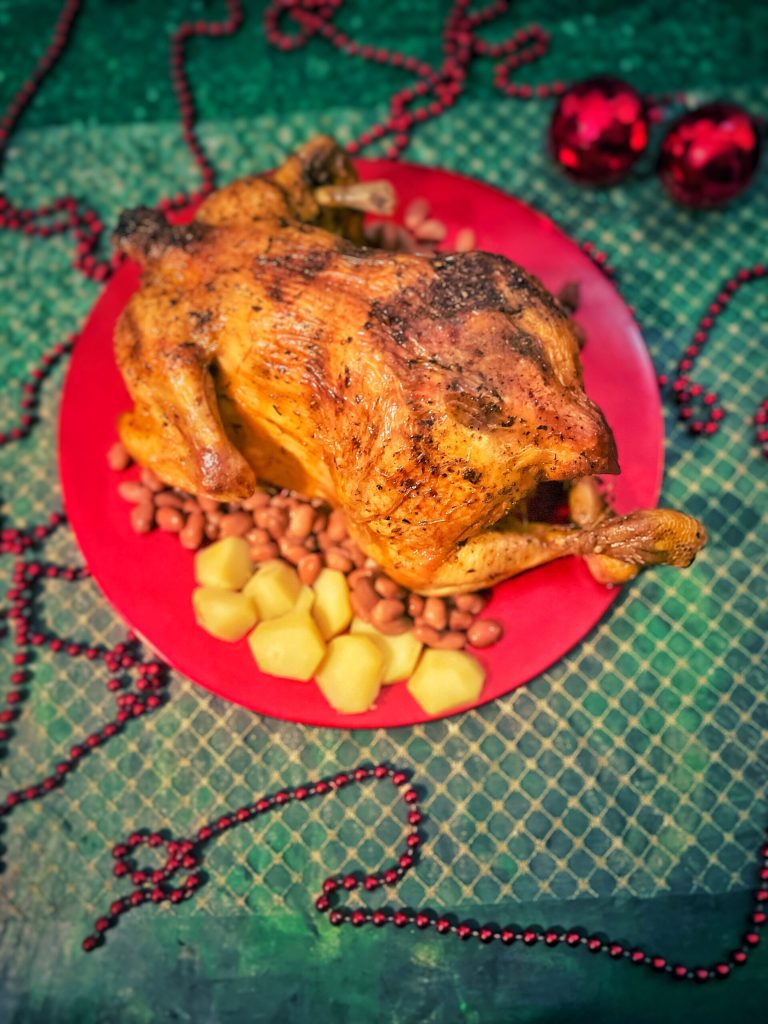
Serve the hen cut into pieces, accompanied by white rice, salad, red beans (habichuelas), or potatoes — according to Nicaraguan Christmas tradition.