
The Vasilopita is a Greek cake usually prepared for Saint Basil (New Year’s Day), but also for New Year’s Eve and Epiphany.
A soft cake known in Greek as “Βασιλόπιτα” with flour, butter, sugar, and eggs.
Vasilopita, “vasilo” and “pitta” literally means “Basil’s bread”.
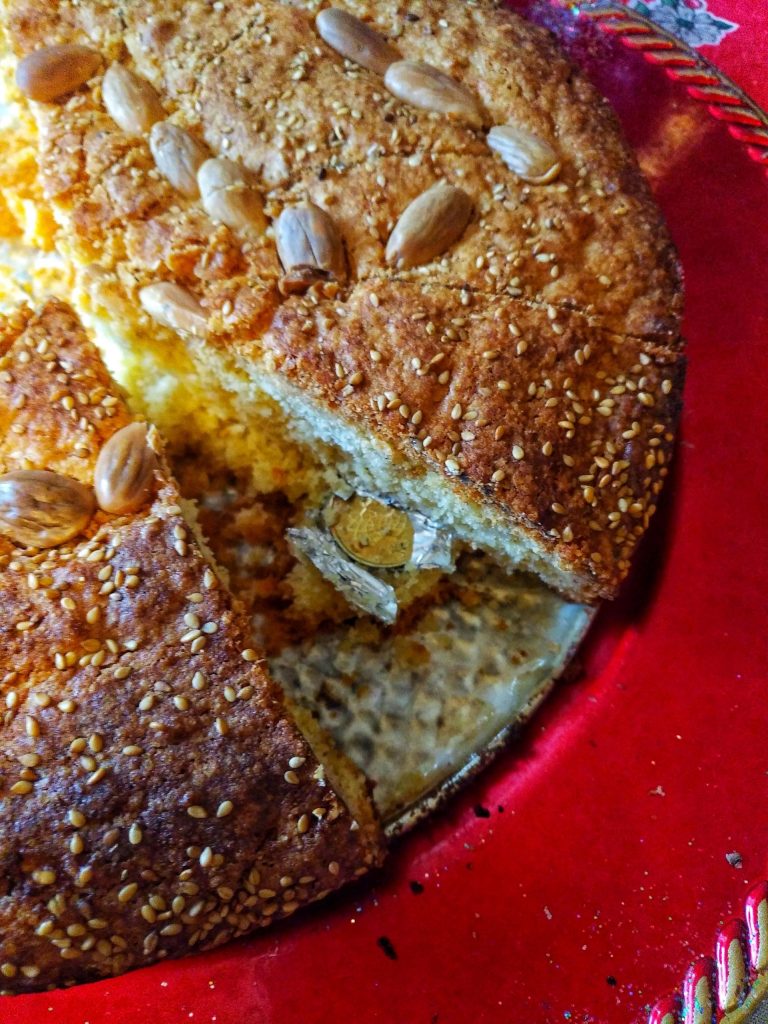
The story goes that in Cappadocia of Caesarea in the first half of the 4th century, the bishop who would become Saint Basil the Great wanted to distribute coins to the poor of his diocese, so he tasked many women with baking a sweet bread with a flourì, or a gold coin, inside.
The tradition of cakes hiding coins is often linked to the Magi and their “gifts”.
The lucky one who finds the coin in their slice will be blessed in the coming year. Similar customs are found in Spain with the Roscon de reyes, and in France with the Galette des Rois.
The vasilopita does not have a single recipe: like all traditional recipes, it is prepared differently in each family. What unites all versions is the simplicity of the ingredients and preparation and the final softness.
Tradition has it that on the surface the number of the new year is written.
The cutting ceremony of the vassilopita is very solemn; after drawing a cross with the knife three times, the head of the family proceeds to cut the first slices which are “untouchable”.
Afterward, a piece is distributed to all family members in age order (starting with the elderly).
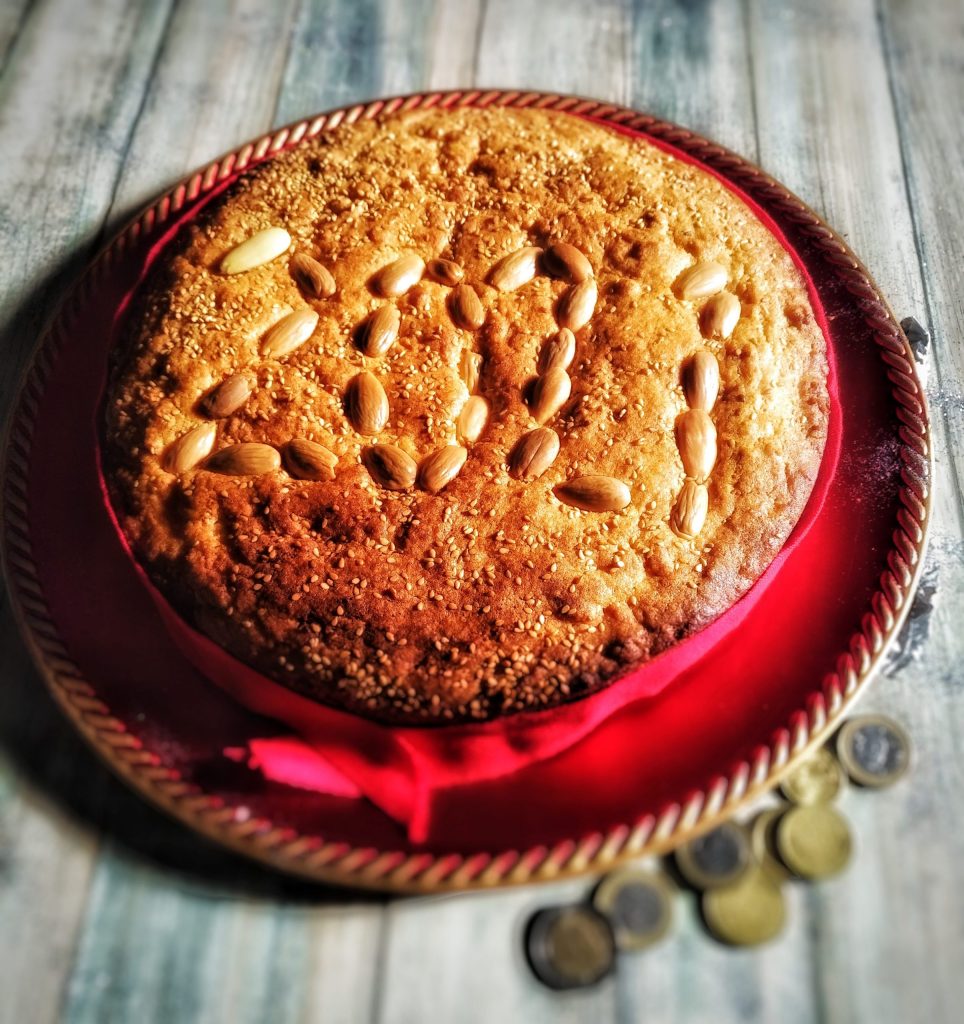
- Difficulty: Very easy
- Cost: Very economical
- Preparation time: 10 Minutes
- Portions: 6 people
- Cooking methods: Oven, Electric oven
- Cuisine: Greek
- Seasonality: New Year's Eve, New Year's Night
Ingredients
- 3 1/2 cups flour
- 7 oz butter (softened)
- 1 1/2 cups sugar
- 4 eggs
- 1 packet vanilla
- 1 packet baking powder
- 1/2 cup sliced almonds
- to taste sesame seeds
- 1 coin
Tools
- 1 Baking Pan 11 inch
Preparation
Beat the butter with the sugar until fluffy. Add the eggs, lightly beaten with a fork, a few at a time, letting them absorb well before adding the next ones.
In another bowl, sift and mix the flour, baking powder, and vanilla.
Combine this dry mix with the butter, eggs, and sugar mixture.
Pour the batter into a well-buttered pan measuring 11 inches.
Wrap the coin in aluminum foil and sink it into the batter so that it is not visible from the surface.
Finally, sprinkle the surface with sliced almonds and sesame seeds and bake in a preheated oven at 350°F for 50-60 minutes.
Variations:
There is also a sweet bread called Vasilopita, flavored with mastic and mahlepi.
Vasilopita is not sweet in all parts of Greece; in Macedonia, for example, a tiropita (with cheese in the dough) or a prassopita (made with leeks) is prepared instead.
In rural areas, it is common to decorate the outside of the vasilopita with a straw stem, a vine or olive branch, or a piece of cheese to encourage the harvest or agricultural products.
While in the rest of Greece this type of brioche cake is prepared for New Year’s, in Lefkada they made (and still make) the Ladopita, hiding a coin inside. Whoever found it would have good fortune all year.
A fun gift for Epiphany could be the children’s book: The story of Befana, e-book format.
