
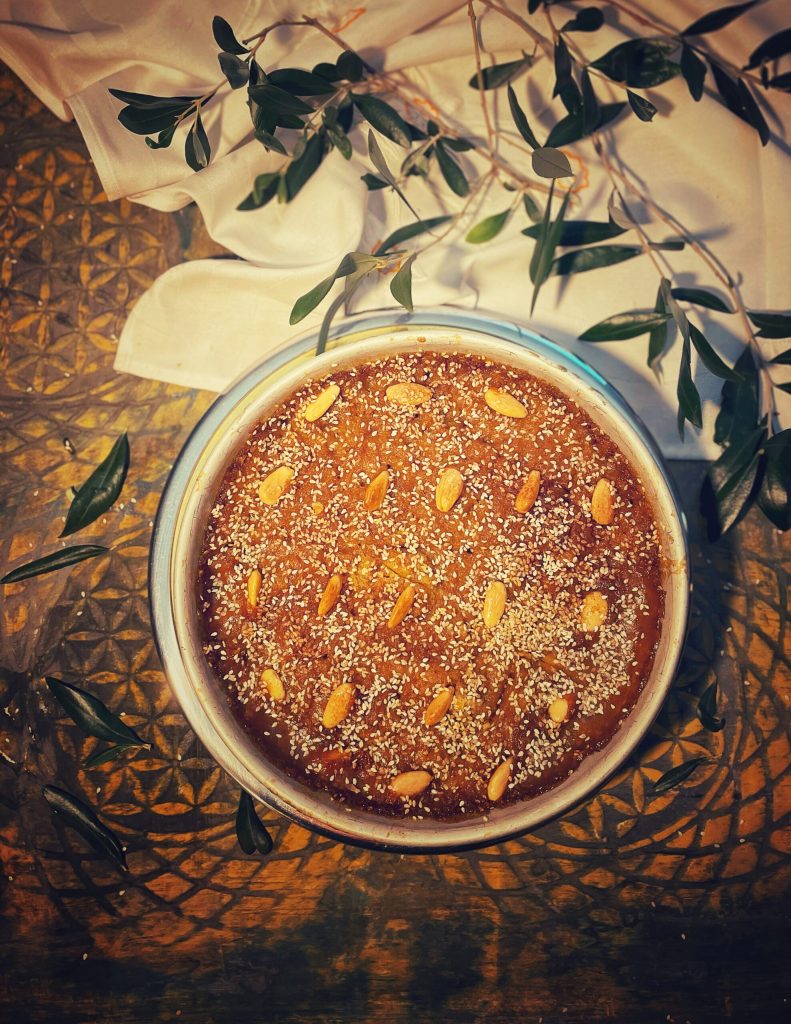
Ladopita is much more than just a dessert: it is the very essence of the island of Lefkada translated into humble but noble ingredients. Although the name may be misleading, it is not a soft cake but belongs to the glorious family of dense syrupy desserts, technically similar to a baked flour halva.
Its structure is compact, rich, and characterized by a deep toasting that gives it an inimitable hazelnut and caramel aroma.
Ladopita or Vasilopita? The paradox of Lefkada
An aspect that often confuses travelers is its role during the holidays.
In Lefkada, in fact, Ladopita is a sort of local Vasilopita. While in the rest of Greece New Year’s is celebrated with a brioche-like leavened cake, and Saint Basil is honored with this oil cake, precisely the Vasilopita.
The two preparations could not be more different: the classic Vasilopita is high and fluffy, while Ladopita is a “substantial” cake, without eggs or dairy, whose magic lies in the reaction between toasted flour and boiling syrup.
The only point of contact? The ritual of the flouri, the hidden coin in the dough that will bring a year of luck to whoever finds it in their slice.
The history of Ladopita is rooted in the agricultural economy of the island, where extra virgin olive oil was the most precious and abundant ingredient. Traditionally prepared for weddings and grand celebrations, this cake was appreciated for its incredible preservation capacity: the toasting technique and the presence of syrup act as natural preservatives, keeping the dessert perfect for weeks.
In this recipe, I will show you how to balance natural flours like rice flour with specific thickeners such as xanthan gum or carob bean flour, essential to replicate the typical body of Greek halvades but in the gluten-free version. The result will be a Gluten-Free Ladopita that has nothing to envy to the original: crunchy on the outside thanks to sesame seeds and almonds, and melting on the inside.
- Difficulty: Medium
- Cost: Economical
- Preparation time: 10 Minutes
- Portions: 6People
- Cooking methods: Stove, Oven, Electric Oven
- Cuisine: Greek
- Seasonality: New Year, All seasons
Ingredients
- 3 ¾ cups water
- 1 ¾ cups sugar
- 3 tbsp honey
- to taste ground cinnamon
- 1 ¾ cups olive oil (or extra virgin olive oil)
- 3 ⅔ cups rice flour
- 1 tbsp xanthan gum
- to taste sesame seeds
- 20 almonds
- to taste granulated sugar
- to taste ground cinnamon
Tools
- 1 Baking Pan 9/9.5 inch
Steps
Syrup: Boil the syrup ingredients for 10 minutes and keep it warm.
Toasting: Heat the oil in a large pot, add the flour, and stir continuously over medium heat. It should become a dark caramel color.
Mix: Pour the syrup (watch out for splashes!) into the toasted flour and stir until it becomes a compact mass that separates from the pot.
Cooking: Spread the dough in the oiled tray sprinkled with sesame. Level well (thickness about 1-1.2 inches), score diamonds, and insert an almond in each piece.
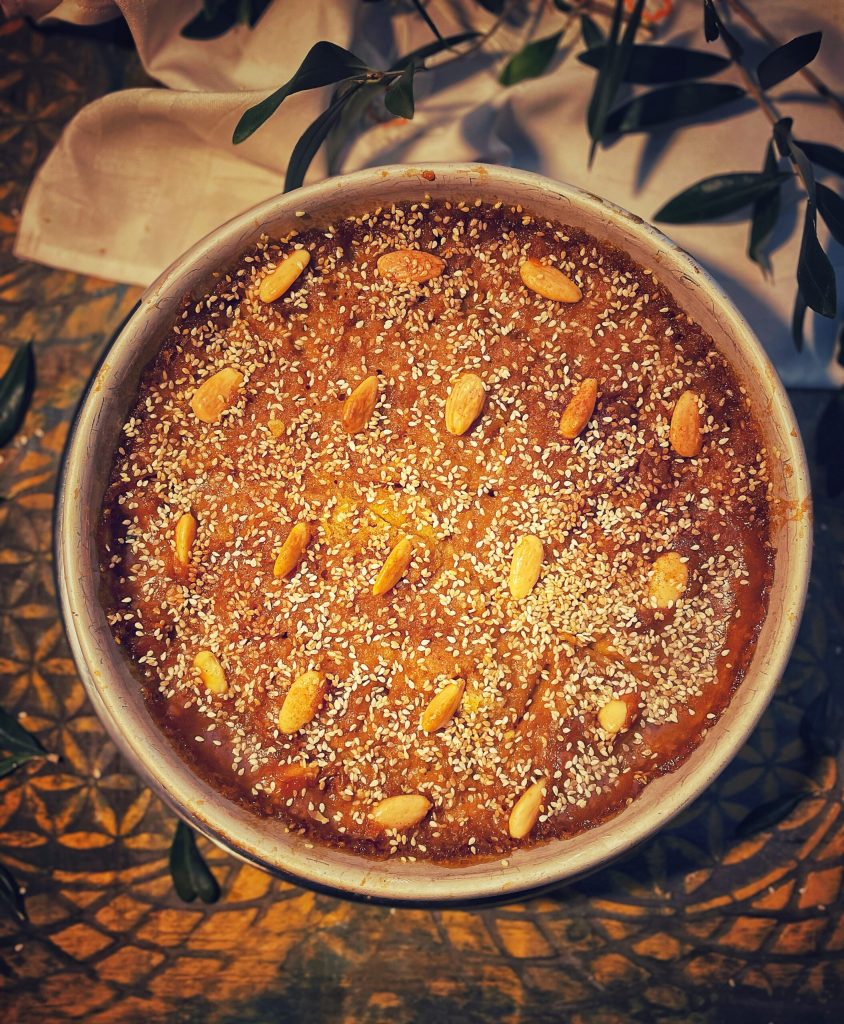
Oven: Bake at 356°F for about 40-50 minutes. The ladopita should be dark and crispy on the surface.Decorate with sugar and cinnamon and let rest before cutting.
Ladopita from Rhodes
In Rhodes, Ladopita is a sort of thin flatbread or fried piadina in oil. It is very versatile: it can be served as savory to accompany souvlaki, or as a sweet garnished with honey, cinnamon, or sugar
FAQ (Frequently Asked Questions)
Why is it said that Ladopita and Vasilopita are similar?
The misunderstanding arises from the fact that they are similar in social function, not in consistency or ingredients.
Here’s why they are often confused or compared:
The role of “Fortune Cake”: Both are the ritual sweets of January 1st. If you go to Lefkada on New Year’s, the “Vasilopita” they will offer you will look and taste like a Ladopita. The name “Vasilopita” (St. Basil’s cake) indicates the function of the dessert, not its recipe. Lefkada has simply chosen Ladopita to fill that role.
The Coin (the Flouri): The element that indissolubly twins them is the hidden coin ritual. For a Greek, any dessert containing a lucky coin for the new year is mentally categorized as “a version of Vasilopita”.
The Symbolism: Both represent abundance. Vasilopita does it through the richness of eggs and butter (or the generous leavening), while Ladopita does it through the abundant use of olive oil and honey, age-old symbols of prosperity in the Mediterranean.
In summary: they are related in ritual, but strangers in the kitchen. It’s like comparing Panettone to Pandoro: they serve the same purpose, but the structure is completely different.
