
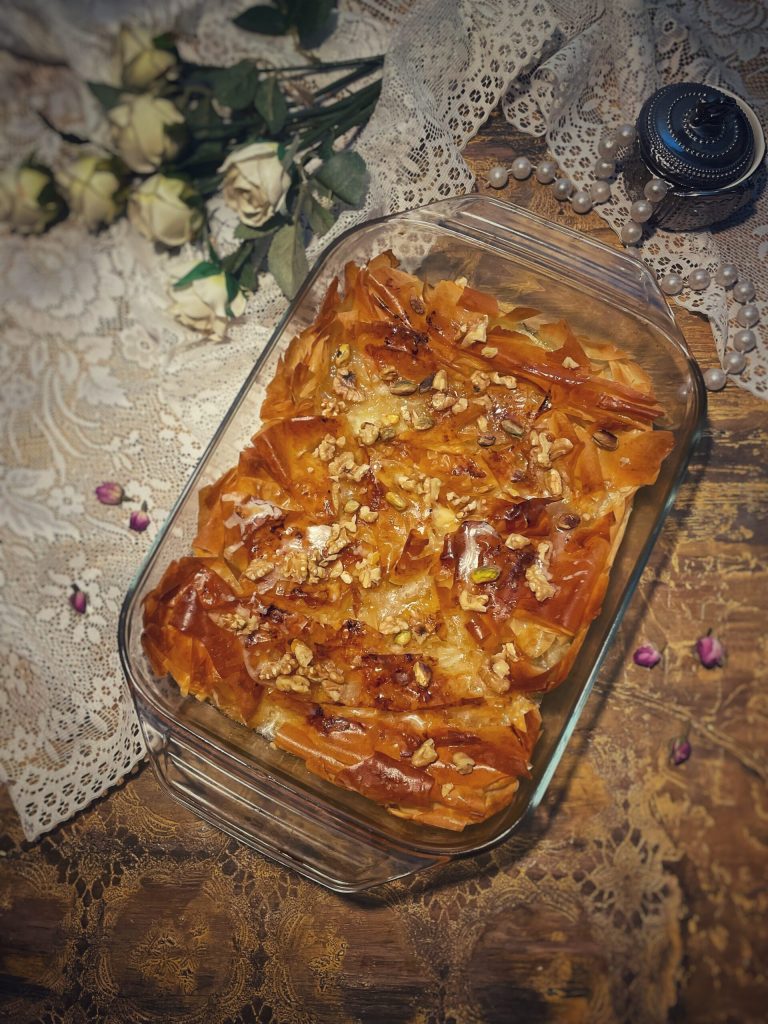
If you’ve been on social media lately, you’ve surely come across a golden, crunchy, and irresistible cake called Crinkle Cake. But did you know this dessert is not a modern invention? Its real name is Muakacha (المكشكشة), which in Arabic means literally “wrinkled” or “crinkled”.
Muakacha is a treasure of Iraqi pastry, made famous throughout the Middle Eastern world. It is considered a simplified “cousin” of Baklava, sharing the use of phyllo dough and aromatic syrup.
While Baklava requires meticulous precision in layering the sheets of dough, in Muakacha the sheets are intentionally crumpled into an accordion shape to create spaces that become nests of crispiness.
The phyllo dough is first drenched with plenty of melted butter, then topped with a velvety custard that cooks between the folds, remaining soft.
The final touch, essential in Middle Eastern tradition, is the Attar: a sugar syrup infused with rose or orange blossom water, poured cold over the hot cake to create that typical “crunch”.
Finally, the original recipe is enriched with a shower of chopped pistachios.
And in the video, I offer you a version with bergamot-flavored syrup.
- Difficulty: Easy
- Cost: Low Cost
- Preparation time: 10 Minutes
- Cooking methods: Stovetop, Oven, Electric Oven
- Cuisine: Middle Eastern
Ingredients
- 12 sheets phyllo dough
- 1/2 cup butter (melted)
- 1 1/4 cups milk
- 3 eggs
- 3/4 cup sugar
- 1/3 cup unsalted pistachios
- 1/2 cup water
- 1 teaspoon lemon juice
- 3 pods cardamom
- 2 tablespoons rose water
Tools
- 1 Baking Pan 8×12 inches
Steps
1. Fold the phyllo dough
Take two sheets of phyllo dough at a time and fold them accordion-style (folds of about 1-2 inches).
Place them in the buttered 8×12-inch pan close together. Don’t press them too tightly: they should have
space.
Pour the melted butter evenly over the entire surface, making sure it gets into the
folds.
2. Add the custard
Whisk together milk, eggs, sugar. Gently pour this mixture over the phyllo dough.
Place in the oven at 350°F for 25 minutes until the surface is browned and crispy.
3. Prepare the syrup
In a saucepan, combine cardamom, water, sugar, and lemon. Bring to a boil, then reduce the heat
and simmer for 10 minutes until it coats the spoon, add the rose water and let it cool completely. It must be cold when you pour it over the hot cake.
4. Unmold
Unmold the Muakacha and while it is still hot, pour the cold syrup over the entire
surface. Finish with a generous handful of chopped pistachios and nuts. Let it rest for 15
minutes before serving.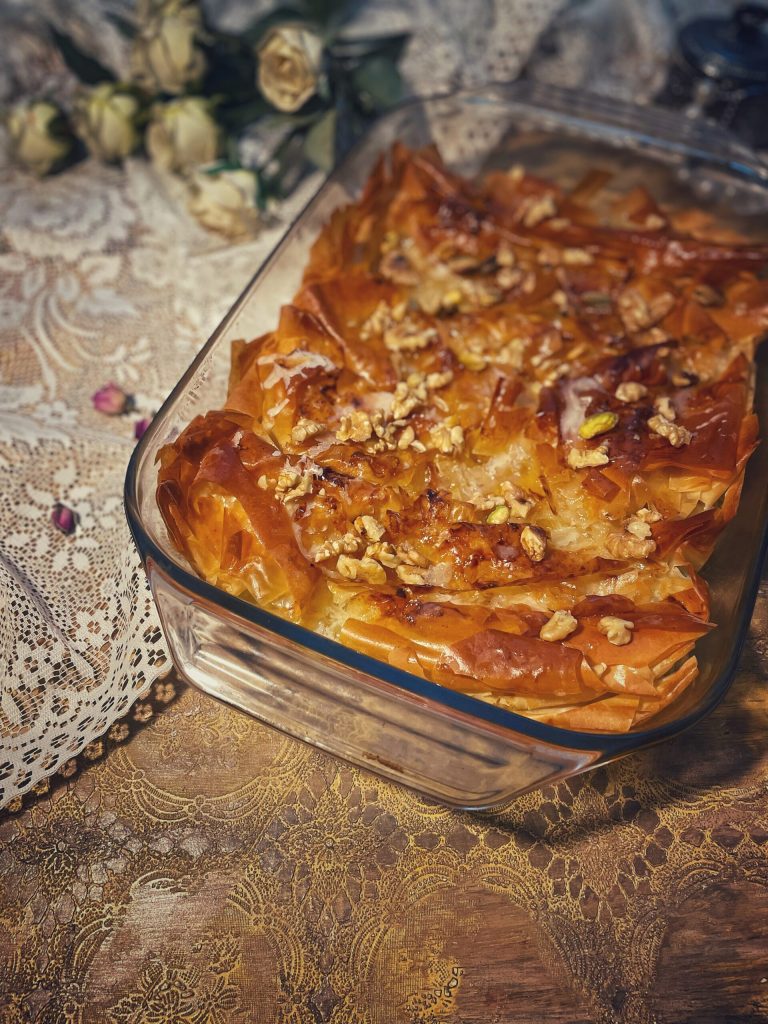
FAQ (Frequently Asked Questions)
What is the difference between Muakacha and crinkle cake?
Actually, Muakacha and Crinkle Cake are the exact same dessert.
Muakacha is the original Arabic name, while Crinkle Cake is the English term that went viral on social media.
However, there are subtle differences between the traditional and the modern social media version:
Flavors: Traditional Muakacha is characterized by the use of rose water or orange blossom and often a touch of cardamom in the syrup. The TikTok version (Crinkle Cake) often uses only vanilla and cinnamon.
Garnish: The original recipe almost always includes a generous handful of chopped pistachios. The modern Crinkle Cake might be left plain or enriched with less conventional ingredients like cereals or other types of fruit.
Sweetness: Viral versions sometimes use condensed milk, while the authentic Muakacha relies solely on sugar syrup (Attar) for sweetness and preservation.
In summary, Crinkle Cake is the simplified and “westernized” version of Muakacha.How did Muakacha become famous worldwide?
The recipe went viral thanks to Ramena, an Iraqi-American content creator who introduced this traditional dessert (which she sold in her bakery) to the broad social media audience, calling it Muakacha.
There are very ancient variants called Moacha or Macashaw that belong to the Assyrian tradition (an indigenous population of Iraq). In these areas, the technique of “crumpling” the dough was a quick homemade way to create desserts similar to Baklava without the need for perfect layering.
