
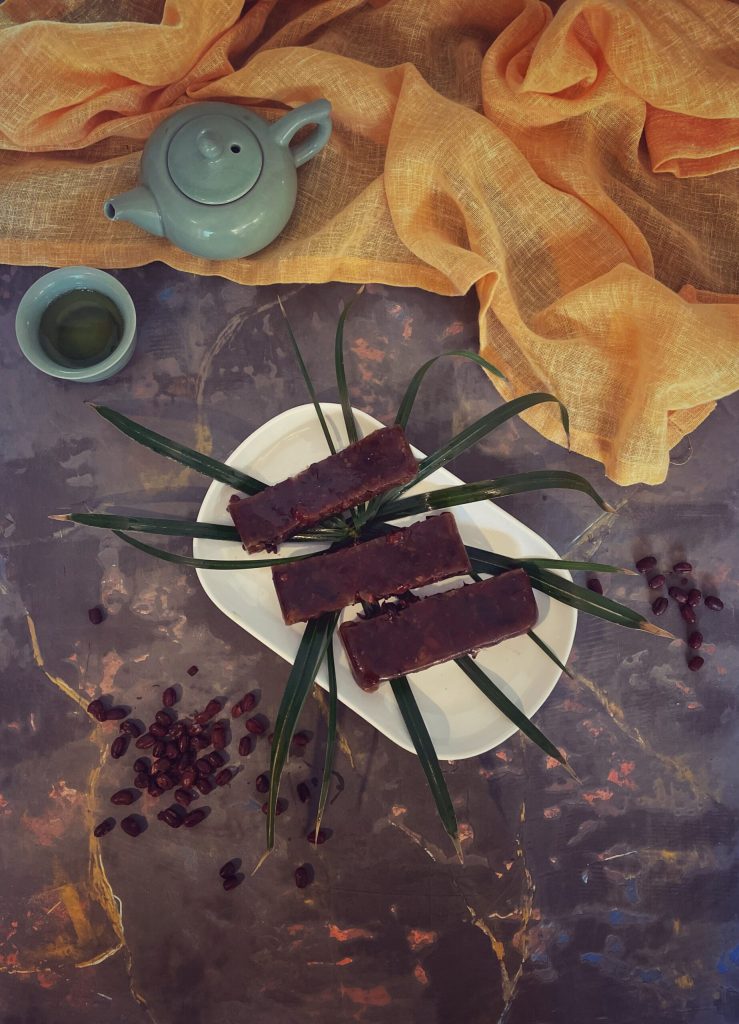
Mizu Yokan is the refreshing summer variant of the classic Yokan (羊羹), the traditional Japanese dessert (wagashi) in loaf shape, made of red bean paste Azuki (Anko), sugar, and Agar Agar (Kanten).
Unlike the solid and dense version, the “Mizu” (water) stands out for its high water content which gives a gelatinous, velvety texture and less sugar usage.
Born in the Edo period (1603-1868), Mizu Yokan was originally a typical dessert of winter festivities. Only in modern times, thanks to refrigerated storage, did it become a symbol of the Japanese summer.
Its preparation is based on mastery in handling the Azuki bean, considered a purifying ingredient in Japan.
In this recipe, tradition meets innovation.
The secret to an excellent Mizu Yokan lies in the Shibunuki (渋抜き), the repeated boiling process of the beans. This artisanal technique is crucial to eliminate tannins and bitterness, ensuring a clean taste and a bright ruby red color, which enhances the purity of homemade Anko.
- Difficulty: Easy
- Cost: Very cheap
- Rest time: 2 Hours
- Preparation time: 2 Minutes
- Portions: 6 People
- Cooking methods: Boiling
- Cuisine: Japanese
- Seasonality: All seasons
Ingredients
- 200 g anko (or see below)
- 3 g agar agar
- 1 cup water
- 1 pinch salt
Tools
- 1 Mold rectangular 6×4
Steps
If you don’t use ready anko: soak 250 g of azuki beans for 12 hours, boil them for 10 minutes with a glass of water and repeat twice. Drain. Repeat two more times, then add 1 liter of water and 250 g of sugar and cook for two while ensuring the mixture does not dry out, adding more water if needed. Mash to make the mixture creamy.
Dissolve Agar Agar: In a cold saucepan, mix water with agar agar powder. Bring to a boil over medium heat, stirring continuously.
Cook: Once boiling, reduce heat and let simmer for about 2 minutes to fully activate the gelling agent.
Combine the Anko: Add sugar and anko. Mix well until the mixture is smooth and lump-free. Add the pinch of salt at the end.
Cool: Pour the mixture into a rectangular mold (previously moistened with water for easy removal). Let it cool to room temperature and then refrigerate for at least 2 hours.
Serve: Cut into thick bricks and serve cold with matcha tea.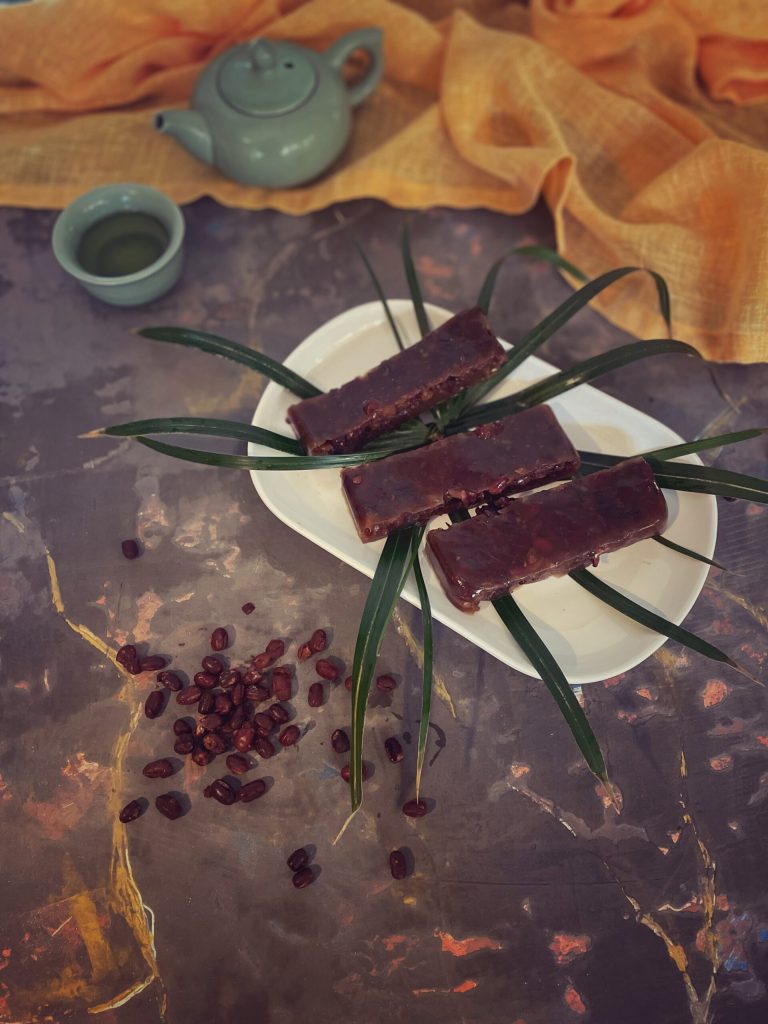
Yokan is Mrs. Hatsue’s favorite dessert, one of the characters in the delightful novel by Sanaka Hiiragi, titled in Italian: “Il magico studio fotografico di Hirasaka”
Served with a Leaf
Traditionally, Mizu Yokan is served on or wrapped in a cherry leaf (Sakura no ha) or, even more commonly for the summer version, a bamboo leaf (Sasa).
Here’s why it’s used:
Aroma: The leaf (especially the pickled cherry leaf) imparts a delicate, slightly salty fragrance that perfectly contrasts with the sweetness of the azuki.
Aesthetics: The green of the leaf highlights the dark and glossy color of the Yokan, evoking the freshness of nature.
Practicality: It helps prevent the dessert from sticking to the plate or hands.
FAQ (Frequently Asked Questions)
How many variants of yokan are there?
Although there is often mention of three main types, the world of Yōkan is much wider and varied, with the technical macro-categories based on the production method:
The 3 Technical “Mother” Categories
Neri Yōkan (練り羊羹): The dense and firm version, cooked for a long time while continuously stirring. It has the longest shelf life.
Mizu Yōkan (水羊羹): More water, less agar-agar, silky and refreshing texture.
Mushi Yōkan (蒸し羊羹): The steamed variant. Unlike the others, it doesn’t use agar-agar but wheat or arrowroot flour (kudzu) as a thickener, resulting in a more elastic and less “gelatinous” product.
Beyond the technique, Yōkan changes name based on its content:
Ogura Yōkan: Contains whole azuki beans cooked in sugar mixed with smooth paste.
Kuri Yōkan: The autumn version with pieces of chestnuts.
Imo Yōkan: Made with sweet potatoes instead of azuki (a typical Tokyo specialty).
Shiro Yōkan: Made with white beans, often used as a “canvas” to add flavors like matcha, yuzu, or coffee.
Shio Yōkan: A slightly salty version that enhances the contrast with the sugar.
The “Artistic” Yōkan
There are also creative Yōkan (like those from the famous confectioneries Toraya or Nagato-ya), where layers of different colors and transparencies create landscapes, flowers, or seasonal scenes visible only when slicing.For Mizu Yokan, is it better to blend the anko with sugar or not?
If you want a perfectly smooth and velvety Mizu Yokan (Koshian style), you shouldn’t blend it with sugar to become a thick jam.
Why it’s important: If you over-blend it, making it very dense (like for mochi fillings), it will be difficult to dissolve it perfectly in the agar agar liquid, risking lumps in the final dessert.
The secret of Mizu Yokan: For this “watery” version, the Anko should still be slightly soft. Once ready, you’ll combine it with the water and agar agar solution over the heat; then the two parts will merge into a smooth mixture that will then solidify.
When TO blend: The blending process (cooking until you see the bottom of the pot) is for creating Tsubuan, or the dense bean jam for spreading or for Dorayaki.Yokan visually resembles dhodhol, but what are the differences?
Dodol (or Dhodhol) is a typical dessert from Southeast Asia (Indonesia, Malaysia, Philippines), and it is fundamentally different from Yokan for three fundamental technical reasons.
The Thickening Agent:
Yokan: Uses Agar Agar (seaweed), which creates a firm jelly that “breaks” sharply.
Dodol: Uses glutinous rice flour. This makes it extremely sticky, elastic, and chewy (similar to a very dense caramel or toffee).
The Fat Content:
Yokan: Is completely fat-free. It consists only of azuki, water, and sugar.
Dodol: Contains coconut milk, giving it a rich, fatty consistency and a very intense tropical flavor.
Cooking Process:
Yokan: The preparation is relatively quick once the anko is ready; it’s about gelling the mixture.
Dodol: Requires long cooking in large woks, stirring continuously until it becomes dark, dense, and shiny due to the caramelization of palm sugar.
In summary: Yokan is a clean, firm, and refreshing legume jelly; Dodol is a dense, elastic, and very caloric coconut rice paste.
