
If the voice of Malika Ayane were a flavor, it would be a perfect balance between rare spices and Mediterranean breezes.
To celebrate her return to Sanremo 2026 with the song “Animali Notturni”, I chose to bring to the table a jewel of elite Moroccan cuisine: the savory M’hanncha with seafood.
The name M’hanncha literally means “snake” in Arabic, evoking the spiral shape that warqa pastry takes in the pan.
It is a refined savory variant of the better-known sweet almond version.
If pastilla is the dish for family celebrations, the M’hanncha is the symbol of royal banquets in Rabat and Casablanca.
I chose it for Malika both for her Moroccan roots and because it reflects her own sinuosity: a melody that slowly unfurls, revealing layers of depth.
Like her voice, which can be light and powerful at the same time, this dish hides under a glassy, crunchy crust an intense heart of saffron and seafood.
A reversal of perspective that turns tradition “Upside Down”, transforming a sweet icon into a savory masterpiece.
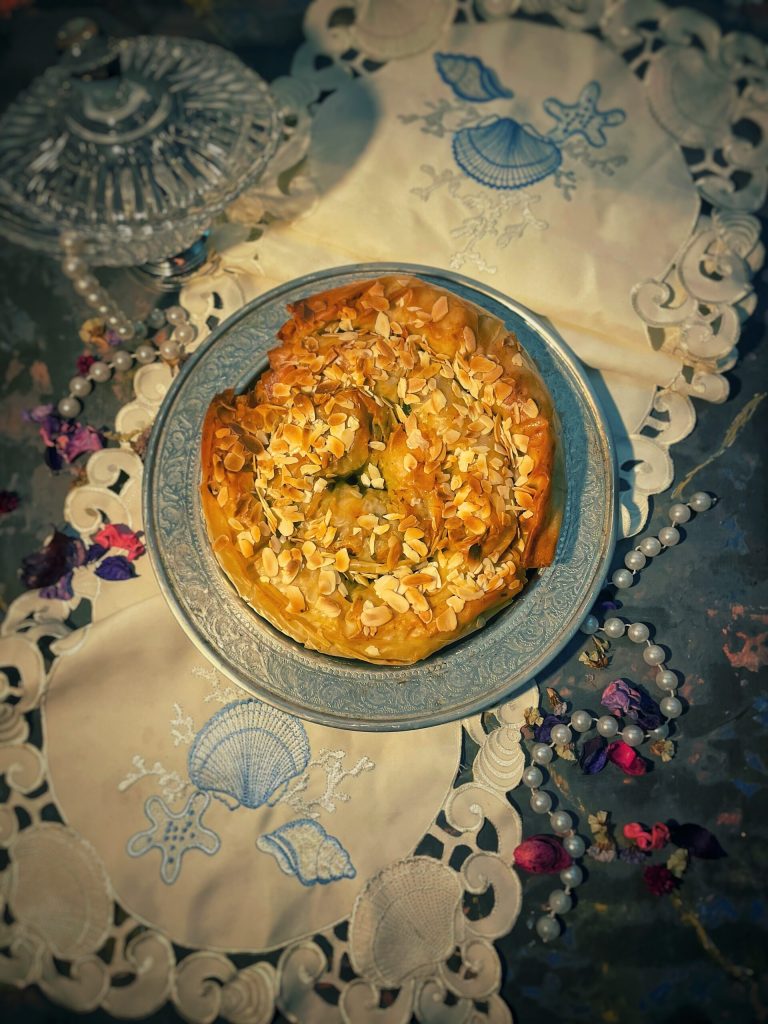
- Difficulty: Medium
- Cost: Moderate
- Preparation time: 20 Minutes
- Portions: 6 People
- Cooking methods: Oven
- Cuisine: Moroccan
- Seasonality: All seasons
Ingredients
For the Chermoula:
Fresh cilantro: 1 bunch (leaves only, chopped).
Flat-leaf parsley: 1 bunch (leaves only, chopped).
Garlic: 3 cloves (reduced to a paste).
Extra virgin olive oil: 5 tbsp.
Lemon juice and pulp: 3 tbsp (about 40 g).
Spices: Saffron threads (dissolved in 2 tbsp warm water), 1 tbsp sweet paprika, 1 tsp cumin, 1/2 tsp ground ginger.
- 1.1 lb shrimp
- 14 oz squid (cut into cubes)
- 14 oz white fish (sea bream or sea bass)
- 5.3 oz rice vermicelli
- 1.1 oz dried wood ear mushrooms
- 1.8 oz pitted green olives (sliced)
- 1 preserved lemon (salted – rind only)
- 8 sheets warqa pastry (or phyllo)
- 2/3 cup clarified butter (ghee) (or butter)
- 1 egg yolk
- 1/4 cup sliced almonds
Tools
- 1 Baking pan 11 in
Steps
The Broth and the Vermicelli: Peel the shrimp and use the heads to make a quick fumet with a little water. Strain the hot broth and pour it over the rice vermicelli in a bowl. Let rest for 5 minutes, drain and cut the vermicelli with scissors (length 3–4 cm / about 1.25–1.6 inches).
Seafood Cooking: In a large pan, heat half of the Chermoula (blend all ingredients). Sauté the squid for 5 minutes, add the shrimp for another 2 minutes. Turn off the heat and add the steamed, flaked white fish.
The Filling: In a large bowl, combine the seafood mix, the vermicelli, the mushrooms, the olives, the preserved lemon and the remaining Chermoula. Mix well and let cool completely (a vital step to avoid breaking the pastry).
Building the “Cigars”: Lay out a sheet of phyllo, brush it with melted butter, overlay a second sheet (also brushed). Create a long cord of filling along the long side. Roll tightly into a cylinder. Seal the ends with the egg yolk. Repeat until the filling is used up (you will get about 4–5 cylinders).
The Spiral (M’hanncha): On a round baking pan (about 10–11 inches / 25–28 cm) lined with parchment paper, coil the first cylinder onto itself starting from the center. Tuck the beginning of the second cylinder into the end of the first and continue turning outward.
Baking: Brush generously with the remaining butter. Bake at 356°F for 25–30 minutes until golden and crispy.
To Serve: Garnish with toasted almonds and serve piping hot.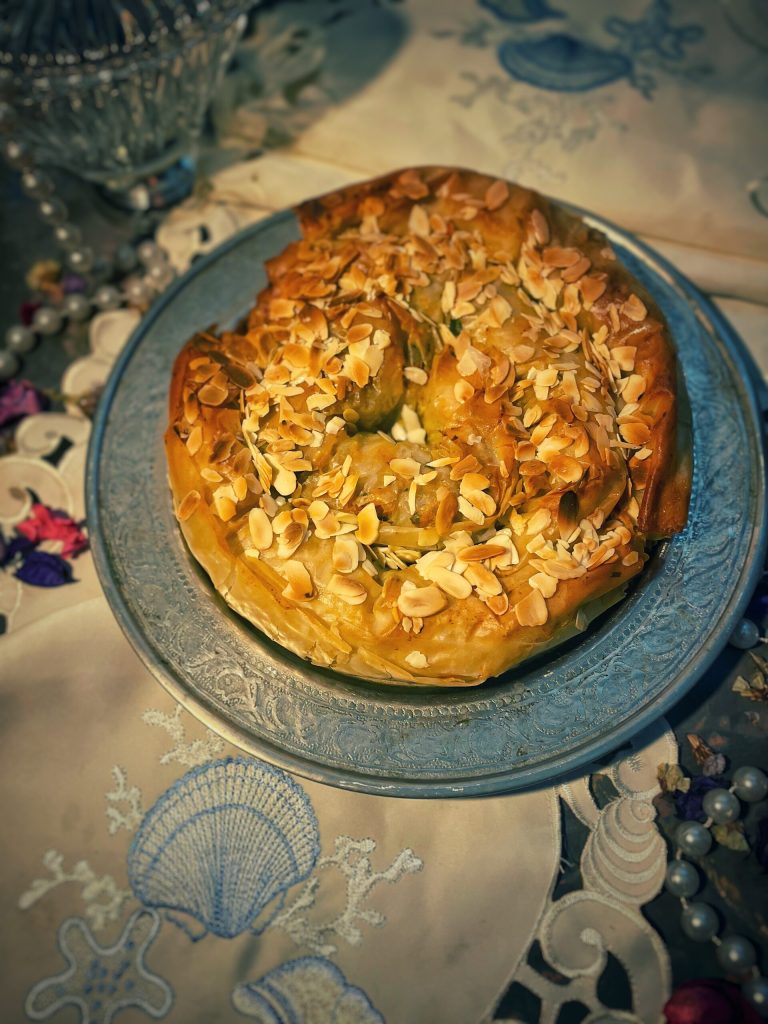
FAQ (Questions and Answers)
What is the difference between M’hanncha and Burek?
Visually the M’hanncha is quite similar to the Albanian or Balkan Byrek (or Burek) in its spiral version (called Rreze or rollé), but there are substantial differences:
The Pastry: Burek uses yufka or a hand-stretched, more elastic and slightly thicker sheet.
The M’hanncha uses warqa pastry (or phyllo), which is much thinner and glassy: once baked, it flakes into a thousand shards, giving a sensation of lightness that feels much more “chic” and elegant.
The Filling: While Burek is often “rustic” (minced meat, cheese or spinach), the seafood M’hanncha is an explosion of oriental aromas thanks to the Chermoula. The presence of rice vermicelli and saffron makes it much closer to a crunchy soufflé than to a savory pie.
The Cooking: Burek is often cooked with a lot of oil or fat to keep it soft inside.
The M’hanncha bets on browning in the oven with clarified butter, resulting almost “cookie-crisp” on the outside.Who is Malika Ayane?
Born in Milan to a Moroccan father and an Italian mother, Malika Ayane debuted at the Festival in 2009 with “Come foglie”, a song written by Giuliano Sangiorgi that immediately consecrated her as a style icon. Since then, her career has been a crescendo of elegance, winning the “Mia Martini” Critics’ Award several times. Her Moroccan roots are never a didactic motif, but a nuance, an attitude of hospitality and aesthetic recherche that we find in every note. With “Animali Notturni”, she invites us on a journey between lights and shadows, the same one we travel tasting the spices of her land of origin.
Why are thin rice vermicelli, typically Chinese, used in the seafood M’hanncha recipe?
Rice vermicelli (called cheveu d’ange or chaariya in the wheat version) are a fundamental and traditional ingredient of elite Moroccan cuisine for fish fillings.
Colonial and commercial influence: Morocco has been a crossroads of trade for centuries. Vermicelli entered the cuisine of the imperial cities (Fès, Rabat) centuries ago, becoming the standard for Pastilla and M’hanncha with seafood.
Technical properties: Unlike couscous, which would absorb too much of the fish juices and turn into a “mush”, rice vermicelli remain distinct and slippery. They have the magical ability to “trap” the Chermoula between their strands without weighing down the dish.
Chaariya (Cheveux d’ange) – Moroccan Tradition
What they are: Very thin little spaghetti made from durum wheat semolina.
Traditional use: They are usually used in Harira (the typical soup) or for Seffa.
Rice Vermicelli (Vermicelles de Riz) – For the “seafood” version
What they are: The translucent white ones made from rice flour (the ones often called “Chinese”).
Why are they used in the seafood M’hanncha? Despite the name “Chaariya” being used generically for fine spaghetti, in the M’hanncha or Pastilla with seafood, rice vermicelli are almost exclusively used.
Rice vermicelli do not “overcook” and do not become a gummy mash when in contact with the liquids from shrimp and squid. They remain separate and absorb the saffron becoming a bright golden color.
