
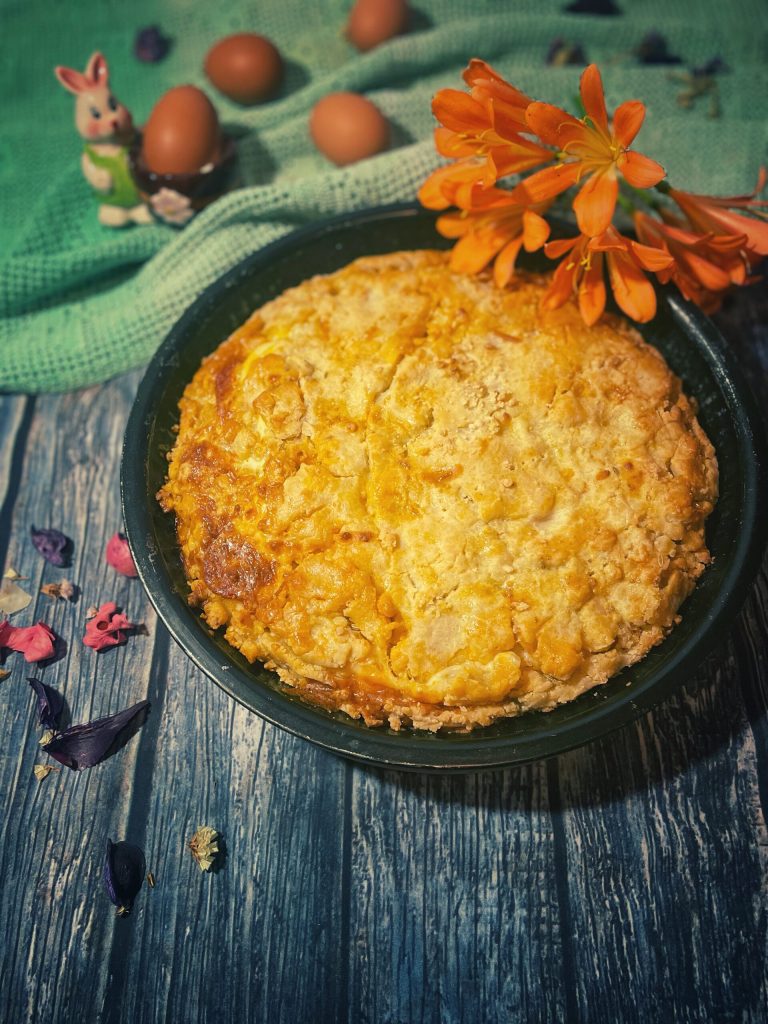
The Scarcedda (or scarcedd) is the gastronomic symbol of Easter in Basilicata, originating in Pomarico in the Matera area, where it is also called the “Pomarico Easter pie.”
Historically, this savory pie made with durum wheat semolina flour, water, leavening, oil and fennel seeds, filled with Lucanian sausage, local cheeses and hard-boiled eggs, marked the end of Lenten fasting, celebrated with abundant use of eggs and cured local meats that were accumulated during the weeks of abstinence.
Its name evokes “liberation” from sin and rebirth, concepts central to Easter symbolism.
At the heart of the recipe are the hard-boiled eggs, a universal symbol of life and rebirth.
In the past, during Lent it was forbidden to eat eggs; they were therefore saved and used abundantly for Easter preparations as a sign of celebration and the end of fasting.
The strictest tradition requires a filling of seven layers — a number with strong religious significance — composed exclusively of eggs, local cheeses and Lucanian sausage, excluding modern variants such as ricotta.
In this preparation, the ancient soul of the recipe meets a contemporary technique: the dough is made with gluten-free flours and sourdough starter, a choice aimed at giving fragrance and digestibility.
There is also a sweet version (both Lucanian and Apulian): a shortcrust cookie or a sweet bread (shaped like a ring, dove or basket) where a hard-boiled egg is placed on the surface and held with two strips of dough in the shape of a cross.
- Difficulty: Difficult
- Cost: Budget-friendly
- Rest time: 6 Hours
- Preparation time: 15 Minutes
- Cooking time: 50 Minutes
- Portions: 6 People
- Cooking methods: Oven, Electric oven
- Cuisine: Italian
- Seasonality: Easter, Spring
Ingredients
- 5.3 oz fresh gluten-free sourdough starter (refreshed)
- 3/4 cup water (warm)
- 4 cups gluten-free flour mix
- 1/3 cup extra virgin olive oil
- 2 tsp salt
- 1 tablespoon fennel seeds
- 14 oz toma (or primo sale)
- 5 hard-boiled eggs
- 10.6 oz Lucanian cured sausage
- 1 egg (for glazing)
- to taste black pepper
Tools
- 1 Pan 11 in
Steps
Activation: Dissolve the sourdough starter in the warm water together with the honey until it becomes slightly foamy.
Dough: Add the gluten-free flour mix and begin to knead. Add the oil in a thin stream and finally the salt and the fennel seeds.
Proofing: Since this is a gluten-free dough, it will not develop the elastic gluten network of wheat, so the rise will be less obvious in volume but is essential for digestibility. Let the dough rest in a covered bowl for about 4–6 hours in a warm place.
Assembly: Roll out two discs (base about 12 1/2–13 1/2 in to cover the edges of a 12 in pan and a 12 in lid).Traditionally, the components are alternated to create the famous 7 layers.
Here is how to compose the filling:
Base: A layer of cheese slices.
Second: A generous layer of sausage slices.
Third: Hard-boiled eggs cut into wedges or halves, arranged evenly.
Fourth: More sausage.
Fifth: More cheese.
Sixth: More eggs.
Seventh: A final layer of cheese and black pepper.
Sealing: Fold the edges of the base over the lid, creating a cord (a pizz’t).
Vents: Prick densely with a fork and brush with beaten egg.
Bake in the oven at 356°F for 50 minutes.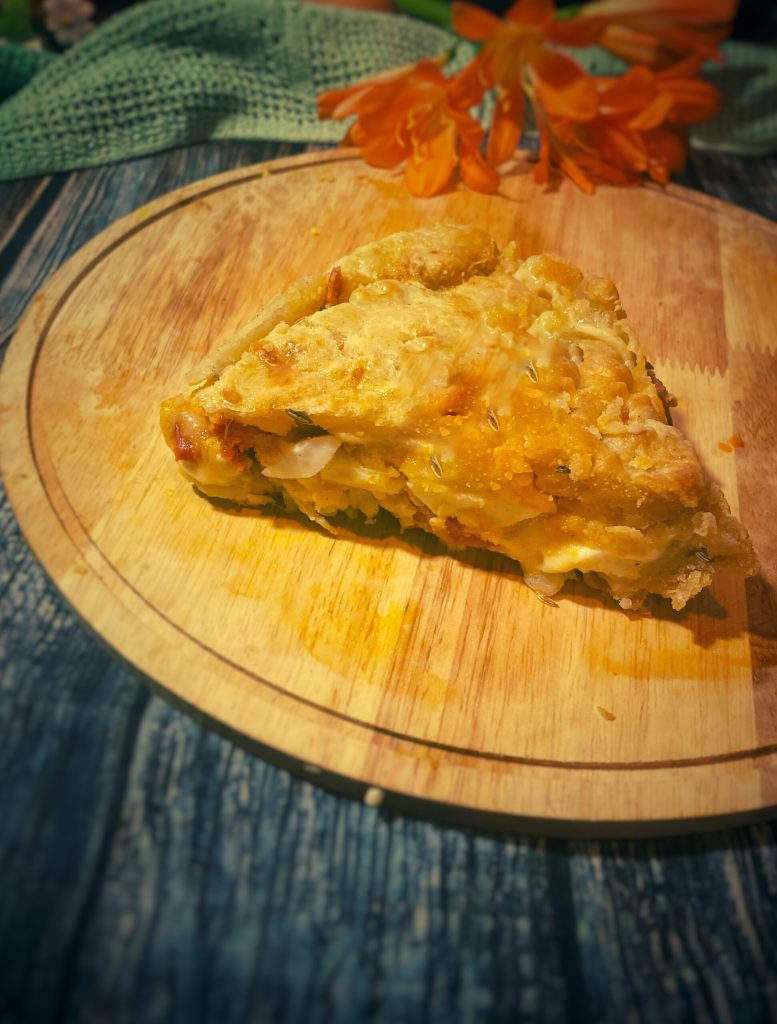
Serving:
The traditional scarcedda should not be eaten hot. It should rest at least 12 hours (better 24) so the flavors of the sausage and cheese can “migrate” into the dough.
FAQ (Questions and Answers)
What alternative sausage can I use for Lucanian Scarcedda if I can’t find Lucanian sausage?
If you cannot source the original Lucanian varieties (such as Pezzente or the Stagionata di Cancellara), to remain true to the spirit of the scarcedda you should look for a sausage with three characteristics: coarse grind, presence of fennel and a medium curing time.
Here are the best alternatives:
Calabrian sausage (sweet or spicy): It is the ideal substitute. It has a similar texture (cut by knife) and often contains wild fennel. Choose the “chain” or “curved” style.
Soppressata from Basilicata (PAT) or Calabrian soppressata. If you use a northern soppressata (e.g., Venetian or Tuscan), which tends to be milder and without chili/fennel, add a pinch of fennel seeds between the layers to recall the authentic taste of Pomarico.Is Lucanian Scarcedda the same as pizza chiena?
They are conceptually very similar, but they belong to different regional traditions and show some key differences in ingredients and dough.
In Basilicata, the terms “pizza chiena” (or “pizz chiena”) and “scarcedda” are often used interchangeably to indicate the same Easter savory pie. However, if we compare the Lucanian scarcedda with the classic Campanian pizza chiena (Neapolitan or Irpinian), interesting distinctions emerge:
Geographical origin:
Scarcedda: Typical of Basilicata (notably Pomarico).
Pizza Chiena: Traditional agri-food product of Campania.
Dough:
Scarcedda: Traditionally uses durum wheat semolina flour, water and often fennel seeds for flavor.
Pizza Chiena: Usually uses bread dough (00 or 0 flour) enriched with lard (strutto).
Filling:
Scarcedda: Characterized by the use of Lucanian sausage and whole or cut hard-boiled eggs “set” into the filling.
Pizza Chiena: The filling is a compact block of beaten eggs that “bind” together a large variety of cured meats (salame Napoli, prosciutto, pancetta) and cheeses (pecorino, provolone, sometimes ricotta).
Texture:
The Campanian pizza chiena tends to be wetter inside thanks to the large amount of beaten eggs that create a kind of rich omelet. The Lucanian scarcedda is often drier and layered, with the hard-boiled eggs remaining clearly visible when sliced.
