
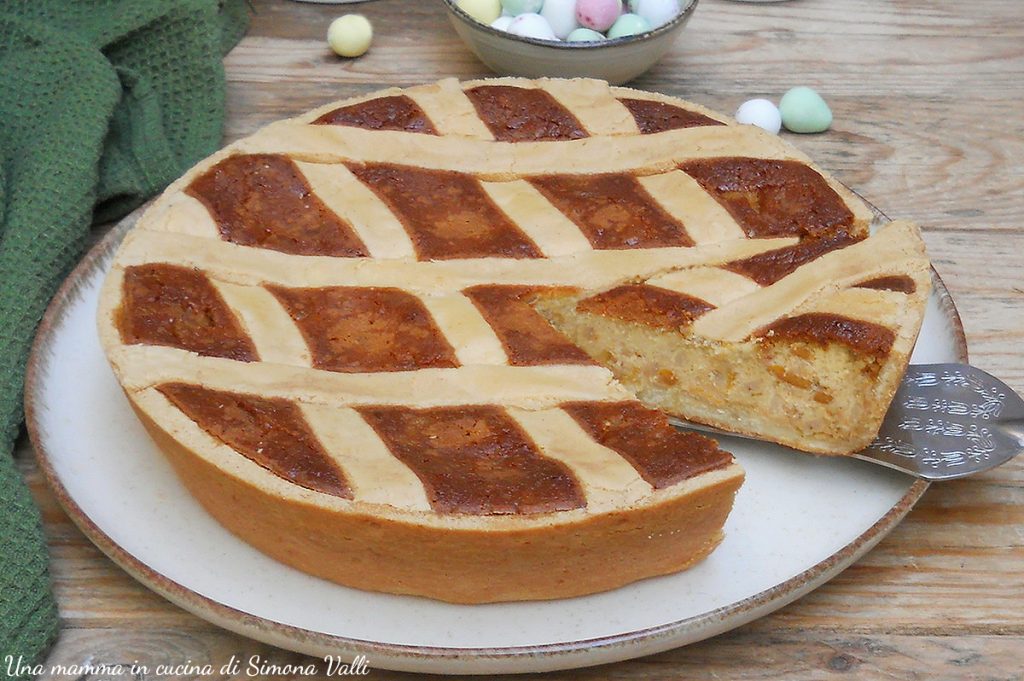
The Neapolitan pastiera by Iginio Massari is an extraordinary version in which the Maestro made small modifications that allow a wider audience to enjoy it.
The pastiera is the iconic Neapolitan Easter cake made of a shortcrust pastry shell and a rich, indulgent filling based on wheat, ricotta and citrus. While originally tied only to the region where it was born, it has now spread throughout the country and is one of the Maestro’s favorite Neapolitan desserts.
His version has small variations compared to the traditional recipe: Massari chose to use cow’s ricotta instead of sheep’s ricotta and replaced lard with butter. For the aromatic part he preferred to replace orange blossom with neroli essential oil (extracted from bitter orange), which is more delicate and less overpowering.
The wheat is cooked in the pastry shop, so it is very different from the pre-cooked wheat we buy in supermarkets because it contains a lot of water; in this case I had to increase the quantity from 150 to 200 g.
If you like, try it and let me know what you think.
Also try the other recipes:
- Difficulty: Easy
- Cost: Medium
- Rest time: 2 Hours
- Preparation time: 1 Hour
- Cooking time: 1 Hour 30 Minutes
- Portions: 10 People
- Cooking methods: Stovetop, Electric oven
- Cuisine: Italian
- Seasonality: Easter
- Energy 441.51 (Kcal)
- Carbohydrates 64.86 (g) of which sugars 39.64 (g)
- Proteins 8.07 (g)
- Fat 17.98 (g) of which saturated 11.30 (g)of which unsaturated 6.44 (g)
- Fibers 1.23 (g)
- Sodium 124.95 (mg)
Indicative values for a portion of 100 g processed in an automated way starting from the nutritional information available on the CREA* and FoodData Central** databases. It is not food and / or nutritional advice.
* CREATES Food and Nutrition Research Center: https://www.crea.gov.it/alimenti-e-nutrizione https://www.alimentinutrizione.it ** U.S. Department of Agriculture, Agricultural Research Service. FoodData Central, 2019. https://fdc.nal.usda.gov
Ingredients
- 2 2/3 cups all-purpose flour (00 flour)
- 7 oz butter (about 1 3/4 US sticks (approx. 14 tbsp))
- 1 1/4 cups powdered (confectioners') sugar
- 1 egg egg (1 medium egg — weigh it, sometimes it can be 10 g more)
- 1/3 tsp salt
- Half bean vanilla bean
- lemon zest (grated, from half a fresh lemon)
- 1 cup cooked wheat (for pastiera) (from a jar, or use 3/4 cup if you cook the wheat yourself (original recipe uses 150 g if cooked at home))
- 1 cup milk
- orange peel pieces (in small pieces, you need three small pieces of fresh orange)
- 1 1/2 tbsp butter
- Half bean vanilla bean
- 1 1/4 cups cow's ricotta
- 2 eggs eggs (about 120 g total)
- 1/4 cup milk
- 1 1/2 cups granulated sugar
- 1 cup wheat (in the cream prepared previously)
- 2/3 cup candied orange (cut into small cubes)
- 2 drops neroli essential oil (or two tablespoons of orange flower water)
- lemon zest (grated, from half a lemon)
- orange zest (grated, from half an orange)
- Half bean vanilla bean
- 1 tbsp butter
Tools
- 1 Cutting board
- 1 Rolling pin
- 1 Dough thickness guide
- 1 Saucepan
- 1 Bowl
- Plastic wrap
- 1 Pan for pastiera pan 9.5–10.2 in diameter
Procedure
Cut the butter into small cubes and leave it at room temperature for 10 minutes; it should be pliable but not fridge-cold.
Put the eggs in a small bowl, add the salt and mix — this helps the salt dissolve and gives a more even flavor.
In the planetary mixer bowl (or a glass bowl) put the butter, powdered sugar, vanilla, grated lemon zest, the eggs and the flour; mix everything with the paddle at low speed until you obtain a homogeneous, compact dough that does not stick to your fingers (this will take about 1 minute).
Shape a low disk (about 3/4 in thick), wrap it in plastic wrap and refrigerate for 8 hours or overnight.
After resting, take the shortcrust and work it on the work surface or in the mixer for 1 minute (especially if it rested overnight); this will make the dough homogeneous and pliable.
The shortcrust pastry for Massari’s pastiera is ready.
In a saucepan put the milk, the precooked wheat, the orange peel pieces, the seeds from the vanilla bean and the butter. Bring to a boil and cook for 12–13 minutes over low heat, stirring often; the wheat must absorb the liquids. Turn off the heat and let cool. Remove the orange peels.
P.S. I had to increase the amount of precooked wheat because it contains a lot of water that evaporates during cooking; to obtain 1 cup (about 240 g) of wheat cream I increased the wheat from 150 g to 200 g. If you cook the wheat at home use 150 g (about 3/4 cup).
In a bowl mix the ricotta with the sugar, add the cooled wheat cream and incorporate.
Add the milk, the lightly beaten eggs, the milk, the vanilla, the citrus zests, 2 drops of neroli essential oil (or two tablespoons of orange flower water) and the candied orange cut into small dice. Mix everything very well until you have a homogeneous mixture.
The filling is ready; it should be smooth and free of lumps. If you like, you can prepare it the day before and keep it in the fridge — it will be even more aromatic.
Roll the shortcrust to a thickness of 3 mm (about 1/8 in), cut a circle larger than the pan and 7 strips about 3/4 in wide. Always work with cold shortcrust to avoid problems.
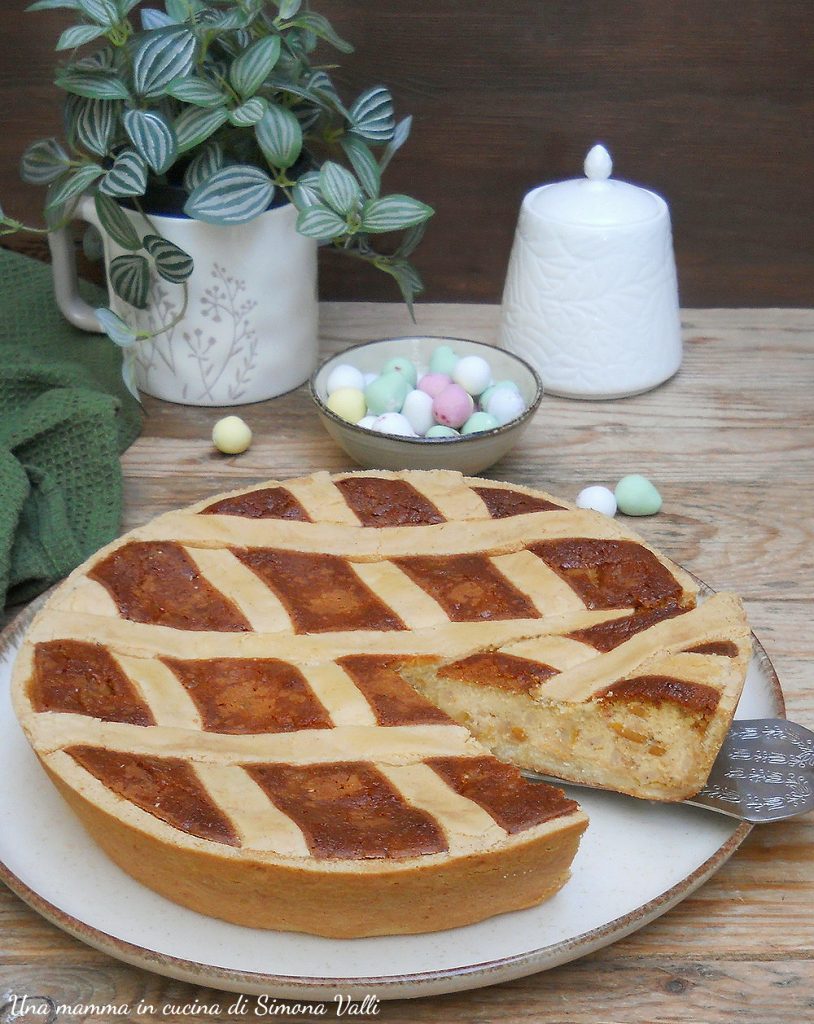
Butter a pastiera pan 9.5–10.2 in in diameter and line it with the shortcrust, pour in the filling and decorate with strips of dough (traditionally it is said to place only 7 crossed strips, but according to some research this is a web legend less than 7 years old).
Bake the pastiera in a hot preheated oven at 329°F for 1 hour, placing it in the lower part of the oven; then lower the temperature to 302°F and bake for another 30 minutes.
I used a 9.5 in pan so it turned out fairly tall; if you use a wider pan the baking time will be shorter. Massari bakes the pastiera at 356°F for 45 minutes with the vent open, but he specifies that everyone should know their own oven and adjust time and temperature based on their appliance. I prefer lower temperatures so the cake does not puff up.
Remove the Neapolitan pastiera by Iginio Massari from the oven and let it cool until the next day. By tradition it is served after two days of resting.
Tips
Storage
The pastiera, by tradition, is prepared on Holy Thursday and served on Easter Sunday. The resting days help make the filling even more tasty and flavorful. For these 2–3 days it is kept at room temperature. After Easter, if any remains, store it in the refrigerator because the filling based on eggs and ricotta can spoil in warm weather.
****************************
For advice on making the recipes contact me on FACEBOOK and, if you like, follow me on INSTAGRAM
Send me your photos and I will happily post them on my socials
