
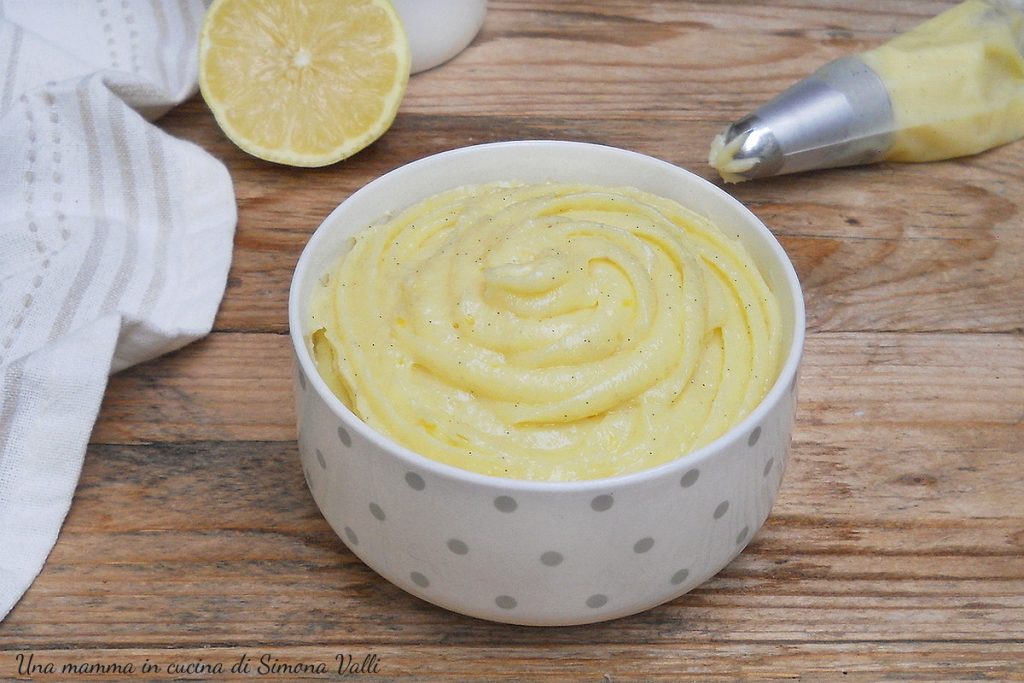
The dense pastry cream is a very light cream with a delicate flavor thanks to the use of whole eggs instead of yolks. Very easy to make, it has a less intense flavor compared to creams made with yolks, which, in my opinion, are decidedly more tasty. Extremely versatile, it can be paired with nut pastes such as pistachio or hazelnut or with jams.
The recipe I propose today is from Maestro Massari and is taken from a book that I have owned for years. I find it ideal, besides the pairings I mentioned above, to fill layered cakes or tarts with preserves, ganache and fresh fruit where the flavor of the cream should not overpower the other preparations; however it is essential to flavor it well with citrus and vanilla.
Usually in creams the egg yolk is used because it contains, among other components, lecithin, an emulsifier that prevents the separation of liquids if the mixture is cooked at the correct temperature. Creams made with whole eggs are mainly used for baking, but from the books I own I note that Maestro Massari often uses them in less technical versions like this one.
A good pastry cream must be smooth, silky, glossy with a fresh taste of vanilla and lemon and with a consistency appropriate to the recipe being made. It is a simple preparation but in reality you must respect some fundamental steps, how much and how to cook it are the two most important aspects.
How to cook pastry cream?
Cooking can be done in a bain-marie, on a classic stovetop or on an induction hob, stirring constantly with a whisk. If you are experienced you can also cook it in the microwave.
How long should pastry cream be cooked?
The pastry cream does not have an exact cooking time but it varies based on the number of eggs used and the thickeners (rice starch, cornstarch, flour) you choose because each thickener gels at a different temperature: from the 82/83°C of the starches to the 92/94°C of the flour (you will find a clearer table below the recipe).
If the cream is undercooked or overcooked besides an alteration of flavor you can have the formation of liquid at the bottom of the container after resting (“syneresis”); to avoid this problem I recommend the use of a thermometer (affordable).
If you want to know more follow me because I will soon publish a much more complete article dedicated to pastry cream.
Try also these other recipes:
- Difficulty: Easy
- Cost: Economical
- Rest time: 1 Hour
- Preparation time: 10 Minutes
- Cooking time: 4 Minutes
- Portions: for 28 oz (800 g) of pastry cream
- Cooking methods: Stovetop
- Cuisine: Italian
- Seasonality: All seasons
- Energy 157.22 (Kcal)
- Carbohydrates 25.75 (g) of which sugars 15.05 (g)
- Proteins 5.26 (g)
- Fat 4.22 (g) of which saturated 2.18 (g)of which unsaturated 2.05 (g)
- Fibers 0.10 (g)
- Sodium 97.16 (mg)
Indicative values for a portion of 100 g processed in an automated way starting from the nutritional information available on the CREA* and FoodData Central** databases. It is not food and / or nutritional advice.
* CREATES Food and Nutrition Research Center: https://www.crea.gov.it/alimenti-e-nutrizione https://www.alimentinutrizione.it ** U.S. Department of Agriculture, Agricultural Research Service. FoodData Central, 2019. https://fdc.nal.usda.gov
Ingredients
In this preparation glucose syrup is used; if you prefer you can replace it with sugar in a smaller amount (about 40 g, roughly 3 tablespoons). Glucose syrup allows the cream to be glossier and silkier, and helps preserve the product by preventing the formation of liquid after resting in the fridge (syneresis).
- 1 3/8 cups whole milk
- 5 eggs eggs (whole)
- 1/2 cup granulated sugar
- 1/3 cup glucose syrup (you can replace it with 40 g (about 3 tbsp) of sugar as noted above)
- 5 tbsp rice starch
- Half bean vanilla
- lemon zest (grated, zest of 1 unwaxed lemon)
- 1/4 tsp salt (about 1 g)
Tools
- 1 Bowl
- 1 Scale
- 1 Saucepan
- 1 Immersion blender
- 1 Thermometer recommended if you're not experienced
Procedure
Pour the milk into a saucepan, add the grated lemon zest, the seeds of the vanilla bean and the salt, bring to a boil and turn off.
In a bowl mix the rice starch with the sugar, add the eggs, whisk the mixture well and add the glucose syrup. Pour the hot milk little by little so as not to create lumps.Note: if I have time and want a more aromatic cream I heat the milk the night before, leaving the chosen aromatics to infuse overnight; the next day I strain the milk and use it for the cream, reheating it in the microwave or again on the stovetop.
Cook the cream in a bain-marie or on the stovetop, stirring constantly with a whisk until you obtain a nice dense and glossy cream; the correct cooking temperature is 176/180°F. As soon as it’s ready, turn off the heat and emulsify it well with the immersion blender.
Cool it quickly: to do this transfer it to a shallow dish, cover it with plastic wrap in contact and place it in the refrigerator or use an ice-water bath. Rapidly lowering the cream’s temperature prevents bacterial proliferation.
The Massari dense pastry cream is ready.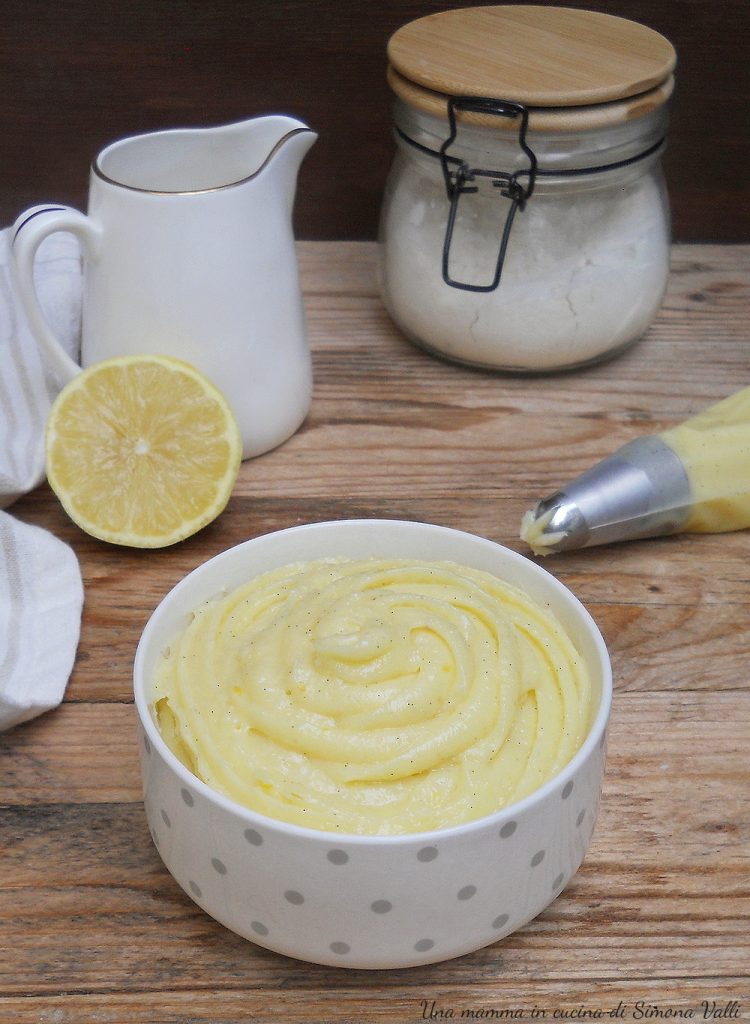
Tips
Storage
The dense pastry cream by Iginio Massari can be stored in the refrigerator at 32°F to 39°F for 4–5 days.
************************
For advice on making the recipes contact me on FACEBOOK and, if you like, follow me on INSTAGRAM.
Send me your photos, I will happily publish them on my social channels.
FAQ (Questions and Answers)
What is the correct temperature for cooking pastry cream?
The egg coagulates around 158°F but when we prepare a pastry cream we add milk, sugar, starches, cream, salt and aromatics; these ingredients interfere with the egg coagulation and allow us to take the cooking of the mixture and therefore also of the eggs to around 176/180°F.
How long should pastry cream be cooked?
The cooking time of pastry cream varies based on the amount of eggs present but above all on the thickener used:
with rice starch bring it to 176°F
with cornstarch bring it to 181°F
with half cornstarch and half rice starch bring it to 181°F
with flour it is necessary to reach 198/201°F — a very high temperature for the egg which risks ruining it by bringing out an unpleasant sulfur taste; this is why starches are preferred to flour.
