Romagna Easter Loaf soft, tender and delicious. I always enjoy discovering new recipes, even those typical of other regions, and I like to share them with all of you. The recipe I want to tell you about today is a Romagna traditional recipe for Easter. It’s a leavened sweet, not overly sweet, soft, tender and fragrant. Traditionally it was eaten on Easter morning accompanied by hard-boiled eggs, cheeses and cured meats. A sweet/salty contrast that I like a lot. A recipe for Easter just like my Sweet Easter Braid and the Mini Easter Pie in a quick version. The Loaf is a “rich bread”, a leavened dough with notes of anise, lemon zest and raisins, able to bring whole generations together at the table. It’s the festive bread, the one shared with joy at the table. Making it requires patience; leavening is its secret, but the result will reward you for every minute of waiting. A dark, glossy crust contrasts with the light, soft interior enriched with many sweet raisins. It’s perfect for breakfast, on the table for Easter lunch, but you’ll always find the right moment to enjoy it. I actually recommend not making it only at Easter: whenever you have time and feel like kneading it’ll be a celebration to bring to the table. And if you want to make it more indulgent add some chocolate chips. Let’s get into the kitchen and make a delicious Sweet Raisin Bread
DON’T MISS THESE RECIPES TOO:
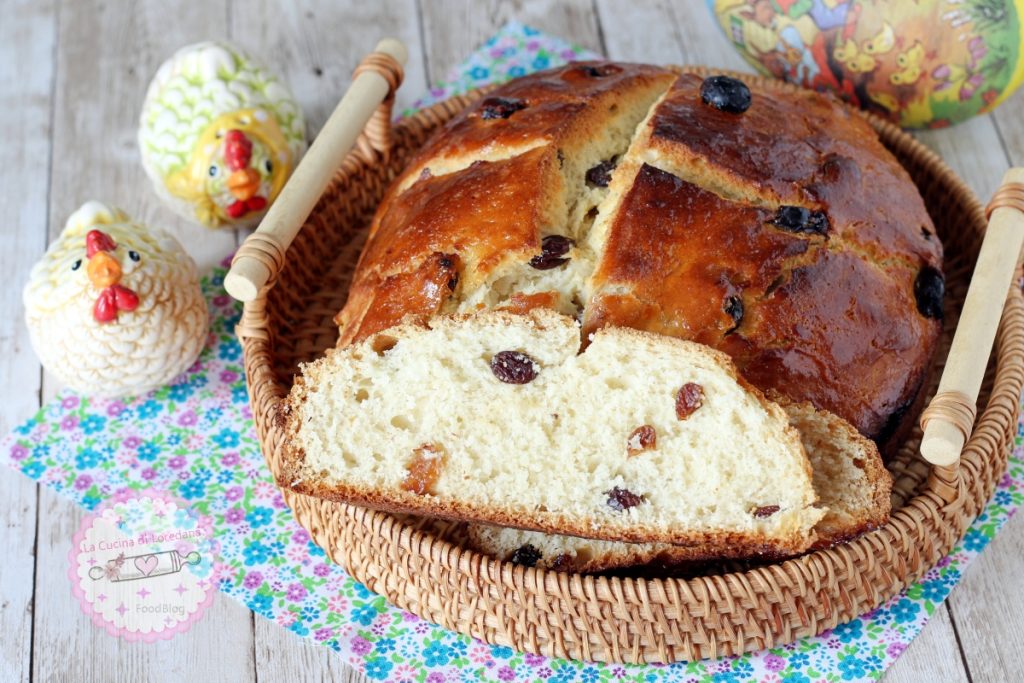
- Difficulty: Easy
- Cost: Inexpensive
- Rest time: 5 Hours
- Preparation time: 20 Minutes
- Cooking time: 30 Minutes
- Portions: For one 500-gram (about 1.1 lb) loaf
- Cooking methods: Oven
- Cuisine: Italian
- Seasonality: Easter
- Energy 250.78 (Kcal)
- Carbohydrates 44.17 (g) of which sugars 17.91 (g)
- Proteins 5.84 (g)
- Fat 5.88 (g) of which saturated 3.43 (g)of which unsaturated 2.24 (g)
- Fibers 2.15 (g)
- Sodium 73.67 (mg)
Indicative values for a portion of 80 g processed in an automated way starting from the nutritional information available on the CREA* and FoodData Central** databases. It is not food and / or nutritional advice.
* CREATES Food and Nutrition Research Center: https://www.crea.gov.it/alimenti-e-nutrizione https://www.alimentinutrizione.it ** U.S. Department of Agriculture, Agricultural Research Service. FoodData Central, 2019. https://fdc.nal.usda.gov
Ingredients for the Easter Loaf
- 1/3 cup flour
- 1 packet fresh brewer's yeast (about 7 g)
- 3 tbsp water
- 1 tsp honey
- 3/4 cup type 0 flour
- 3/4 cup Manitoba (strong) flour
- 1 egg
- 5 tbsp sugar
- 2 tbsp milk
- 3 tbsp butter
- 1/2 cup raisins
- 1 shot anise liqueur
- 1/2 lemon zest (unwaxed)
- 1 pinch salt
- 1 1/2 tbsp sugar
- 1 1/2 tbsp water
- 1 tsp honey
How to prepare the Easter Loaf
First prepare the starter. In a bowl dissolve the brewer’s yeast with the water and the honey. Add the flour and stir to form a smooth, thick batter. Cover with plastic wrap and let it rise in a warm place for one hour.
Meanwhile, soften the raisins in a small bowl by adding the anise liqueur or simply hot water. Mix the type 0 flour with the Manitoba flour. You can prepare the Easter Bread dough by hand in a bowl or use a stand mixer. Pour the milk and the starter into the bowl. Mix and also add one egg, the sugar, the grated zest of half a lemon and half of the flour. Stir.
Add the softened butter, the remaining flour, the drained raisins and a small shot of anise liqueur. You can also use the liqueur in which you softened the raisins. Knead well and for a long time to obtain a soft but not sticky dough. Transfer the dough onto the work surface and flatten it with your hands to form a rectangle. Fold one third of the dough toward the center and then fold the other third toward the center as well.
Repeat the same operation on the other side. Roll out again and refold. Repeat these steps 3-4 times. The folds help make the dough more elastic and promote leavening. Finally shape the dough into a round loaf and place it inside an oiled 8-inch diameter pan. Cover with plastic wrap and let it rise in a warm place for 3-4 hours.
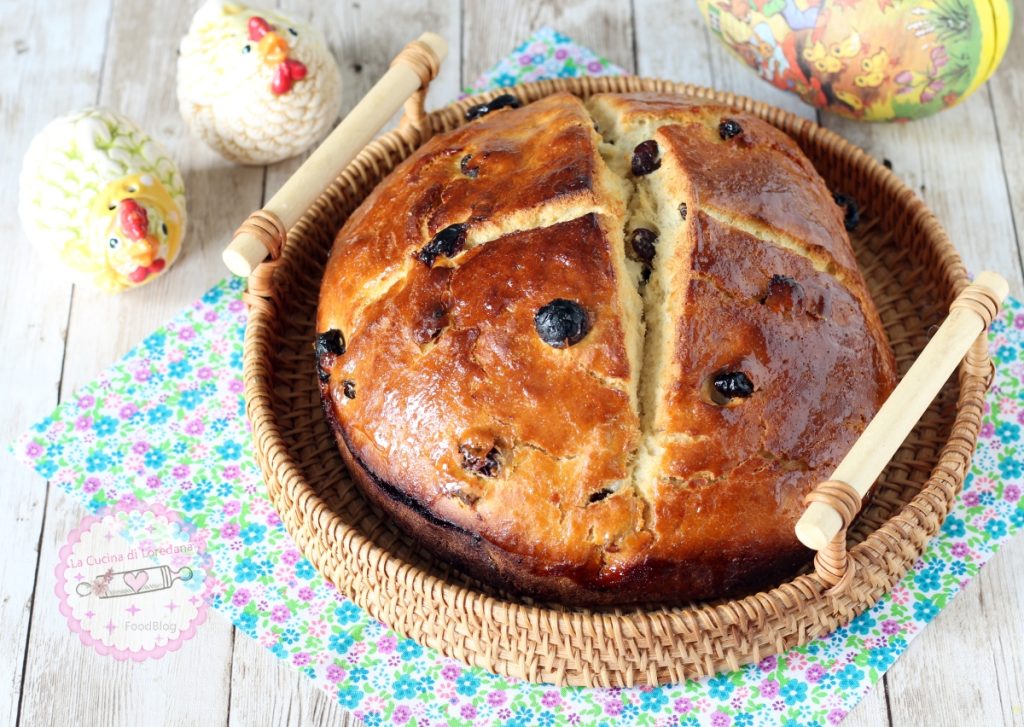
Prepare the syrup: in a small saucepan heat the water with the sugar and honey, let it simmer for one minute. Preheat the oven to 392°F. Make a cross cut on the risen loaf and brush it with the syrup. Bake the Sweet Raisin Easter Bread in a fan-assisted oven at 392°F for 30-35 minutes. If the surface browns too much cover the pan with a sheet of aluminum foil. Remove the loaf from the oven and brush it again while still hot with the syrup for a special glaze.
See you tomorrow with a new recipe, big hug, Loredana
I think this raisin loaf is also a great idea for a delicious gift for relatives and friends. Place it on a round tray and wrap it in clear cellophane or a simple bread paper bag. Tie the bag with coarse twine or a jute ribbon. Tuck a fresh olive twig into the knot of the twine (or rosemary, if you prefer a stronger scent) and, if you have one, a small wildflower or peach blossom.
Loredana’s Tips
Don’t rush the leavening: the Loaf needs its time, just like spring that blooms slowly. If you pamper it with the right warmth, it will reward you with unforgettable softness!
And how do you eat it? Are you on team ‘just sweet’ or do you love the pairing with salami, cheese and hard-boiled eggs like me? Tell me in the comments!
Don’t miss the recipe for the Savory Easter Braid
Your questions
Can I make it with sourdough starter?
Yes, replace the starter with about 150 g of refreshed sourdough, but allow much longer rising times (even overnight).
How should it be stored?
It keeps well for 3-4 days if stored in a food bag or container. If it becomes a bit dry, it’s delicious toasted with a smear of jam or dipped in milk. You can also freeze it whole or in slices.
Can I substitute the raisins?
Certainly! If you don’t like raisins, you can use dark chocolate chips or candied citron cubes. For a very traditional “poor” version, you can also leave it plain: the scent of anise and lemon will be enough to make it special.
Can I prepare the dough the night before?
Yes, that’s a great idea! You can let the dough rise in the refrigerator (in the least cold part) overnight. The next morning, let it come back to room temperature for an hour, shape the loaves and proceed with the second rise. It will be even lighter!